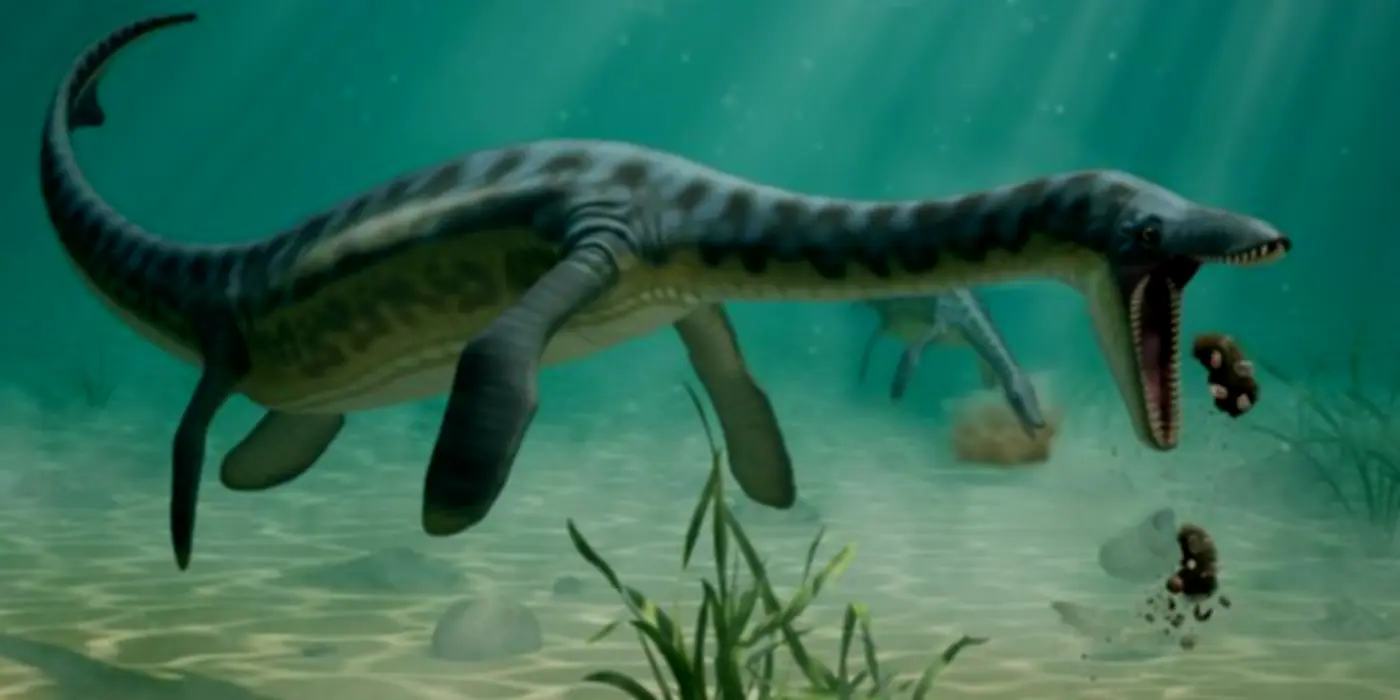
Jurassic Puke: Plesiosaurs Knew Not To Vomit Where They Eat
Jurassic monsters sometimes needed to vomit. When they did, they went to shore.
Jurassic monsters sometimes needed to vomit. When they did, they went to shore.


A self-healing aircraft could be available in the near future, thanks to an epoxy resin developed by Bristol University aerospace engineers that ‘bleeds’ from embedded vessels near the holes or cracks and quickly seals them up, restoring structural integrity.
As well as the obvious safety benefits, this breakthrough could make it possible to design lighter aeroplanes in the future. This would lead to fuel savings, cutting costs for airlines and passengers and reducing carbon emissions too.
By mixing dye into the resin, any ‘self-mends’ could be made to show as colored patches that could easily be pinpointed during subsequent ground inspections, and a full repair carried out if necessary. The dye mixed with the resin would be ultra-violet fluorescent and so would not show up in normal lighting conditions.

ESA has today opened applications for talented individuals wishing to become an astronaut in the European Astronaut Corps. There has not been a selection campaign since 1992, so this is a rare opportunity to be at the forefront of ESA’s human spaceflight programmes including future missions to the ISS, the Moon and beyond.
Applicants will be asked to enter some personal information and contact details, and to upload a private-pilot medical examination certificate, from an Aviation Medical Examiner who has been certified by their national Aviation Medical Authority; or alternatively the ESA Medical Statement, approved by a physician (see also specific requirements). Then within 24 hours the candidate will receive login details to fill in a detailed application form.
Since the 1980’s Dr. Joseph M. Prospero, professor of Marine and Atmospheric Chemistry at the University of Miami’s Rosenstiel School of Marine and Atmospheric Science, has pioneered studies in the worldwide measurement of aerosols, fine particles suspended in the atmosphere and carried by winds.
His team’s work focuses on the aerosol chemistry of the marine atmosphere. They are particularly interested in the long-range transport of pollutants from the continents to the oceans and their impact on climate and on biogeochemical processes in ocean waters.
Starting in 1980 Prospero established a network of island stations in the North and South Pacific Oceans. These stations made continuous measurements of the concentration of major aerosol species that play a role in climate: mineral dust, nitrate, sulfate, and sea salt. The network was eventually extended to the Indian Ocean and Antarctica. Throughout the 80’s and into the late 90’s the UM team maintained a total of 30 stations in constant operation in all ocean regions. The data obtained are unique and they have played a critical role in the development and testing of the global chemical transport models used in the recent climate assessment carried out by Intergovernmental Panel on Climate Change.
Molecular and statistical genetic studies in 15 Finnish families have shown that there is a substantial genetic component in musical aptitude.
Musical aptitude was determined using three tests: a test for auditory structuring ability (Karma Music test), and the Seashore pitch and time discrimination subtests. The study represents the first systematic molecular genetic study that aims in the identification of candidate genes associated with musical aptitude.
The identified regions contain genes affecting cell extension and migration during neural development. Interestingly, an overlapping region previously associated with genetic locus for dyslexia was found raising a question about common evolutionary background of music and language faculties. The results show that musical aptitude is likely to be regulated by several predisposing genes/variants.

Engineers and applied physicists from Harvard University have demonstrated the first room-temperature electrically-pumped semiconductor source of coherent Terahertz (THz) radiation, also known as T-rays. The breakthrough in laser technology, based upon commercially available nanotechnology, has the potential to become a standard Terahertz source to support applications ranging from security screening to chemical sensing.
Spearheaded by research associate Mikhail Belkin and Federico Capasso, Robert L. Wallace Professor of Applied Physics and Vinton Hayes Senior Research Fellow in Electrical Engineering, both of Harvard's School of Engineering and Applied Sciences (SEAS), the findings will be published in the May 19 issue of Applied Physics Letters. The researchers have also filed for U.S. patents covering the novel device.
Using lasers in the Terahertz spectral range, which covers wavelengths from 30 to 300å, has long presented a major hurdle to engineers. In particular, making electrically pumped room-temperature and thermoelectrically-cooled Terahertz semiconductor lasers has been a major challenge. These devices require cryogenic cooling, greatly limiting their use in everyday applications.
A new report from Perth’s Telethon Institute for Child Health Research has found a strong link between childhood ear infections and exposure to tobacco smoke.
The families of 100 Aboriginal children and 180 non-Aboriginal children participated in the Kalgoorlie Otitis Media Research Project, allowing the collection of social, demographic, environmental and biological data to investigate the causes of otitis media (middle ear infections). The children had regular ear examinations from birth until 2 years of age.
Chief Investigator Dr Deborah Lehmann, who heads the Institute’s infectious diseases research, said ear infections were the most common reason that young children see a doctor and can cause life-long problems.
Pancreatic cancer, the fourth-leading cause of cancer death in this country, takes some 34,000 lives a year. It's usually detected after it has already spread and only 4 percent of individuals with pancreatic cancer live for five years after diagnosis.
An herb used in traditional medicine by Middle Eastern countries may help in the fight against pancreatic cancer, say researchers at Thomas Jefferson University in Philadelphia. They have found that thymoquinone, an extract of nigella sativa seed oil, blocked pancreatic cancer cell growth and killed the cells by enhancing the process of programmed cell death.
While the studies are in the early stages, the findings suggest that thymoquinone could eventually have some use as a preventative strategy in patients who have gone through surgery and chemotherapy or in individuals who are at a high risk of developing cancer.
The University of Rochester will mark another important step in the effort toward attaining sustainable fusion, the ultimate source of clean energy, Friday, May 16. University President Joel Seligman, along with special guests, will dedicate the new Omega EP (Extended Performance) laser facility at the Robert L. Sproull Center for Ultra High Intensity Laser Research at the Laboratory for Laser Energetics (LLE).
The Omega EP comprises a new set of four ultra-high-intensity laser beams that will unleash more than a petawatt—a million billion watts—of power onto a target just a millimeter across. Working in conjunction with LLE's original 60-beam Omega laser, the Omega EP will open the door to a new concept called "fast ignition," which may be able to dramatically increase the energy derived from fusion experiments and provide a possible new avenue toward clean fusion power. If successful, fast ignition could lead to the highest energy densities ever achieved in a laboratory.

Census of Marine Life-affiliated scientists, plumbing the secrets of a vast underwater mountain range south of New Zealand, captured the first images of a novel “Brittlestar City” established against daunting odds on the peak of a seamount – an underwater summit taller than the world’s tallest building.
Its cramped starfish-like inhabitants, tens of millions living arm tip to arm tip, owe their success to the seamount’s shape and to the swirling circumpolar current flowing over and around it at roughly four kilometers per hour. It allows Brittlestar City’s underwater denizens to capture passing food simply by raising their arms, and it sweeps away fish and other hovering would-be predators.
Discovery of this marine metropolis, announced today along with important new insights into seamount geology and physics, highlighted a month-long April expedition to survey the Macquarie Ridge aboard the Research Vessel Tangaroa of New Zealand’s National Institute of Water & Atmospheric Research, host of the Census of Marine Life seamount programme, CenSeam. The voyage was largely funded by the New Zealand Foundation for Research, Science and Technology.
With systems biology methods, CancerSys investigates molecular- and cell-biological processes in the formation of tumors in the liver
Systems Biology is a young field with the overall aim of creating a holistic picture of dynamic life processes with regard to all levels - from the genome via the proteome and the organisation of the cell organelles all the way to the complete cell or even an entire organism. In doing so, Systems Biology takes into consideration the dynamic interplay of the components involved. In order to achieve this high aspiration, Systems Biology combines quantitative methods used in molecular biology with knowledge gathered in mathematics, informatics and systems science.
Obesity experts today questioned Burger King's commitment to improve its standards on marketing to children on the day it launched its new 'Indiana Jones' campaign in the US with toys, internet games and scratch competition prizes.
They fear the new campaign running on children's cable channels such as Nickelodeon and Disney will in effect promote the overall brand range including another Indiana Jones special - the Indy Double Whopper being sold in the USA at $4.29. The standard Double Whopper contains almost 1000 kcalories and a heart-stopping 30 grams of saturated fat.
Burger King's latest sales drive to children includes games linked to the latest Indiana Jones film, the Kingdom of the Crystal Skull. Promotions include a 'Reveal the Secret' scratch and win game, and a 'Big Dig' online game, and an 'adventure heroes' toy series to collect. Burger King has pledged to restrict its advertising to children under 12, which uses third-party licensed characters, to Kids Meals meeting its nutrition criteria.
Rochester Medical Center scientists reported in the May issue of Molecular Therapy that a vaccine they created prevents the development of Alzheimer’s disease-like pathology in mice without causing inflammation or significant side effects.
Alzheimer’s is a progressive neurodegenerative disease associated with dementia and a decline in performance of normal activities. Hallmarks of the disease include the accumulation of amyloid plaques in the brains of patients and the loss of normal functioning tau, a protein that stabilizes the transport networks in neurons. Abnormal tau function eventually leads to another classic hallmark of Alzheimer’s, neurofibrillary tangle in nerve cells. After several decades of exposure to these insults, neurons ultimately succumb and die, leading to progressively damaged learning and memory centers in the brain.