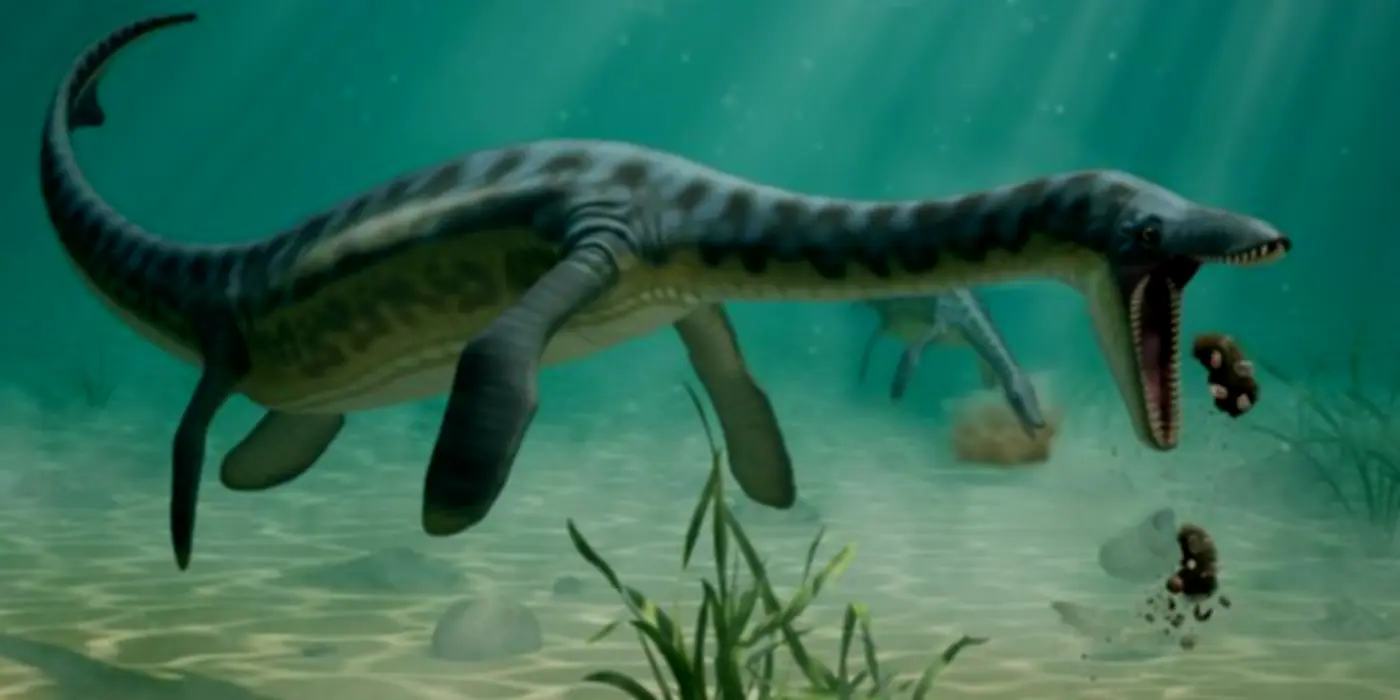
Jurassic Puke: Plesiosaurs Knew Not To Vomit Where They Eat
Jurassic monsters sometimes needed to vomit. When they did, they went to shore.
Jurassic monsters sometimes needed to vomit. When they did, they went to shore.


Yes, witness that we are promoting an old media company (Wiley-Blackwell) but only because they aren't charging anyone ridiculous subscription fees and convincing you your career is over if they're not in your citation list when your review comes up.
They have added yet another name to their 1400-title long publication list. But this one is free. We couldn't agree more with free.
A new journal called Evolutionary Applications publishes articles that use evolution to address pressing issues such as climate change, endangered species, food safety, infectious diseases, and invasive species. In other words, someone besides us finally figured out that showing the practical uses of evolution, and how evolutionary biology is absolutely necessary to understanding the biological world, would be a good thing.

It seems rumors of the greater dwarf cloud rat's demise have been greatly exaggerated. Sure, he stayed low key for the last 112 years but he really never left his natural habitat.
Seeing the little guy once and then declaring him extinct was likely premature.
Carpomys melanurus, the greater dwarf cloud rat, has dense, soft reddish-brown fur, a black mask around large dark eyes, small rounded ears, a broad and blunt snout, and a long tail covered with dark hair. An adult weighs about 185 grams.
"This beautiful little animal was seen by biologists only once previously - by a British researcher in 1896 who was given several specimens by local people, so he knew almost nothing about the ecology of the species," said Lawrence Heaney, Curator of Mammals at the Field Museum and Project Leader. "Since then, the species has been a mystery, in part because there is virtually no forest left on Mt. Data, where it was first found."

A new model of inner Earth constructed by Arizona State University researchers pulls past information and hypotheses into a coherent story to clarify mantle motion.
“The past maybe two or three years there have been a lot of papers in Science and Nature about the deep mantle from seismologists and mineral physicists and it’s getting really confusing because there are contradictions amongst the different papers,” says Ed Garnero, seismologist and an associate professor in Arizona State University’s School of Earth and Space Exploration.
“But we’ve discovered that there is a single framework that is compatible with all these different findings,” he adds.
Garnero partnered with geodynamicist and assistant professor Allen McNamara, also in the School of Earth and Space Exploration in ASU’s College of Liberal Arts and Sciences, to synthesize the information for their paper to be published in the May 2 issue of Science.
Researchers at McGill University and the McGill University Health Centre (MUHC) have performed the world’s first totally automated administration of an anesthetic.
Nicknamed “McSleepy,” the new system developed by the researchers administers drugs for general anesthesia and monitors their separate effects completely automatically, with no manual intervention.
The anesthetic technique was used on a patient who underwent a partial nephrectomy, a procedure that removes a kidney tumor while leaving the non-cancerous part of the kidney intact, over a period of 3 hours and 30 minutes. To manipulate the various components of general anesthesia, the automated system measures three separate parameters displayed on a new Integrated monitor of anesthesia (IMATM): depth of hypnosis via EEG analysis, pain via a new pain score, called AnalgoscoreTM, and muscle relaxation via phonomyographyTM, all developed by ITAG. The system then administers the appropriate drugs using conventional infusion pumps, controlled by a laptop computer on which “McSleepy” is installed.
Fewer caribou calves are being born and more of them are dying in West Greenland as a result of a warming climate, according to Eric Post, a Penn State associate professor of biology. Post, who believes that caribou may serve as an indicator species for climate changes including global warming, based his conclusions on data showing that the timing of peak food availability no longer corresponds to the timing of caribou births.
Caribou -- which are closely related to wild reindeer -- are dependent on plants for all their energy and nutrients. Throughout the long Arctic winter, when there is no plant growth, they dig through snow to find lichens; however, in spring they rapidly switch to grazing on the new growth of willows, sedges, and flowering tundra herbs. As the birth season approaches, they are cued by increasing day length to migrate into areas where this newly-emergent food is plentiful.
Evolution is like the mafia, according to Omar Tonsi Eldakar and David Sloan Wilson at Binghamton University. Altruists(the exploited) ‘pay’ the the punishers of the selfish(exploiters) by allowing themselves to be exploited, while the selfish punishers return the favor with their second-order altruism. It's like a protection racket - without getting a canoli.
Rather than comparing it to La Familia, Eldakar and Wilson consider this behavioral strategy the "Selfish Punisher," which exploits altruists and punishes other selfish individuals, including other selfish punishers.
This strategy might seem hypocritical in moral terms but it is highly successful in Darwinian terms, according to their theoretical model published in PNAS and a computer simulation model published in the Journal of Theoretical Biology. Selfish punishers can invade the population when rare but then limit each other, preventing the altruists from being completely eliminated.
There has been greatly increasing attention given to the potential of ‘biochar’, or charcoal made from biological tissues (e.g., wood) to serve as a long term sink of carbon in the soil. This is because charcoal is carbon-rich and breaks down extremely slowly, persisting in soil for thousands of years.
This has led to the suggestion being seriously considered by policy makers worldwide that biochar could be produced in large quantities and stored in soils. This would in turn increase ecosystem carbon sequestration, and thereby counteract human induced increases in carbon-based greenhouse gases and help combat global warming.
In a series of mate choice experiments with Phintella vittata (the Chinese jumping spider), a group researchers has found that female spiders would rather mate with males that reflect ultraviolet B (UVB) rays than those that do not. This is the first evidence of an animal using UVB rays to communicate with other members of its species.
“It has long been recognized that solar UVB has direct deleterious effects on a wide range of living organisms; for example, it can cause skin cancer and damage the retinal tissues of the eyes of mammals,” said Daiqin Li of National University of Singapore, who is also an Adjunct Professor in Hubei University, China.
As marine pollution continues to rise, various interesting solutions have been proposed to remove toxic contaminants.
Various species of seaweed are able to extract toxic compounds from seawater, says Shinichi Nagata of the Environmental Biochemistry Group, at Kobe University, Japan, and colleagues at Shimane University and Nankai University, China.
They point to the brown seaweed, Undaria pinnatifida, known as wakame in Japan, and note that it has been the focus of research in this area for almost a decade.

Scientists probing volcanic rocks from deep under the frozen surface of the Arctic Ocean have discovered a special geochemical signature until now found only in the southern hemisphere. The rocks were dredged from the remote Gakkel Ridge, which lies under 3,000 to 5,000 meters of water; it is Earth’s most northerly undersea spreading ridge.
The Gakkel extends some 1,800 kilometers beneath the Arctic ice between Greenland and Siberia. Heavy ice cover prevented scientists from getting at it until the 2001 Arctic Mid-Ocean Ridge Expedition, in which U.S and German ice breakers cooperated.
This produced data showing that the ridge is divided into robust eastern and western volcanic zones, separated by an anomalously deep segment. That abrupt boundary contains exposed unmelted rock from earth’s mantle, the layer that underlies the planet’s hardened outer shell, or lithosphere.

Scientists at the Georgia Institute of Technology have discovered a new climate pattern called the North Pacific Gyre Oscillation.
This new pattern explains changes in the water that are important in helping commercial fishermen understand fluctuations in the fish stock. They also believe that as the temperature of the Earth warms, large fluctuations in these factors could help climatologists predict how the oceans will respond in a warmer world.
“We’ve been able to explain, for the first time, the changes in salinity, nutrients and chlorophyll that we see in the Northeast Pacific,” said Emanuele Di Lorenzo, assistant professor in Georgia Tech’s School of Earth and Atmospheric Sciences.
The electromagnetic fields produced by incubators alter newborns’ heart rates, says a small study published in the Fetal and Neonatal Edition of Archives of Disease in Childhood.
The research team assessed the variability in the heart rate of 43 newborn babies, none of whom was critically ill or premature.