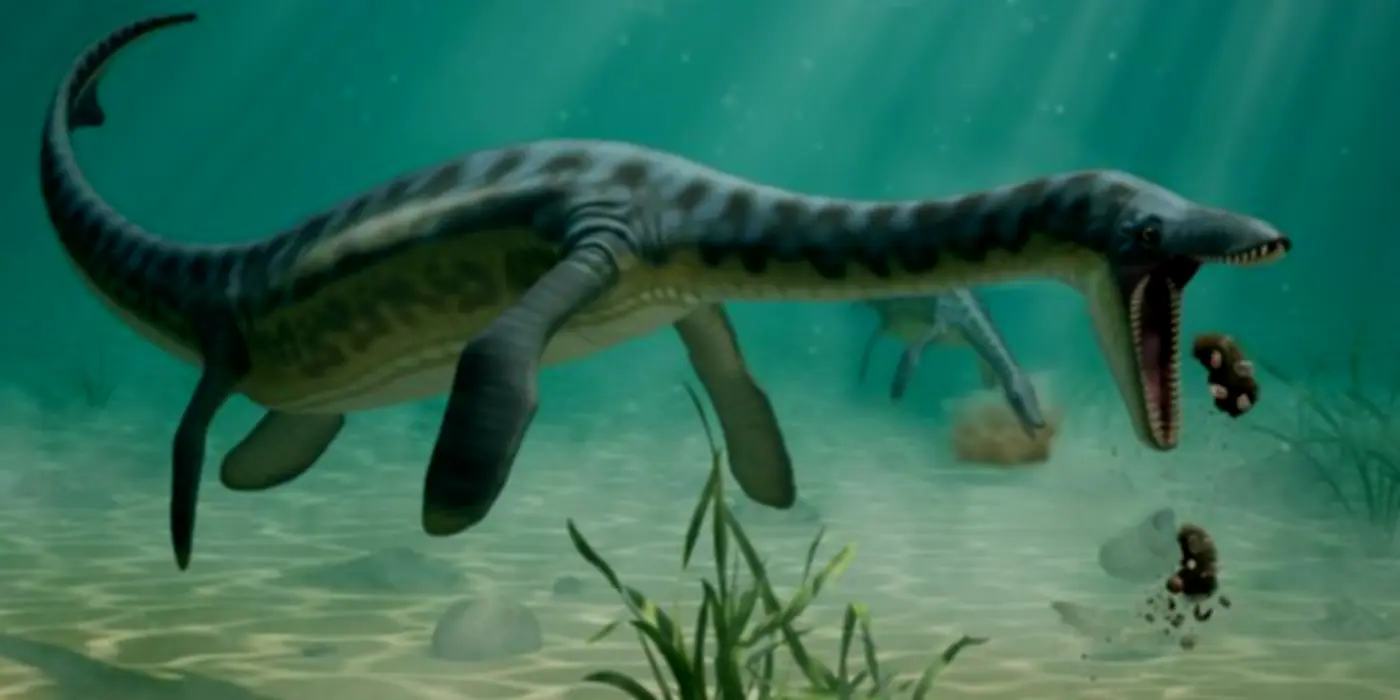
Jurassic Puke: Plesiosaurs Knew Not To Vomit Where They Eat
Jurassic monsters sometimes needed to vomit. When they did, they went to shore.
Jurassic monsters sometimes needed to vomit. When they did, they went to shore.


The genome analysis of a champion biomass-degrading fungus has revealed a surprisingly minimal repertoire of genes that it employs to break down plant cell walls, highlighting opportunities for further improvements in enzymes customized for biofuels production.
The discovery of Trichoderma reesei, the target of the published analysis, dates back to World War II, when it was identified as the culprit responsible for the deterioration of fatigues and tents in the South Pacific. This progenitor strain has since yielded variants for broad industrial applications and is known today as an abundant source of enzymes, particularly cellulases and hemicellulases, currently being explored to catalyze the deconstruction of plant cell walls as a first step towards the production of biofuels from lignocellulose.
A process of self-digestion called autophagy prompts the maturation of red blood cells. Without a protein called Nix, the cells would not effectively rid themselves of organelles called mitochondria and consequently become short-lived, leading to anemia, said researchers at Baylor College of Medicine in Houston.
“It’s changed our thinking on autophagy,” said Dr. Jin Wang, assistant professor of immunology at BCM and senior author of the report in Nature. During autophagy, the cell forms an envelope or vesicle around components of the cell that need to be degraded and removed. The vesicle then fuses with a cellular component called a lysosome that degrades its contents. The inclusion of components in the cell by autophagy vesicles was generally considered to be nonspecific.
Cross-sectional studies, which collect information at a single point in time, generally find that young Americans report having more lifetime alcohol problems than older Americans, despite having had less time to develop these problems.
But these studies are hampered by the fact that people of different ages may remember or report problems to different degrees. A new examination of data, collected on similarly aged groups one decade apart, has found substantial increases in drinking and alcohol dependence among women – particularly white and Hispanic women – beginning with those born in the United States after World War II.
Leptospirosis is a serious but neglected emerging disease that infects humans through contaminated water. It is a major public health problem in South East Asia and South America, with over 500,000 severe cases every year. Between 5% and 20% of these cases are fatal.
Rats and other mammals carry the disease-causing pathogen Leptospira interrogans in their kidneys and when they urinate, they contaminate surface water with the bacteria, which can survive in the environment for long periods.
Now research published in the May issue of the journal Microbiology shows for the first time how bacteria that cause the disease survive in the environment.

A golden coil smaller in diameter than a human hair and a diamond pin embossed with gold may represent the future of high frequency electronics.
Carol L. Kory, who specializes in complex electromagnetic computer simulations, will present two papers describing the design and predicted performance of new backward wave oscillators at the Ninth International Vacuum Electronics Conference (IVEC) in Monterey, California.
James A. Dayton, Jr., chief technology officer of Teraphysics and inventor of the devices, will follow with two presentations describing the innovative fabrication technology that has been developed to create these two oscillators. Both structures are the essential components of novel 0.65-terahertz electronic oscillators under development at Teraphysics, located in Highland Heights, Ohio.
Ethylene (C2H4) is a gaseous hormone produced naturally in plants and by man in combustion (1). When plants encounter ethylene they soften and ripen (fruit) or wilt and fade (flowers.)
We all like fruit that is ripe but lasts longer and flowers that stay colorful are a good thing so some growers spray plants with products like EthylBloc for flowers or SmartFresh for fruits and vegetables which contain a compound, 1-methylcyclopropane or 1-MCP, that blocks ethylene’s action on plants.
But how this compound works at the molecular level remains uncertain despite several chemical pathways chemists have proposed.
A review of scientific data in CMAJ (Canadian Medical Association Journal) finds that, in some cases, stun guns may stimulate the heart in experimental models. This evidence is contrary to current views that stun guns only affect skeletal muscles.
Dr. K. Nanthakumar and colleagues point out that most theoretical and some experimental studies reveal that cardiac stimulation does not occur with stun gun discharges. However, experimental studies on pigs by 3 independent groups of investigators found that “a stun gun discharge can stimulate the heart” depending on the location of the stun gun barbs. Barbs that are located such that they form a vector across the heart have greater effect than those focused on the abdomen.
The researchers caution against applying data from pigs to humans, although “most of the basic mechanistic concepts in cardiac fibrillation and defibrillation are derived from animal studies, not humans.”

The Earth's atmosphere is a gigantic prism that disperses sunlight. In the most ideal atmospheric conditions, such as those found regularly above Cerro Paranal, this will lead to the appearance of so-called green and blue flashes at sunset. The phenomenon is so popular on the site that it is now the tradition for the Paranal staff to gather daily on the telescope platform to observe the sunset and its possible green flash before starting their long night of observations.
The green and blue flashes are fleeting events that require an unobstructed view of the setting Sun, and a very stable atmosphere. These conditions are very often met at Paranal, a 2635m high mountain in the Chilean Atacama Desert, where the sky is cloudless more than 300 days a year. Paranal is home of ESO's Very Large Telescope, an ensemble of four 8.2-m telescopes and four 1.8-m Auxiliary Telescopes that together form the world's most advanced optical telescope.
If you've ever used an internet translation tool, you know how immature the translation technology is compared to other sorts of computer programs. Punctuation errors, misplaced words and grammatical mistakes can make them almost unintelligible.
Verbal language translation is ever worse. Mo one has been able to develop an automatic translation system that comes anywhere close to the capabilities of a human translator or interpreter. ‘Constrained speech’ utilities that can only translate certain predefined words and phrases are adequate for a tourist booking a hotel but useless if you want to understand a news bulletin.
Europeans have a keen desire for a true universal translator. With 23 official languages, European institutions spend more than a billion euros a year translating documents and interpreting speeches. Companies trading across the EU’s internal borders spend millions more just to understand their business partners. It's a situation unparalleled anywhere else in the world.
Throughout the history of Earth there have been numerous mass extinctions and there are just as many theories as to why they occurred.
The largest we know of occurred some 250 million years ago, give or take, but the mass extinction of the dinosaurs more recently has long been a favorite topic of scientists and philosophers.
Scientists at the Cardiff University Centre for Astrobiology have a new twist on an old idea and built a computer model to try and support it. Their model mapped our solar system’s movement and found that it continually “bounces” up and down through the plane of the galaxy. As we pass through the densest part of the plane, gravitational forces from the surrounding giant gas and dust clouds dislodge comets from their paths. The comets plunge into the solar system, some of them colliding with the earth.
'Clone' is an odd term culturally. Thanks to science fiction on one side and ethical hysteria on the other, people tend to overstate the meaning of it.
Back before genomes, to 'clone a gene' was to basically discover it - it meant you found the stretch of DNA encoding that gene - but now we know where almost all of the genes are. So 'cloning' in this context does not mean 'discovery' and it certainly doesn't mean Sith Lords spitting out an army of warriors to take over the universe - it means taking known genes (in tiny pieces in the genome) and isolating the spliced versions into a format that can be used in the lab.
While a few human genomes have been sequenced, the real work of understanding cancer (and curing it) is still a long way off because most human genes have not been isolated.

It makes sense that massive black holes lurking in galactic nuclei and weighing millions of Suns can disrupt stars that come too close. Astrophysicists say that the black hole’s gravity pulls harder on the nearest part of the star, an imbalance that pulls the star apart over a period of hours, once it gets inside the so-called "tidal radius."
Two astrophysicists from Paris Observatory say the fate of stars that venture too close to massive black holes could be even more violent than previously believed. Not only are they crushed by the black hole’s huge gravity, but the process can also trigger a nuclear explosion that tears the star apart from within. In addition, shock waves in the pancake star carry a brief and very high peak of temperature outwards, that could give rise to a new type of X-ray or gamma-ray bursts.
Yes, it's galactic flambé.