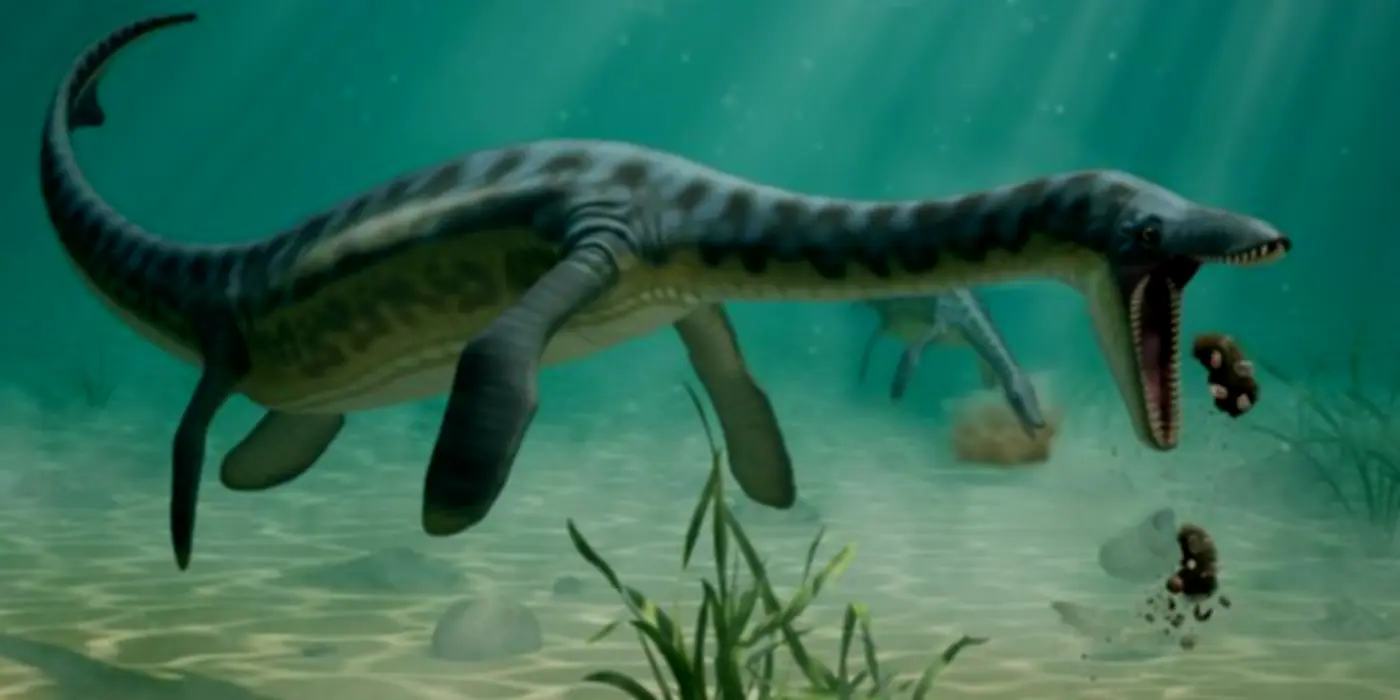
Jurassic Puke: Plesiosaurs Knew Not To Vomit Where They Eat
Jurassic monsters sometimes needed to vomit. When they did, they went to shore.
Jurassic monsters sometimes needed to vomit. When they did, they went to shore.

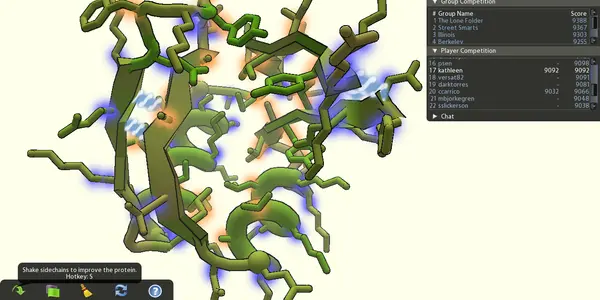
Like video games? Want to also solve puzzles for science?
A new game, named Foldit, turns protein folding into a competitive sport. Introductory levels teach the rules, which are the same laws of physics by which protein strands curl and twist into three-dimensional shapes – key for biological mysteries ranging from Alzheimer's to vaccines.
After about 20 minutes of training, people feel like they're playing a video game but are actually mouse-clicking in the name of medical science.

Investigations continue into the cause of a mysterious illness that has resulted in the deaths of thousands of bats since March 2008. At more than 25 caves and mines in the northeastern U.S, bats exhibiting a condition now referred to as “white-nosed syndrome” have been dying.
The U.S. Geological Survey (USGS) recently issued a Wildlife Health Bulletin, advising wildlife and conservation officials throughout the U.S. to be on the lookout for the condition known as “white-nose syndrome” and to report suspected cases of the disease.
USGS wildlife disease specialist Dr. Kimberli Miller advises that "anyone finding sick or dead bats should avoid handling them and should contact their state wildlife conservation agency or the nearest U.S. Fish & Wildlife Service field office to report their observation.”
Neuroscientists at Johns Hopkins have discovered that mice lacking an enzyme that contributes to Alzheimer disease exhibit a number of schizophrenia-like behaviors. The finding raises the possibility that this enzyme may participate in the development of schizophrenia and related psychiatric disorders and therefore may provide a new target for developing therapies.
The BACE1 enzyme, for beta-site amyloid precursor protein cleaving enzyme, generates the amyloid proteins that lead to Alzheimer’s disease. The research team years ago suspected that removing BACE1 might prevent Alzheimer.
“We knew at the time that in addition to amyloid precursor protein, BACE1 interacts with other proteins but we didn’t know how those interactions might affect behavior,” says Alena Savonenko, M.D., Ph.D., an assistant professor in neuropathology at Hopkins.
Researchers at the OU Cancer Institute have identified a new gene that causes cancer, according to an article in Oncogene.
The gene and its protein, both called RBM3, are vital for cell division in normal cells. In cancers, low oxygen levels in the tumors cause the amount of this protein to go up dramatically. This causes cancer cells to divide uncontrollably, leading to increased tumor formation.
Researchers used new powerful technology to genetically “silence” the protein and reduce the level of RBM3 in cancerous cells. The approach stopped cancer from growing and led to cell death. The new technique has been tested successfully on several types of cancers – breast, pancreas, colon, lung, ovarian and prostate.

Chile’s Chaiten Volcano is shown spewing ash and smoke (centre left of image) into the air for hundreds of km over Argentina’s Patagonia Plateau in this Envisat image acquired on 5 May 2008.
The 1000 m-high volcano had been dormant for thousands of years before erupting on 2 May, causing the evacuation of thousands. Chaiten Volcano is located in southern Chile 10 km northeast of the town of Chaiten on the Gulf of Corcovado.
Envisat’s Medium Resolution Imaging Spectrometer (MERIS) instrument processed this image at a resolution of 1200 m.
Distiller’s grains are a by-product of ethanol processing that can be used for animal feed. There’s been some skepticism about using distiller’s grains in Texas but one scientist says the type of grain used makes all the difference.
Dr. Jim MacDonald, AgriLife Research beef nutritionist at Amarillo, said, “I believe we can do it successfully, provided we have distiller’s grains that are equivalent in quality to those used in the North Plains states.”
Two years ago, MacDonald began investigating the dramatically different animal performance responses observed in the Northern Plains and Southern Plains, and to determine how to successfully incorporate distiller’s grains into this region’s finishing rations.

A team of Dutch and German astronomers have discovered part of the missing matter in the Universe using the European X-ray satellite XMM-Newton. They observed a filament of hot gas connecting two clusters of galaxies. This tenuous hot gas could be part of the missing “baryonic” matter.
The existence of this hot gas (with a temperature of 100 000 - 10 000 000 degrees), known as a warm-hot intergalactic medium, was predicted 10 years ago as a possible source for the missing dark matter. Gas at such high temperature and low density is very difficult to detect and many attempts have failed in past years.
The team observed a pair of clusters of galaxies (Abell 222 and Abell 223) using the European X-ray satellite XMM-Newton. Their observations (see Fig. 1) clearly show a bridge connecting both clusters. The gas they observed there is probably the hottest and densest part of the diffuse gas in the cosmic web, which would be part of the missing “baryonic” dark matter.
Scientists used to think that hermaphrodites, due to their low position in the evolutionary scale, did not have sufficiently developed sensory systems to assess the “quality” of their mates.
A new work has shown, however, that earthworms are able to detect the competition by fertilising the eggs that is going to find its sperm, tripling its volume when there is rivalry. This ability is even more refined as they are able to transfer more sperm to more fertile partners.
Hermaphrodites, organisms that have both female and male reproductive organs, such as earthworms, are denied the right to choose their partner. However, a study by researchers at the University of Vigo has shown that worms are capable of telling whether another worm is a virgin or not, and triple the volume of sperm transferred during copulation if they detect a fertilisation competition risk.
The National Geographic Society and the international polling firm GlobeScan today unveiled a new mechanism for measuring and comparing individual consumer behavior as it relates to the environment.
“Greendex™ 2008: Consumer Choice and the Environment — A Worldwide Tracking Survey” looks at environmentally sustainable consumption and behavior among consumers in 14 countries. This first-of-its-kind study reveals surprising differences between consumers in developed and developing countries in terms of environmentally friendly actions.
This year’s results are a baseline against which results of future annual surveys will be compared, in order to monitor improvements or declines in environmentally sustainable consumption at both the global level and within countries.
You wouldn't think that clean air would be bad for the Amazon rainforest but UK and Brazilian climate scientists writing in Nature say just that.
Reduced sulphur dioxide emissions from less burning coal and increased sea surface temperatures in the tropical north Atlantic, are causing a heightened risk of drought in the Amazon rainforest.
A team from the University of Exeter, Centre for Ecology and Hydrology, Met Office Hadley Centre and Brazilian National Institute for Space Studies used the Met Office Hadley Centre climate-carbon model to simulate the impacts of twenty-first century climate change on the Amazon rainforest. They compared the model to data from the 2005 drought, which caused widespread devastation across the Amazon basin.
A new approach to estimating tumor growth based on breast screening results from almost 400,000 women is published today in Breast Cancer Research. This new model can also estimate the proportion of breast cancers which are detected at screening (screen test sensitivity). It provides a new approach to simultaneously estimating the growth rate of breast cancer and the ability of mammography screening to detect tumors.
The results of the study show that tumor growth rates vary considerably among patients, with generally slower growth rates with increasing age at diagnosis. Understanding how tumours grow is important in the planning and evaluation of screening programs, clinical trials, and epidemiological studies. However, studies of tumour growth rates in people have so far been based mainly on small and selected samples.

The first genome sequencing project of a mammal that lays eggs is complete and, like the animal itself, the DNA of the platypus is something of a patchwork.
The platypus, found in eastern Australia, including Tasmania, is one of the five species of mammals that lay eggs instead of giving birth to live young. The four species of echidna are the other mamimals that share this distinction.
The curious discovery of the duck-billed, egg-laying, otter-footed, beaver-tailed, venomous platypus in 1798, comfortable on land and in water, convinced British scientists that it must be a hoax. Sketches of its appearance were thought to be impossible.
But new research proves that the oddness of the platypus' looks isn't just skin-deep. Platypus DNA is an equally cobbled-together array of avian, reptilian and mammalian lineages that may hold clues for human disease prevention.