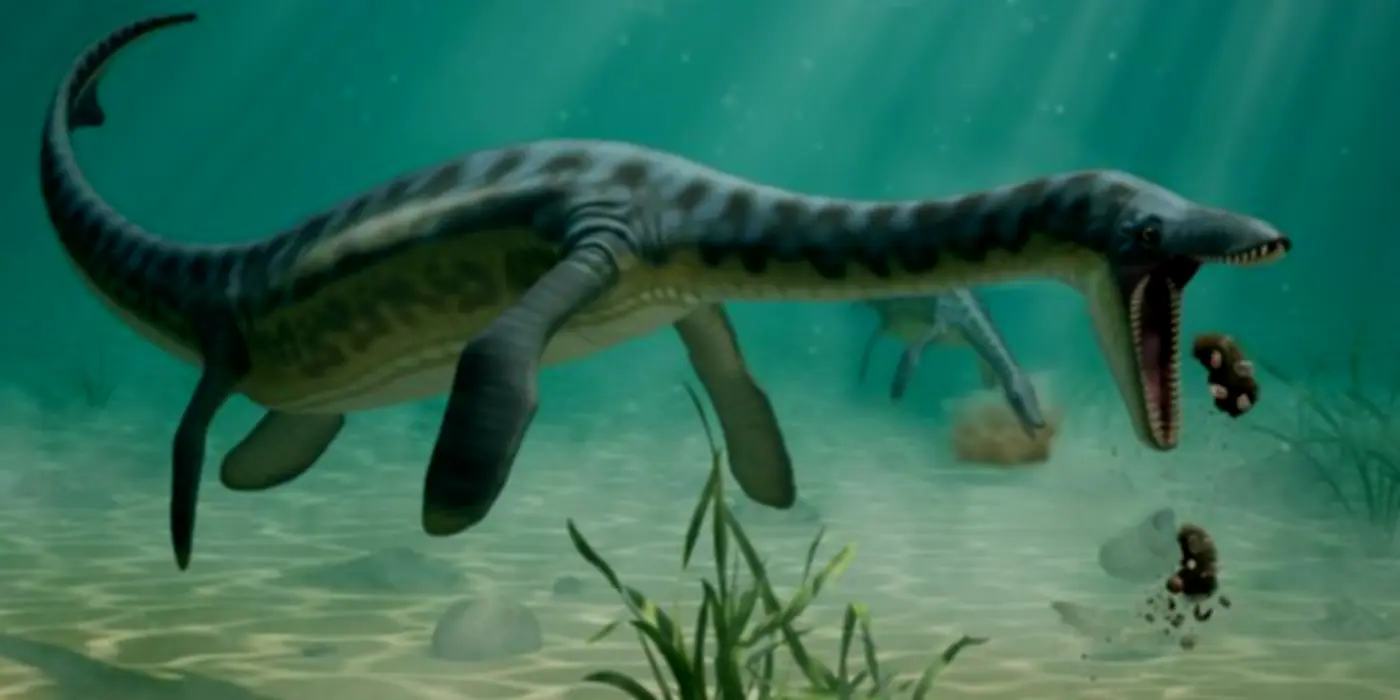
Jurassic Puke: Plesiosaurs Knew Not To Vomit Where They Eat
Jurassic monsters sometimes needed to vomit. When they did, they went to shore.
Jurassic monsters sometimes needed to vomit. When they did, they went to shore.


The direct effect predators have on their prey is to kill them. The evolutionary changes that can result from this direct effect include prey that are younger at maturity and that produce more offspring.
But killing prey also has indirect effects – rarely characterized or measured – such as a decline in the number of surviving prey, resulting, in turn, in more food available to survivors.
In a new study characterizing the complex ecological interactions that shape how organisms evolve, UC Riverside biologists Matthew Walsh and David Reznick present a novel way of quantifying these indirect effects by showing that prey adapt to food availability as well as the presence of predators.
The preservation of coastal ecosystem services such as clean water, storm buffers or fisheries protection does not have to be an all-or-nothing approach, a new study indicates, and a better understanding of how ecosystems actually respond to protection efforts in a “nonlinear” fashion could help lead the way out of environmental-versus-economic gridlock.
There may be much better ways to provide the majority of environmental protection needed while still maintaining natural resource-based jobs and sustainable communities, scientists from 13 universities and research institutes will suggest Friday in a new article in the journal Science.
“The very concept of ecosystem-based management implies that humans are part of the equation, and their needs also have to be considered,” said Lori C
University of California, Irvine researchers have identified a gene that is specifically responsible for generating the cerebral cortex, a finding that could lead to stem cell therapies to treat brain injuries and diseases such as stroke and Alzheimer’s.
Dr. Edwin Monuki, doctoral student Karla Hirokawa and their colleagues in the departments of Pathology & Laboratory Medicine and Developmental & Cell Biology found that a gene called Lhx2 serves as the long-sought cortical “creator” gene that instructs stem cells in the developing brain to form the cerebral cortex. This portion of the brain is responsible for higher sensory and cognitive functions, such as language, decision-making and vision. Without this gene, cortical cells will not form.
Researchers have discovered the secret of why larger and seemingly healthier dark sheep on a remote Scottish Island are mysteriously declining, seemingly contradicting Darwin’s evolutionary theory - and it shows just how complex natural selection is.
Dr. Jacob Gratten and Dr. Jon Slate, from the University of Sheffield's Department of Animal and Plant Sciences, looked at coat color in a feral population of Soay sheep on Hirta in the St Kilda Archipelago. On Hirta about three quarters of sheep have dark brown coats, while the remaining quarter have light sandy coats. The dark-coated Soay sheep are larger, which is usually linked to survival and reproductive success, but the frequency of light-coated sheep has increased over the last 20 years.

Movie characters from the Terminator to the Bionic Woman use bionic eyes to zoom in on far-off scenes, have useful facts pop into their field of view, or create virtual crosshairs. Off the screen, virtual displays have been proposed for more practical purposes -- visual aids to help vision-impaired people, holographic driving control panels and even as a way to surf the Web on the go.
The device to make this happen may be familiar. Engineers at the University of Washington have for the first time used manufacturing techniques at microscopic scales to combine a flexible, biologically safe contact lens with an imprinted electronic circuit and lights.
Most chromosomal abnormalities are inherited but researchers writing in the American Journal of Human Genetics found that seven percent of children with autism carry structural changes in the genome that are not found in their parents. The rate of such de novo changes in the general population is typically less than one percent.
Structural variants in the chromosomes were found to influence ASD with sufficiently high frequency to suggest that genomic analyses be considered in routine clinical workup, according to the researchers.
“Historical studies in identical twins and their families have provided strong evidence for a genetic basis of autism,” said Stephen Scherer of The Hospital for Sick Children and the University of Toronto.

Three-dimensional snowflakes can now be grown in a computer using a program developed by mathematicians at UC Davis and the University of Wisconsin-Madison.
No two snowflakes are truly alike, but they can be very similar to each other, said Janko Gravner, a mathematics professor at UC Davis. Why they are not more different from each other is a mystery, Gravner said.
Sugars were once credited with magical healing powers but are now seen like salt as an evil necessary in small doses but the cause of numerous diseases such as diabetes if taken in excess. Yet latest research suggests this view ignores the vital role played by more complex sugars in many biological structures, and the great therapeutic potential they have.
A recent workshop organized by the European Science Foundation (ESF) focused on the current state of the art in glycoscience, the study of complex sugars in biology.
A key point was that complex sugars are involved every time cells, and smaller structures within cells, communicate or bind with each other. This means they play a major part in all processes, including immune recognition and brain functions such as memory.
Natural gas distributed throughout the Marcellus black shale in northern Appalachia could conservatively boost proven U.S. reserves by trillions of cubic feet if gas production companies employ horizontal drilling techniques, according to a Penn State and State University of New York, Fredonia, team.
"The value of this science could increment the net worth of U.S. energy resources by a trillion dollars, plus or minus billions," says Terry Engelder, professor of geosciences, at Penn State.
The Marcellus shale runs from the southern tier of New York, through the western portion of Pennsylvania into the eastern half of Ohio and through West Virginia. In Pennsylvania, the formation extends from the Appalachian plateau into the western valley and ridge.
Researchers from the University of Granada have for the first time analyzed the antioxidant properties of olive oil, a product rich in polyphenols. The Environmental, Biochemical and Nutritional Analytical-Control Research Group had already carried out the polyphenolic characterization of food products, such as honey and beer.
In the 1960s, Ancer Keys, a US expert on nutrition, studied the health benefits of the Mediterranean diet for the first time. Since then many studies on the benefits of olive oil have been conducted.
LOS ANGELES, January 17 /PRNewswire/ --
BioGold Fuels Corporation, in a joint venture with Bioteknia, has entered into a letter of intent to build a waste to fuel production facility in the Dominican Republic. Bioteknia will provide the contracts for the land to build the plant, the supply of waste for processing and the purchase of the resulting fuel and energy. Bioteknia will also secure the necessary governmental permits to build and operate the plant. BioGold will provide the technology and know how to build and operate the plants, as well as the funding necessary for construction.
"BioGold is excited to be expanding our operations into the Dominican Republic," said BioGold's CEO, Steve Racoosin. "This plant will be a flagship for the waste to energy marketplace. This is the first step towards achieving BioGold's global goal of eliminating the waste just sitting in our landfills and converting it to renewable energy and fuels."

A gigantic palm that flowers itself to death and exists as part of an entirely unique genus has been discovered in Madagascar. The mystery palm has a huge trunk which towers over 18m high and fan leaves which are 5m in diameter - among the largest known in flowering plants. This is the most massive palm ever to be found in Madagascar. It's so large it can be seen on Google Earth.