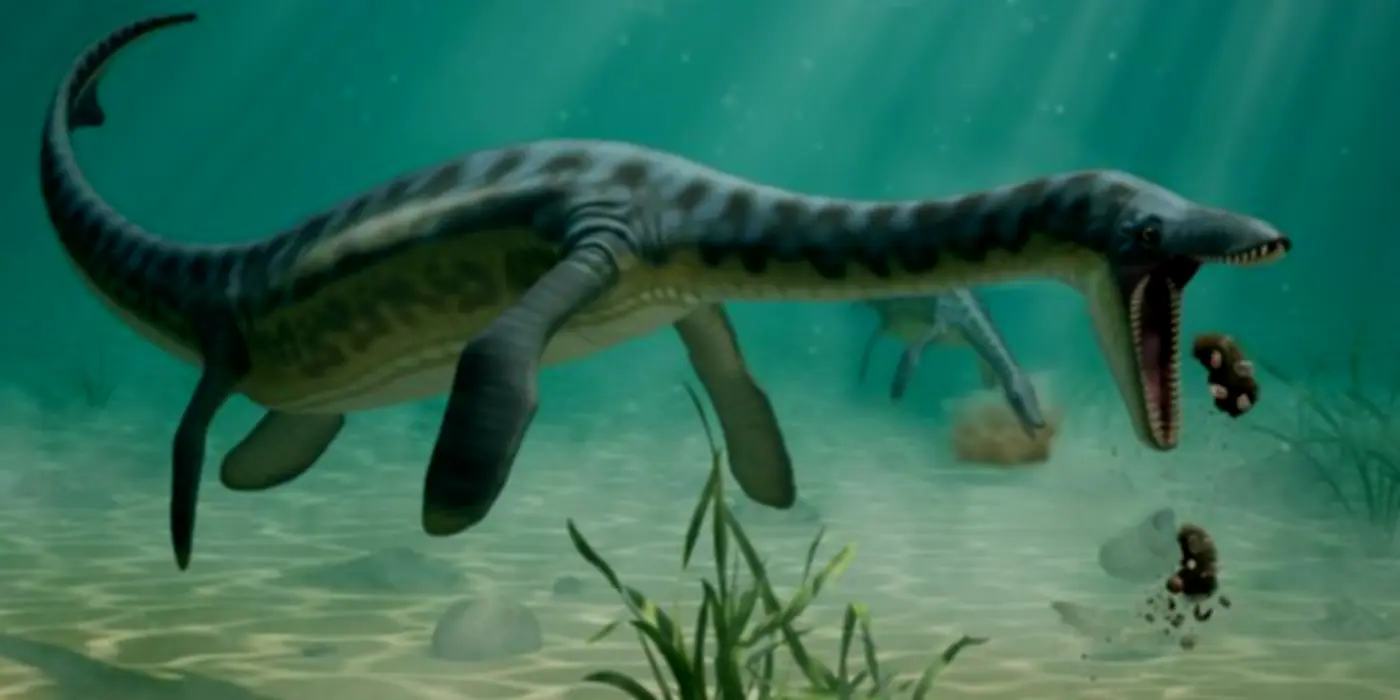
Jurassic Puke: Plesiosaurs Knew Not To Vomit Where They Eat
Jurassic monsters sometimes needed to vomit. When they did, they went to shore.
Jurassic monsters sometimes needed to vomit. When they did, they went to shore.


In studies involving more than 35,000 people and a survey across the entire human genome, an international team supported in part by the National Institutes of Health (NIH) has found evidence that common genetic variants recently linked to osteoarthritis may also play a minor role in human height. The findings were released in Nature Genetics.
The variants most strongly associated with height in the new genome-wide association study lie in a region of the human genome thought to influence expression of a gene for growth differentiation factor 5 (GDF5), which is a protein involved in the development of cartilage in the legs and other long bones.
One of the most common human parasites, Toxoplasma gondii, uses a hormone lifted from the plant world to decide when to increase its numbers and when to remain dormant, researchers at Washington University School of Medicine in St. Louis have found.
The scientists report this week in Nature that they successfully blocked production of the molecule, known as abscisic acid (ABA), with a plant herbicide. Low doses of the herbicide prevented fatal T. gondii infection in mice.
"As a target for drug development, this pathway is very attractive for several reasons," says author L. David Sibley, Ph.D., professor of molecular microbiology. "For example, because of its many roles in plant biology, we already have several inhibitors for it.
Many researchers have tried to create a mathematical model of how cells pack together to form tissue, but most models have many different complicated factors, and no model is universal.
Researchers at Northwestern University have now created a functional equation -- using only two parameters -- to show how cells pack together to create the eyes of Drosophila, better known as the fruit fly. They hope that the pared-down equation can be applied to different kinds of tissues, leading to advances in regenerative medicine.
Sascha Hilgenfeldt, associate professor of engineering sciences and applied mathematics and of mechanical engineering in the McCormick School of Engineering and Applied Science, teamed up with Richard W.

Four years of observations from the European Space Agency’s Integral (INTErnational Gamma-Ray Astrophysics Laboratory) satellite may have cleared up one of the most vexing mysteries in our Milky Way: the origin of a giant cloud of antimatter surrounding the galactic center.
As reported by an international team in the January 10 issue of Nature, Integral found that the cloud extends farther on the western side of the galactic center than it does on the eastern side.
The last fish you ate probably came from the Bering Sea. At present, the Bering Sea provides roughly half the fish caught in U.S. waters each year and nearly a third caught worldwide.
While the basic dynamics of a 'greenhouse ocean' are not well understood, marine ecologists writing in Marine Ecology Progress Series expressed concern that, if their predictions are true, a warming ocean would lead to a much different ecology there.
“All the fish that ends up in McDonald’s, fish sandwiches — that’s all Bering Sea fish,” said USC marine ecologist Dave Hutchins.
An international research team has discovered that a magnetic field can interact with the electrons in a superconductor in ways never before observed.
Andrea D. Bianchi, the lead researcher from the Université de Montréal, explains in the January 11 edition of Science magazine what he discovered in an exceptional compound of metals – a combination of cobalt, indium and a rare earth – that loses its resistance when cooled to just a couple of degrees above absolute zero.
“When subjected to intense magnetic fields, these materials produce a completely new type of magnetic tornado that grows stronger with increasing fields rather than weakening,” said Prof. Bianchi. “The beauty of this compound is how we can experiment without breaking it.”
New ways to make sure people are adequately informed about the risks and benefits of taking part in a clinical trial can be field-tested for effectiveness as vigorously as new medical treatments themselves, a study led by a Johns Hopkins bioethicist suggests.
Informed consent, a mainstay of ethical clinical trials, is the process by which potential research subjects are asked to decide whether to participate in research.
A new study by University of Colorado at Boulder researchers indicates older, multi-year sea ice in the Arctic is giving way to younger, thinner ice, making it more susceptible to record summer sea-ice lows like the one that occurred in 2007.
The team used satellite data going back to 1982 to reconstruct past Arctic sea ice conditions, concluding there has been a nearly complete loss of the oldest, thickest ice and that 58 percent of the remaining perennial ice is thin and only 2-to-3 years old, said the lead study author, Research Professor James Maslanik of CU-Boulder's Colorado Center for Astrodynamics Research.
The roundworm C. elegans, a staple of laboratory research, may be key in unlocking one of the central biological mysteries: why we sleep.
Researchers at the University of Pennsylvania School of Medicine report in this week’s advanced online edition of Nature that the round worm has a sleep-like state, joining most of the animal kingdom in displaying this physiology. This research has implications for explaining the evolution and purpose of sleep and sleep-like states in animals.
In addition, genetic work associated with the study provides new prospects for the use of C. elegans to identify sleep-regulatory genes and drug targets for sleep disorders.
Cranberry juice, long dissed as a mere folk remedy for relieving urinary tract infections in women, is finally getting some respect.
Thanks to Prof. Itzhak Ofek, a researcher at Tel Aviv University's Sackler Faculty of Medicine, the world now knows that science supports the folklore. Prof. Ofek's research on the tart berry over the past two decades shows that its juice indeed combats urinary tract infections.
And, he’s discovered, the refreshing red beverage has additional medicinal qualities as well. Prof. Ofek has found that cranberry juice exhibits anti-viral properties against the flu, can prevent cavities, and lessens the reoccurrence of gastric ulcers.
Methadone can be dangerous for some patients but is heroin a good idea for heroin addicts?
Maintenance treatment with heroin is appropriate for heroin misusers under certain circumstances, argue Jürgen Rehm from the Centre for Addiction and Mental Health in Toronto and Benedikt Fischer from the University of Victoria, British Columbia.
They point to trials in Switzerland, the Netherlands and Germany, which found heroin assisted maintenance treatment feasible and effective for those resistant to treatment.
In this week’s BMJ, doctors warn of excess sorbitol intake, a widely used sweetener in “sugar-free” products such as chewing gum and sweets.
Sorbitol has laxative properties and is poorly absorbed by the small intestine.
Their advice follows the cases of two patients with chronic diarrhea, abdominal pain and severe weight loss. Although extensive investigations were carried out, final diagnosis was only established after detailed analysis of eating habits.