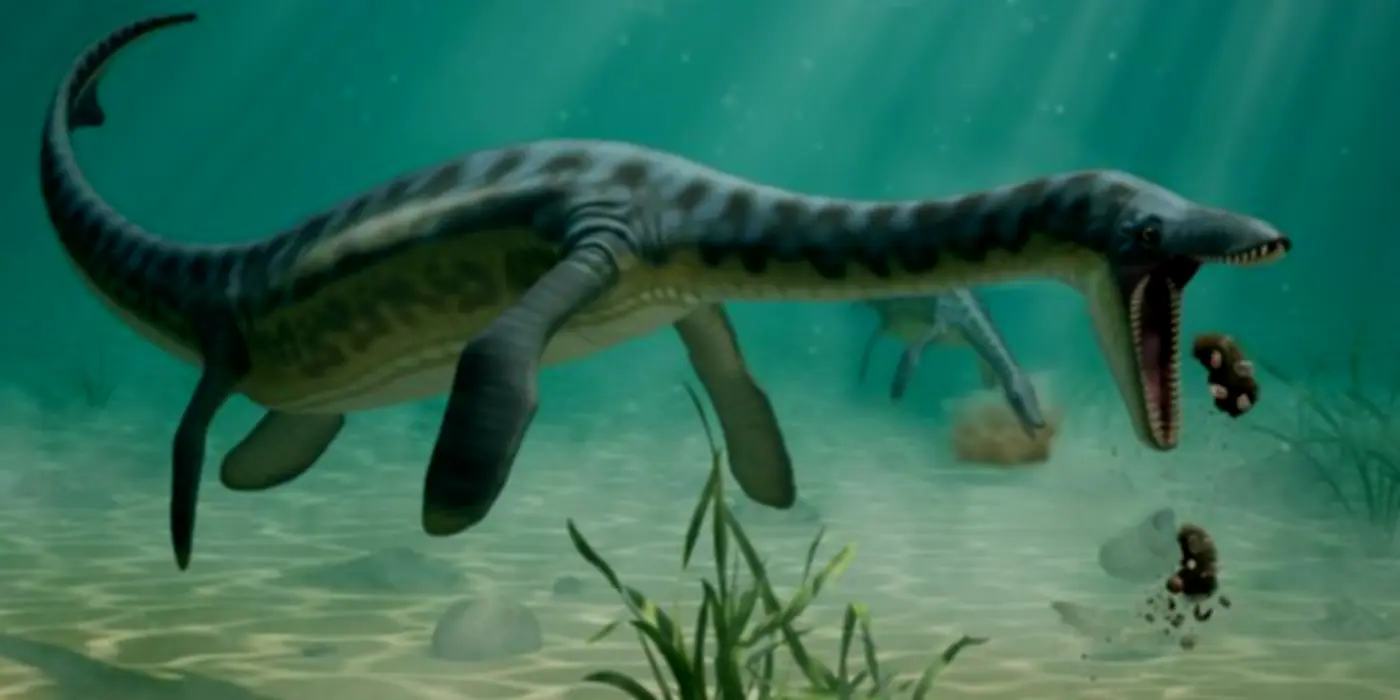
Jurassic Puke: Plesiosaurs Knew Not To Vomit Where They Eat
Jurassic monsters sometimes needed to vomit. When they did, they went to shore.
Jurassic monsters sometimes needed to vomit. When they did, they went to shore.


In the world of commercial materials, lighter and cheaper is better - especially when coupled with superior strength and special properties such as a material's ability to remember its original shape after it's been deformed by a physical or magnetic force.
A new class of materials known as "magnetic shape-memory foams" has been developed by two research teams headed by Peter Müllner at Boise State University and David Dunand at Northwestern University.
The foam consists of a nickel-manganese-gallium alloy whose structure resembles a piece of Swiss cheese with small voids of space between thin, curvy "struts" of material. The struts have a bamboo-like grain structure that can lengthen, or strain, up to 10 percent when a magnetic field is applied.

Do polls reflect who people will vote for or who they would like to be perceived as voting for? A new national study of voters who say they might vote in Democratic primaries (participants were not a representative sample of Democrats but were self-selected volunteers who took an experimental test over the Web) and caucuses shows a striking disconnect between their explicit and implicit preferences, according to Bethany Albertson, a University of Washington assistant political science professor and Anthony Greenwald, a UW psychology professor and inventor of the Implicit Association Test.
When asked who they would vote for, Sen. Barack Obama held a 42 percent to 34 percent margin over Sen. Hilary Clinton. Former senator John Edwards was in third place with 12 percent.

A cosmic explosion that seems to have occurred thousands of light-years from the nearest galaxy-sized collection of stars, gas, and dust has puzzled astronomers. This "shot in the dark" is surprising because the type of explosion, a long-duration gamma-ray burst (GRB), is thought to be powered by the death of a massive star.
"Here we have this very bright burst, yet it's surrounded by darkness on all sides," says Brad Cenko of the California Institute of Technology, Pasadena, Calif., lead author of the team’s paper, which has been accepted for publication in The Astrophysical Journal.
No human can survive longer than a few minutes underwater, and even a well-trained Olympic swimmer needs frequent gulps of air. Our brains need a constant supply of oxygen, particularly during exercise.
Contrast that with Weddell seals, animals that dive and hunt under the Antarctic sea ice. They hold their breath for as long as 90 minutes, and remain active and mentally alert the whole time. The seals aren't fazed at all by low levels of oxygen that would cause humans to black out.
People suffering from chronic mental or physical disabilities should not resort to a dolphin "healing" experience, warn two researchers from Emory University. Lori Marino, senior lecturer in the Neuroscience and Behavioral Biology Program, has teamed with Scott Lilienfeld, professor in the Department of Psychology, to launch an educational campaign countering claims made by purveyors of what is known as dolphin-assisted therapy (DAT).
"Dolphin-assisted therapy is not a valid treatment for any disorder," says Marino, a leading dolphin and whale researcher.

On June 30, 1908 a stunning explosion rocked the forest near the Tunguska river in Siberia. Estimates were that an asteroid exploded in the air a few kilometers above the earth's surface with a force 1,000 times that of the Hiroshima atomic bomb.
A new Sandia supercomputer simulations suggests that the asteroid that caused such a blast was much smaller than previously thought, bringing new concerns; there are more small asteroids than large ones.
“The asteroid that caused the extensive damage was much smaller than we had thought,” says Sandia principal investigator Mark Boslough of the impact that occurred June 30, 1908. “That such a small object can do this kind of destruction suggests that smaller asteroids are something to consider.
A genetic mutation expands lesions in the aorta and promotes coronary atherosclerosis, more commonly known as hardening of the arteries, according to a study by Yale School of Medicine in Cell Metabolism.
The researchers found that mice engineered without the Akt1 gene and fed a high cholesterol diet had many more signs of aortic atherosclerosis compared to their littermates. And, surprisingly, their coronary lesions were similar to humans, say the scientists.
“About 20 percent of the mice died spontaneously, perhaps due to an acute heart attack,” said William Sessa, senior author of the study, professor of pharmacology, and director of Yale’s vascular biology and therapeutics program.
What are the defining discoveries and great developments that are shaping the way we use materials and technologies today? Materials Today magazine has compiled a list of the top ten most significant advances in materials science over the last 50 years.
The top ten includes advances that have altered all our daily lives. Some have completely changed the research arena, and others have opened up new possibilities and capabilities. They are:
1. The International Technology Roadmap for Semiconductors
2. Scanning probe microscopes
3. Giant magnetoresistive effect
4. Semiconductor lasers and light-emitting diodes
5. National Nanotechnology Initiative
6. Carbon fiber reinforced plastics
7. Materials for Li ion batteries
8. Carbon nanotubes
9. Soft lithography
10.

Tiny copper structures with pores at both the nanometer and micron size scales could play a key role in the next generation of detonators used to improve the reliability, reduce the size and lower the cost of certain military munitions.
Developed by a team of scientists from the Georgia Tech Research Institute (GTRI) and the Indian Head Division of the Naval Surface Warfare Center, the highly-uniform copper structures will be incorporated into integrated circuits – then chemically converted to millimeter-diameter explosives.

Adult humans possess some mathematical abilities that are unmatched by any other member of the animal kingdom but there is increasing evidence that the ability to count sets of objects nonverbally is a capacity that humans share with other animal species.
In PLoS Biology, Elizabeth Brannon and Jessica Cantlon discuss how humans and nonhuman animals share a capacity for nonverbal arithmetic. The researchers tested monkeys and college students on a nonverbal arithmetic task in which they had to add the numerical values of two sets of dots together and choose a stimulus from two options that reflected the arithmetic sum of the two sets.
Monkeys perform addition like humans.
MIT scientists have found a way to induce cells to form parallel tube-like structures that could one day serve as tiny engineered blood vessels.
The researchers found that they can control the cells' development by growing them on a surface with nano-scale patterning. A paper on the work was posted in Advanced Materials.
Engineered blood vessels could one day be transplanted into tissues such as the kidneys, liver, heart or any other organs that require large amounts of vascular tissue, which moves nutrients, gases and waste to and from cells.
"We are very excited about this work,” said Robert Langer, MIT Institute Professor and an author of the paper.
Researchers at Oregon Health & Science University’s Neurological Sciences Institute have uncovered the system that tells the body when to perform one of its most basic defenses against the cold: shivering. Most interesting is that it's not the same sensory pathway as conscious cold detection.
Our bodies use two different but related sensory systems to conscious and subconsciously detect cold at the same time.
Shivering is one of the many automatic and subconscious regulatory body functions, often called homeostatic functions, that the brain regulates. Other examples include the adjustment of breathing rates, blood pressure, heart rate and weight regulation. Throughout the day, all of these important functions take place in the body without conscious thought.