Jurassic Puke: Plesiosaurs Knew Not To Vomit Where They Eat
Jurassic monsters sometimes needed to vomit. When they did, they went to shore.
Jurassic monsters sometimes needed to vomit. When they did, they went to shore.


New observations by NASA's Cassini spacecraft indicate the rings of Saturn, once thought to have formed during the age of the dinosaurs, instead may have been created roughly 4.5 billion years ago when the solar system was still under construction.
Professor Larry Esposito, principal investigator for Cassini's Ultraviolet Imaging Spectrograph at CU-Boulder, said data from NASA's Voyager spacecraft in the 1970s and later NASA's Hubble Space Telescope had led scientists to believe Saturn's rings were relatively youthful and likely created by a comet that shattered a large moon, perhaps 100 million years ago.

When humans began to migrate out of Africa about 100,000 years ago, their skin color gradually changed to adapt to their new environments. And when the last Ice Age ended about 10,000 years ago, marine ancestors of ocean-dwelling stickleback fish experienced dramatic changes in skin coloring as they colonized newly formed lakes and streams.
New research shows that despite the vast evolutionary gulf between humans and the three-spined stickleback fish, the two species have adopted a common genetic strategy to acquire the skin pigmentation that would help each species thrive in their new environments.
Researchers at the University of Massachusetts Medical School, gained new insights into autophagy -- a cellular degradation process associated with a form of programmed cell death -- by studying the salivary gland cells of the fruit fly.
Since its initial discovery in the 1960s, programmed cell death has been a primary focus of studies for investigators across a wide array of scientific disciplines.
An essential mechanism in development and homeostasis, programmed cell death allows for the clean intracellular destruction of unnecessary or damaged cells. While apoptosis is the most understood type of programmed cell death, recently scientists have begun to take a closer look at autophagy— a highly regulated, catabolic process that essentially allows a cell to eat itself.
As a step towards designing tomorrow's super-fast optical communications networks, a Duke University-led research team has demonstrated a way to transfer encoded information from a laser beam to sound waves and then back to light waves again.
Swapping data between media like this would allow information to be captured and retained for very brief intervals. Data could be stored within pockets of acoustic vibration created when laser beams interact along a short strand of optical fiber, the team reported in Science.
The Duke experiments address a barrier to efforts at developing computer networks that can run on light instead of electrons.
No one will be farther from home than the astronauts aboard the International Space Station, circling Earth at 17,500 mph and orbiting 16 times each day. NASA is giving the public an opportunity to send personalized holiday greetings to the orbiting crew.
NASA astronaut Peggy Whitson and Flight Engineer Yuri Malenchenko, a Russian cosmonaut, have been on the station since Oct. 12. Flight Engineer Dan Tani, a U.S. astronaut, joined them Oct. 25.
All cells are surrounded by protective, fatty membranes.In the cell membrane there are thousands of membrane proteins that transport nutritional substances, ions, and water through the membrane. Membrane proteins are also necessary for cells to recognize each other in the body and for a nervous system, for example, to be formed.
Researchers at Stockholm University report in Nature that they have now managed to reveal the "molecular code" that governs the insertion of proteins in the cell membrane.
About 25 percent of all proteins in a cell are found in the cell membrane. Since they regulate all communication between the inside of the cell and the surrounding environment, many membrane proteins are crucial to the life of the cell.
Does the consumption of green tea, widely touted to have beneficial effects on health, also protect brain cells? Authors of a new study being published in the December 15th issue of Biological Psychiatry share new data that indicates this may be the case.
The authors investigated the effects of green tea polyphenols, a group of naturally occurring chemical substances found in plants that have antioxidant properties, in an animal model of Parkinson’s disease.
Sugar-based markers on human sperm cells which may prevent them from being attacked by the female immune system could provide a vital clue to how some cancers spread in the human body, according to new research published in the Journal of Biological Chemistry.
Researchers analyzed these markers, believed to tell the female immune system that the sperm are not dangerous pathogens, and therefore should not be attacked by the woman’s white blood cells during the reproductive process. The study, led by Imperial College London and the University of Missouri, suggests that these sugar markers, found on N-glycans which are part of human sperm glycoproteins, can be universally recognised by all human immune systems, regardless of the individual.

More than 10 years after the discovery of the first extrasolar planet, astronomers have now discovered more than 250 of these planets. Until a few years ago, most of the newly discovered exoplanets were Jupiter-mass, probably gaseous, planets. Recently, astronomers have announced the discovery of several planets that are potentially much smaller, with a minimum mass lower than 10 Earth masses: the now so-called super-Earths [1].
In April, a European team announced in Astronomy & Astrophysics the discovery of two new planets orbiting the M star Gliese 581 (a red dwarf), with masses of at least 5 and 8 Earth masses.
Schizophrenia is one of the most debilitating of the major psychiatric disorders, and is also one of the most difficult to treat.
Although numerous antipsychotic treatments are available, they can cause significant side effects and many patients experience only a partial relief of their symptoms and up to 30% no relief at all.
In a new study in Biological Psychiatry, Dr. Stephen Marder of UCLA and colleagues examined the efficacy and safety of a new psychotropic agent for the treatment of schizophrenia in a 6-week, randomized, placebo-controlled trial.
A plentiful ingredient found in human semen drastically enhances the ability of the human immunodeficiency virus (HIV) to cause infection, according to a report in the journal Cell. The findings help to understand the sexual transmission of HIV and suggest a potential new target for preventing the spread of AIDS, the researchers said.
Collaborating research groups in Hannover and Ulm, Germany, show that naturally occurring fragments of so-called prostatic acidic phosphatase (PAP) isolated from human semen form tiny fibers known as amyloid fibrils. Those fibrils capture HIV particles and help them to penetrate target cells, thereby enhancing the infection rate by up to several orders of magnitude.
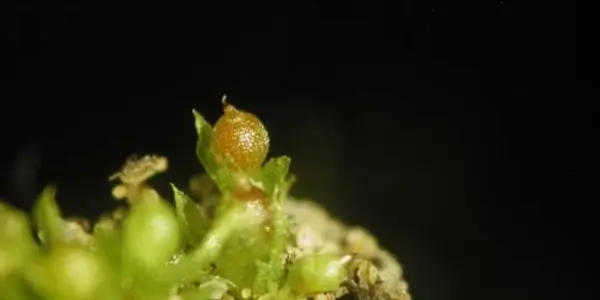
An international team of scientists have sequenced the genome for Physcomitrella – the first non-flowering or ‘lower’ plant to be sequenced – and published their findings in the latest issue of Science.
The moss Physcomitrella patens is a primitive plant, similar to the first plants which began to grow on land around 450 million years ago. Just one cell thick, these early plants had to adapt to withstand cold, heat and drought without roots or complex leaves. The ability of mosses to survive severe dehydration and then regrow when watered could be of enormous use in crops grown in drought-stricken areas of the developing world.
The spore capsule of Physcomitrella.