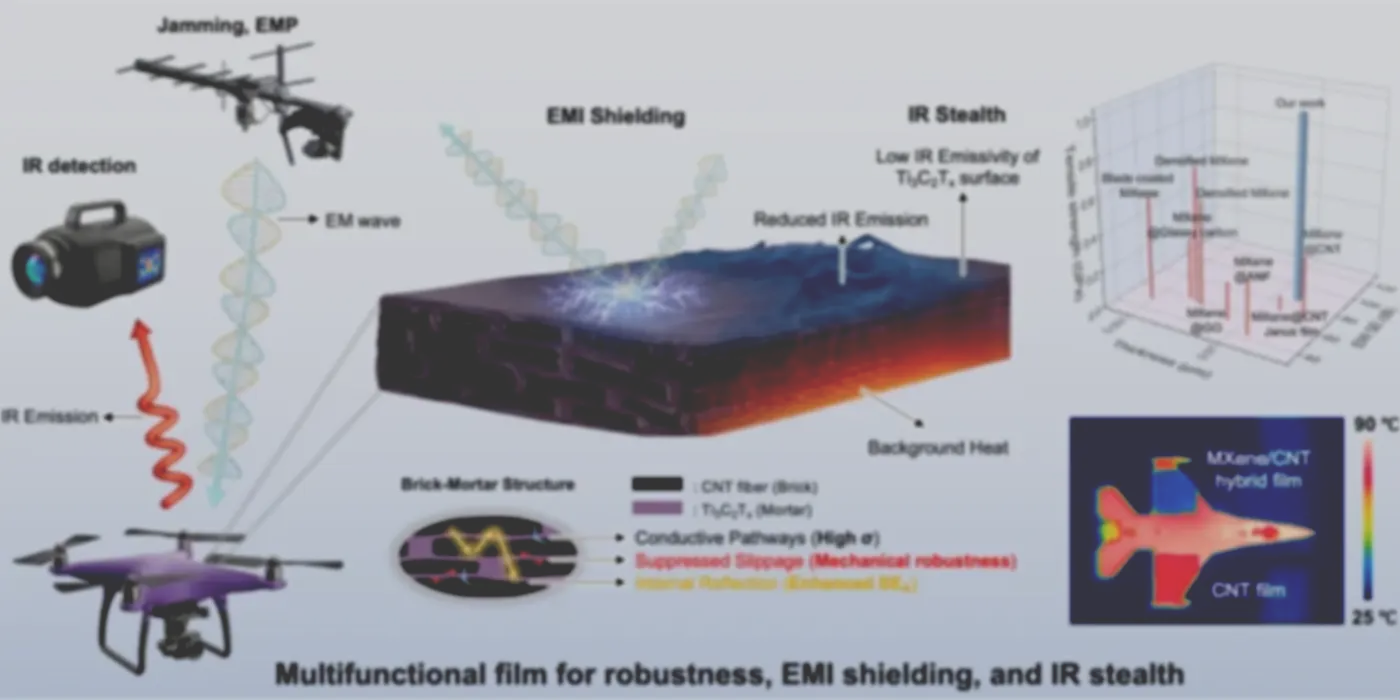
Carbon Nanotube Has EMI And Hides Heat
Researchers have developed a composite film that combines electromagnetic interference shielding, infrared stealth, and high mechanical strength using carbon nanotube fibers and MXene.
Researchers have developed a composite film that combines electromagnetic interference shielding, infrared stealth, and high mechanical strength using carbon nanotube fibers and MXene.


A study about predicting the outcome of actual conflicts found that the forecasts of experts are little better than those of novices, according to a new study.
When presented with actual crises, such as a disguised version of a 1970s border dispute between Iraq and Syria and an unfolding dispute between football players and management, experts were able to forecast the decisions the parties made in only 32% of the cases, little better than the 29% scored by undergraduate students. Chance guesses at the outcomes would be right 28% of the time.
Kesten C. Green of Monash University in Australia says, “Political leaders in the West are pondering how best to deal with the threat of the Iranian government’s nuclear ambitions.
Following are five myths about girls and science, according to the National Science Foundation.
1. Myth: From the time they start school, most girls are less interested in science than boys are.
Reality: In elementary school about as many girls as boys have positive attitudes toward science. A recent study of fourth graders showed that 66 percent of girls and 68 percent of boys reported liking science. But something else starts happening in elementary school. By second grade, when students (both boys and girls) are asked to draw a scientist, most portray a white male in a lab coat. The drawings generally show an isolated person with a beaker or test tube. Any woman scientist they draw looks severe and not very happy.
It turns out boyfriends really do try harder than husbands, according to a new study from George Mason University.
The study of more than 17,000 people in 28 countries found that married men report doing less housework than men who are live-in boyfriends. Still no word on whether or not married men also get less sex. Not that correlation equals causation.
This study was recently published in the Journal of Family Issues by Shannon Davis and co-authors Theodore Greenstein and Jennifer Gerteisen Marks of North Carolina State University.
Genetic markers contain pieces of foreign DNA that allow researchers to know when the gene they inserted into a cell has produced the desired trait, like glowing when exposed to ultraviolet light. This is important because results are not easy to see.
Whitehead Institute for Biomedical Research postdoctoral researchers Alexander Meissner and Marius Wernig have demonstrated that it’s possible to convert specialized mouse skin cells into unspecialized stem cells and have identified successfully reprogrammed cells by looks alone.
Their findings bring human stem cell therapies a step closer to reality.

Einstein's general theory of relativity explained for us that the universe is elastic and gravity distorts space-time like we distort a couch when we sit on it. John Wheeler explained this perfectly when he wrote, "Matter tells space how to curve, and curved space tells matter how to move."
Now astronomers have seen Einstein’s predicted distortion of space-time around three neutron stars, and in doing so they have pioneered a groundbreaking technique for determining the properties of these ultradense objects. Neutron stars cram more than an entire Sun’s worth of material into a sphere the size of a city. A cup of neutron-star stuff would outweigh Mount Everest.
People who live to 100 or more are known to have just as many—and sometimes even more—harmful gene variants compared with younger people. Now, scientists at the Albert Einstein College of Medicine of Yeshiva University have discovered the secret behind this paradox: favorable “longevity” genes that protect very old people from the bad genes’ harmful effects. The novel method used by the researchers could lead to new drugs to protect against age-related diseases.
“We hypothesized that people living to 100 and beyond must be buffered by genes that interact with disease-causing genes to negate their effects,” says Dr.
Engineers at Purdue are working on technology that produces hydrogen by adding water to an alloy of aluminum and gallium. When water is added to the alloy, the aluminum splits water by attracting oxygen, liberating hydrogen in the process. The Purdue researchers are developing a method to create particles of the alloy that could be placed in a tank to react with water and produce hydrogen on demand.
The gallium is a critical component because it hinders the formation of an aluminum oxide skin normally created on aluminum's surface after bonding with oxygen, a process called oxidation. This skin usually acts as a barrier and prevents oxygen from reacting with aluminum.
When soils are too acidic, aluminum that is locked up in clay minerals dissolves into the soil as toxic ions, making it hard for most plants to grow. Aluminum toxicity limits crop production in as much as half the world's arable land, mostly in developing countries.
Now, Cornell researchers have cloned a novel aluminum-tolerant gene in sorghum and expect to have new genetically-engineered aluminum-tolerant sorghum lines by next year.
Sorghum is an important food crop in Africa, Central America and South Asia and is the world's fifth most important cereal crop.
The research provides insights into how specialized proteins in the root tips of some cultivars of sorghum and such related species as wheat and maize can boost aluminum tolerance in crops.
The impact of HIV in Zimbabwe since the early 1980s is explored in new research published this week in the journal PNAS.
Researchers found that HIV’s impact on Zimbabwe’s population as a whole has not been quite as severe as some predicted in 1989, when a group of epidemiologists at a World Health Organisation meeting modelled its potential effects. Some of the models they created suggested that the population of Zimbabwe might start shrinking, with more people dying than being born.
The new research shows that the population of the country continues to grow. However, in the worst affected areas, HIV has reduced the level of population growth by two thirds, from 2.9% to 1.0% each year.
Sheets of highly organized epithelial cells line all the cavities and free surfaces of the body, forming barriers that control the movement of liquids and cells in the body organs. The organized structure of normal breast epithelial cells may also serve as a barrier against cancer, according to a study by University of Helsinki scientists.
Finnish researchers found that the tightly organized architecture of mammary epithelial cells is a powerful restraint against the cancer gene provoked inappropriate proliferation. Their study also links function of a tumor suppressor gene to the development of cancer gene resistant epithelial organization.
Between 5 and 10 degrees of cooling was the success criteria for the first milestone in a project involving magnetic cooling at Risø National Laboratory – Technical University of Denmark (DTU) and the first milestone has been achieved.
The figure is currently at 8.7°C; this means that a refrigerator at room temperature (20°C) can be cooled to almost 11°C, not quite enough to keep milk cold, but the project’s test setup is enough to achieve the objective of conducting research in different materials, varying operating conditions and the strength of the magnetic field.
“The setup is not the largest of its type, but the most important thing is that it ’s easy to exchange parts in the machine.
When white dwarf stars explode, they leave behind a rapidly expanding cloud of 'stardust' known as a Type Ia supernova. These exploding events, which shine billions of times brighter than our sun, are all presumed to be extremely similar, and thus have been used extensively as cosmological reference beacons to trace distance and the evolution of the Universe.
Astronomers have now – for the first time ever – provided a unique set of observations obtained with the ESO Very Large Telescope in Chile and the 10-meter Keck telescope in Hawaii, enabling them to find traces of the material that had surrounded a white dwarf star before it exploded.