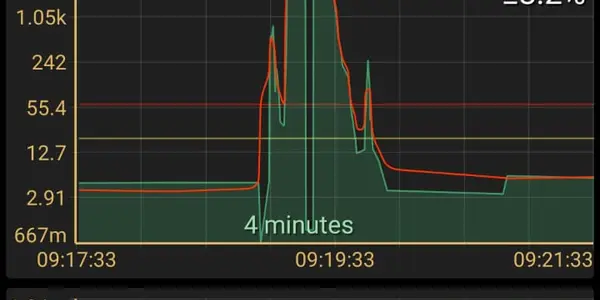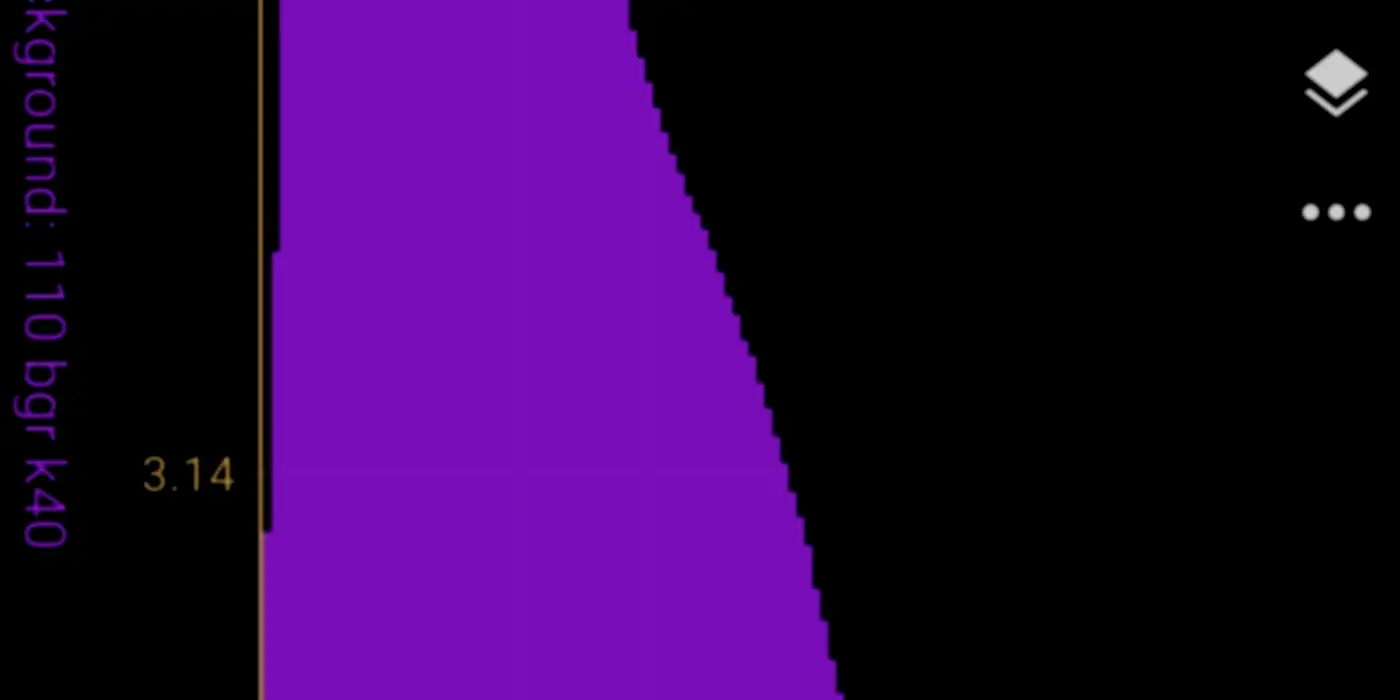
More on Radiacode 110
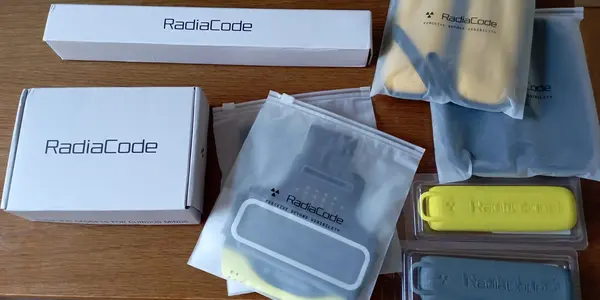
This is the second post reporting a few tests of the Radiacode 110 spectrometer, an extra-cool pocket dosimeter/radiation counter/spectrograph sold by RadiaCode.
This is the second post reporting a few tests of the Radiacode 110 spectrometer, an extra-cool pocket dosimeter/radiation counter/spectrograph sold by RadiaCode.


Expectations are rising for the 2016 run of the Large Hadron Collider. The machine has restarted colliding protons in the cores of ATLAS and CMS, where finally the reality of the tantalizing 750 GeV diphoton bumps seen by the two experiments in their Run 1 and 2015 data *will* be assessed one way or the other.The flurry of papers discussing possible interpretations of the observed effect, first reported last December during a data jamboree at CERN, has slightly reduced in intensity but is still going rather strong in an absolute sense. Over 300 phenomenological interpretations have been published on the preprint Arxiv (but I wonder how many will end up with a publication on a refereed journal ? Maybe just a handful).

Funny how the internet gives you access to information on your own stuff before you know it. The book I have written, "Anomaly!", is still in production (we have not yet even finalized the book cover), and yet you can even apparently buy a copy already, at the World Scientific site. What is funny is that I discovered the page with the book data by chance, browsing through other books to get inspiration!
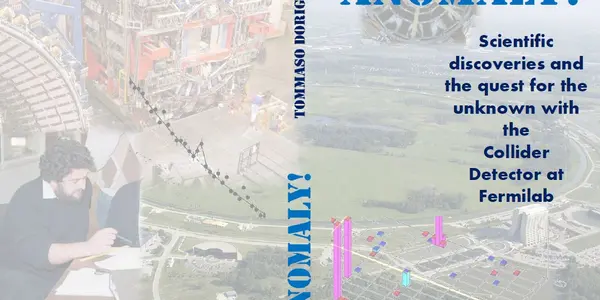
My book "Anomaly! - Collider Physics and the Quest for New Phenomena at Fermilab" is in production at World Scientific, with an expected publication date somewhere in August or September. I have explained what this work is about in previous posts, but maybe what I can do here is to just paste here the few lines of description that have been put together for the back cover:
It's been a while since the last time I talked about myself in this column. I think that a blog must contain personal information to be interesting - otherwise why sticking around, when there's tons of good (yes, also bad) information in the web ? But here you can get some particle physics information mixed in with things that, although you need not know or care about, it's fun to share and comment on. Or at least I hope it's so, for the few of you who read this.
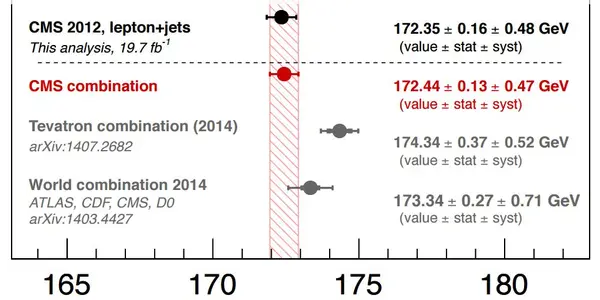
Long-time readers of this blog know that one of the recurrent topics has always been the precision measurement of the top quark mass. The reason for this is at least three-fold. One, I started my career in experimental HEP with searches and measurements of the top quark properties, and the mass was one of the parameters I spent quite some time working on.
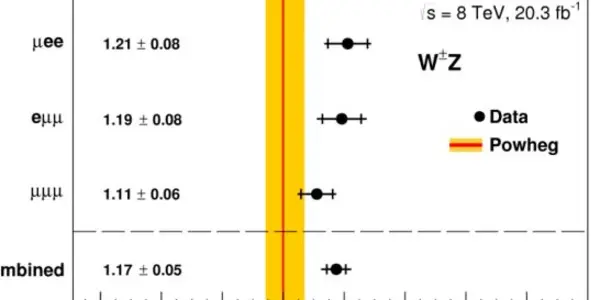
Technically it also creates a diboson final state - two photons - but no, here I am not going to talk about the tentative new particle of which ATLAS and CMS continue to see hints in their data, at a mass of 750 GeV and with characteristics that increasingly resemble those of a heavy higgs boson. Oh, see - I am doing precisely that. It is admittedly hard not to speak of that thing nowadays, but I will insist, as I think it is too good to be true, and so it must be false.
UPDATE: Tiziano tells me that he has been misquoted by the Guardian - he was quoting himself a colleague when he mentioned the 20:1 bet. Sorry to say this bet is not on, at least until the person who offered the bet in the first place will manifest him- or herself....I bet most of you, who are interested in Physics, know what I mean when I talk about "the 750 GeV particle". Last December, the ATLAS and CMS experiments released information about a tantalizing hint of a new particle with a mass in the 750 GeV ballpark. The resonance was seen in the decay to pairs of energetic photons. Since both experiments see more or less the same thing, this may be a fluctuation, but if it is, it is a really rare one.
I think it is due time that I point out a few interesting articles that have appeared in the past couple of months in the blog of the AMVA4NewPhysics network, a consortium of 16 among universities, research institutes, and industries that has the goal of studying Higgs physics and new Physics with the LHC, using advanced statistical learning methods.
The issue is not new. Scientific journals require articles to produce quantitative answers - of course, that's how you do science. And scientists usually rely on a formalism based on classical statistics to report those results: they report the probability of their data given some hypothesis. P-values, that is.
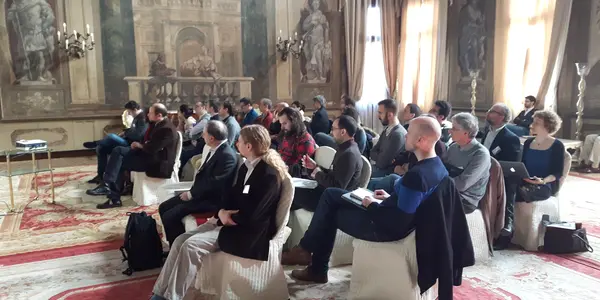
On March 3rd and 4th the AMVA4NewPhysics network met in Venice, in the beautiful venue of Ca' Sagredo. Ca' Sagredo is a 500-year-old palace on the Canal Grande, home of the Sagredo family and in the 600s of Giambattista Sagredo, who hosted many times Galileo Galilei there. As for the AMVA4NewPhysics network, it is a "Innovative Training Network" of 16 research institutes, universities and industries that have joined forces to train young scientists in particle physics and the development of advanced multivariate-analysis tools.
How many phenomenological papers discussing the 750 GeV diphoton resonance have you read since December 15th 2015 ? I believe that having read none of them, or ten, does not make a big difference - you missed most of them anyways. In fact, I think the count has gone past 200 by now.
Do you know what a lucid dream is ? It is the experience of being aware of your asleep state during a dream. Lucid dreaming occurs during the REM phase of sleep, and it is usually created when, while dreaming, one suddenly realizes his or her dreaming state. The dream may then continue, but the individual has some degree of control over what happens. Laws of physics continue to not apply, of course, and one has the power of "writing the script", to some extent. In a sense, one's desires are the driver of the script.