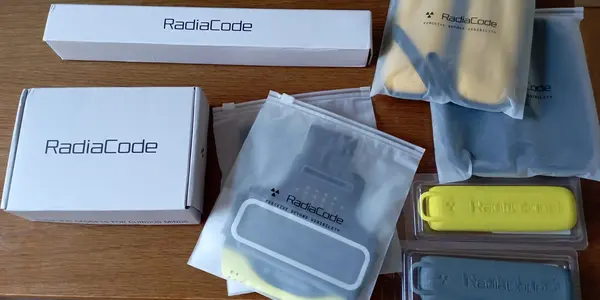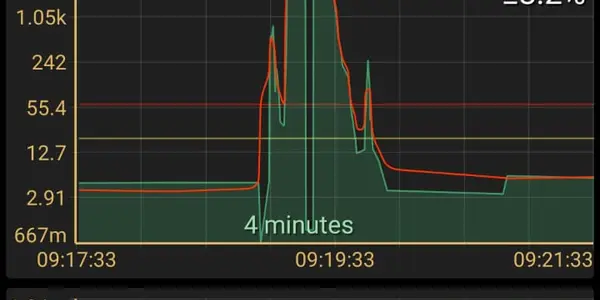
More on Radiacode 110
This is the second post reporting a few tests of the Radiacode 110 spectrometer, an extra-cool pocket dosimeter/radiation counter/spectrograph sold by RadiaCode.
This is the second post reporting a few tests of the Radiacode 110 spectrometer, an extra-cool pocket dosimeter/radiation counter/spectrograph sold by RadiaCode.

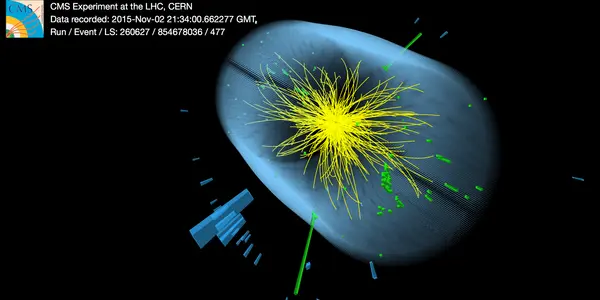
[The article below is courtesy Eilam Gross. Eilam is a physicist from the ATLAS experiment and has been convener of the Higgs group there. I am very happy to host a guest post from him on the exciting topic below...]
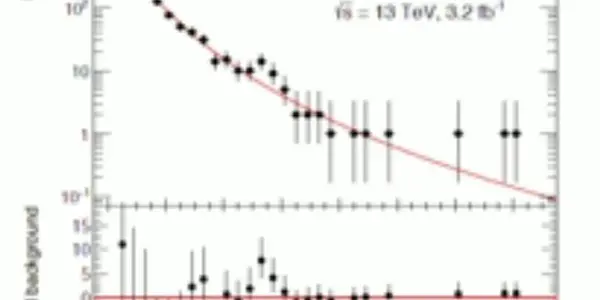
Marumi Kado started his talk by saying he will only present new results based on the full 2015 13 TeV pp collision dataset.For Run 2 there have been a large number of improvements to the detector.Also the trigger has been improved, with a new central trigger processor. Reconstruction software also was improved significantly. Marumi spent a long time describing the retuning of the detector and the performance in reconstruction of impact parameters, physics objects, and the like. The physics modellinghas been verified in several control samples of dibosons, top pairs, etcetera.Marumi shows that the Higgs signals in ATLAS are wanting. 0.7 sigma observed in 4-lepton mode, expected 2.8 sigma. Similar story in diphotons.

Jim Olsen is giving the CMS talk on 13 TeV results. CMS recorded 90% of the 4 inverse femtobarns delivered by the LHC, but only 2.8/fb were taken with the magnet at 3.8 Tesla (for the rest of the time the magnet was off due to a problem with the helium purity).A plot of the dimuon invariant mass of 60,000,000 events collected by dimuon triggers was shown, which is a pleasure to watch. I will attach it here later.CMS has 18 new searches for beyond-the-standard model effects. For objects with masses above 1 TeV the sensitivity of 2.2/fb of analyzed data may be larger than the sensitivity of 2012 data.The diboson bump at 2 TeV is almost completely ruled out; so is the edge signal of SUSY that was seen in run 1 (a 2.6 sigma excess back then).
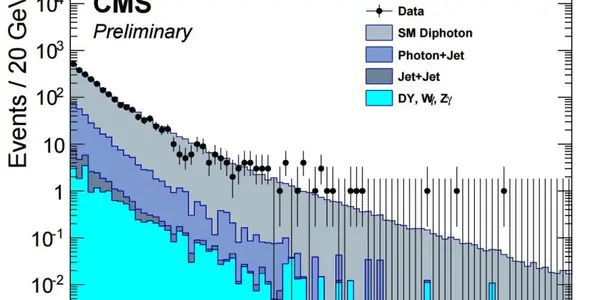
As most of you already know, today at 3PM two back-to-back talks by Jim Olsen (CMS) and Marumi Kado (ATLAS) at CERN will disclose the latest results of physics analyses performed on 13 TeV proton-proton collisions recorded this year by the two experiments. (To follow the talks see here).
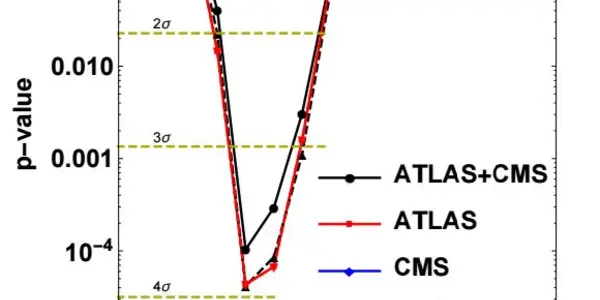
Tomorrow at 2PM two back-to-back talks by Jim Olsen and Marumi Kado at CERN will disclose the newest results of the CMS and ATLAS experiments, which will be based on the analysis of 2.5 to 4 inverse femtobarns of 13 TeV proton-proton collisions acquired by the experiments this year.Why should you be interested ? Of course, because the year could end with a boom! Maybe the experiments have found evidence for something totally unexpected in their data. After all, 13 TeV is 63% more energy than 8 TeV.
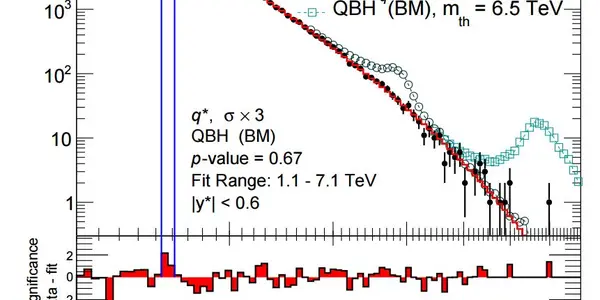
This week's graph is a reminder that particle physicists are, deep in their bones, bump hunters. Sure, some of my colleagues could best be described as detector builders; others as software wizards; still others as statistical gurus. But what excites us the most is to go hunting for a bump in a mass histogram.
Have you recently obtained a Masters degree in a scientific discipline ? Are you fascinated by particle physics ? Do you have an interest in Machine Learning developments, artificial intelligence, and all that ? Or are you just well versed in Statistical Analysis ? Do you want to be paid twice as much as I am for attending a PhD ? If the above applies to you, you are certainly advised to read on.
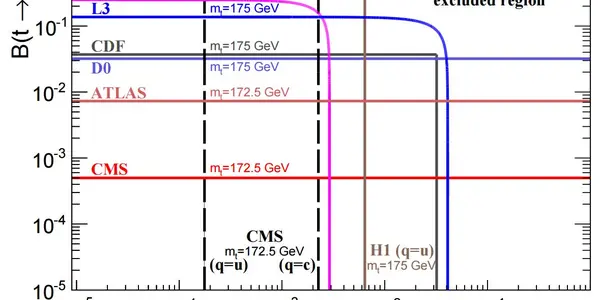
As an editor of the new Elsevier journal "Reviews in Physics" I am quite proud to see that the first submissions of review articles are reaching publication stage. Four such articles are going to be published in the course of the next couple of months, and more are due shortly thereafter.
While in the process of fact-checking information that is contained in the book I am finalizing, I had the pleasure to have a short discussion with Gordon Kane during the weekend. A Victor Weisskopf distinguished professor at the University of Michigan as well as a director emeritus of the Michigan Center for Theoretical Physics, Gordon is one of the fathers of Supersymmetry, and has devoted the last three decades to its study.
I was very happy today to sign a contract with an international publisher that will publish a book I have written. The book, titled "Anomaly! - Scientific Discoveries and the Quest for the Unknown", focuses on the CDF experiment, a particle detector that operated at the Tevatron collider for 30 years. The Tevatron was the highest-energy collider until the turn-on of the LHC. The CDF and DZERO experiments there discovered the sixth quark, the top, and produced a large number of world-class results in particle physics.
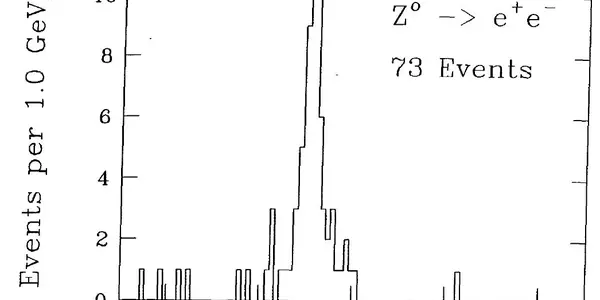
As I am revising the book I am writing on the history of the CDF experiment, I have bits and pieces of text that I decided to remove, but which retain some interest for some reason. Below I offer a clip which discusses the measurement of the natural width of the Z boson produced by CDF with Run 0 data in 1989. The natural width of a particle is a measurement of how undetermined is its rest mass, due to the very fast decay. The Z boson is in fact the shortest lived particle we know, and its width is of 2.5 GeV.
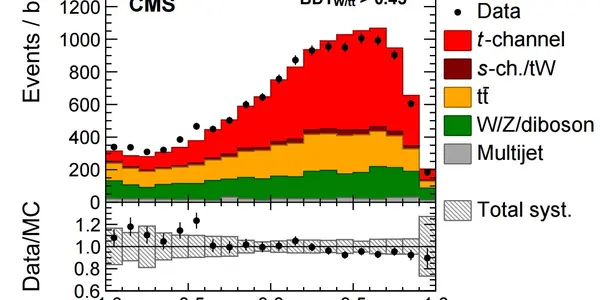
Top quarks, the heaviest known elementary particles, were discovered in 1995 by the CDF and DZERO collaborations, when the two Fermilab experiments spotted the decay of top-antitop pairs produced by strong interactions in the proton-antiproton collisions provided by the Tevatron collider at 1.8 TeV center-of-mass energy.