More on Radiacode 110
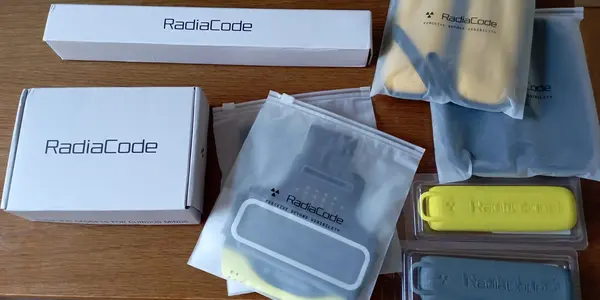
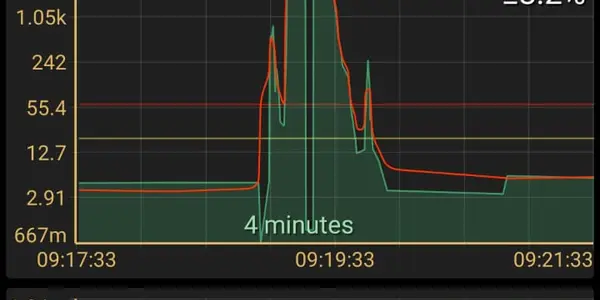
This is the second post reporting a few tests of the Radiacode 110 spectrometer, an extra-cool pocket dosimeter/radiation counter/spectrograph sold by RadiaCode.
This is the second post reporting a few tests of the Radiacode 110 spectrometer, an extra-cool pocket dosimeter/radiation counter/spectrograph sold by RadiaCode.


Yesterday I posed a question - Are the first collisions recorded by the LHC running at 13 TeV the highest-energy ever produced by mankind with subatomic particles ? It was a tricky one, as usual, meant to think about the matter.I received several tentative answer in the comments thread, and thus answered there. I paste the text here as it is of some interest to some of you and I wish it does not go overlooked.---Dear all,

The LHC has finally started to produce 13-TeV proton-proton collisions! The picture below shows one such collision, as recorded by the CMS experiment today. The blue boxes show the energy recorded in the calorimeter, which measures particle energy by "destroying" them as they interact with the dense layers of matter that this device is made up of; the yellow curves show tracks reconstructed by the ionization deposits of charged particles left in the silicon detector layers of the inner tracker.
The European Union has released some data on the latest call for applications for ITN grants. These are "training networks" where academic and non-academic institutions pool up to provide innovative training to doctoral students, in the meanting producing excellent research outputs.
I spent the last weekend in Berlin, attending a conference for editors organized by Elsevier. And I learnt quite a bit during two very busy days. As a newbie - I am handling editor for the journal "Reviews in Physics" since January this year - I did expect to learn a lot from the event; but I will admit that I decided to accept the invitation to attend the event more out of curiosity for a world that is at least in part new to me, rather than out of professional sense of duty.
I am very happy today because I have been notified by the European Community that a project I submitted for funding as coordinator last January has been evaluated very positively by the EU reviewers. The project is a training network of universities and research centres in Europe, with participation of two additional academic partners and four industrial partners from the US, Russia, Italy and Belgium. The network name is "AMVA4NewPhysics", and it aims at developing and applying cutting-edge statistical learning tools to new physics and Englert-Higgs boson studies to the LHC data collected by ATLAS and CMS.

As yesterday in Italy was the equivalent of Labor Day, and today is a Saturday, with people around me exploiting the three-day rest for a recreational trip, I do not feel in a very productive mood, so rather than writing something original here I will exploit other people's work, pointing at what I found interesting or anyway worth my attention among the papers appeared on the Cornell Arxiv in the last few days, and other assorted material.

I am presently in Athens for a few days, to give a seminar and meet the local group of CMS physicists. So I took the chance to visit yesterday evening the Astrophysics department of the University of Athens, where at the top floor is housed a nice 40cm Cassegrain telescope (see picture below). There I joined a small crowd which professor Kosmas Gazeas entertained with views of Jupiter, the Moon, Venus, and a few other celestial targets. I need to thank my friend Nadia, a fellow physicist and amateur astronomer, for inviting us to the event.

Besides being a giant triumph of theoretical physics and the definitive seal on the correctness of the Standard Model -at least at the energies at which we are capable of investigating particle physics nowadays-, the 2012 discovery of the Higgs boson by the CMS and ATLAS collaborations opens the way to new searches of new physics. The Higgs boson is one more particle we know how to identify now, so we can now focus on new exotic phenomena that might produce Higgs bosons in the final state, and entertain ourselves in their search.

"The era of the atom" is a new book by Piero Martin and Alessandra Viola - for now the book is only printed in Italian (by Il Mulino), but I hope it will soon be translated in English.

It is galaxy season in the northern hemisphere, with Ursa Mayor at the zenith during the night and the Virgo cluster as high as it gets. And if you have ever put your eye on the eyepiece of a large telescope aimed at a far galaxy, you will agree it is quite an experience: you get to see light that traveled for tens or even hundreds of millions of years before reaching your pupil, crossing sizable portions of the universe to make a quite improbable rendez-vous with your photoreceptors.

Particle physics is so cool - you get to build huge detectors with a specific goal clearly stated in your letter of intents and technical proposals, but are then allowed to use them to study many other things.