More on Radiacode 110
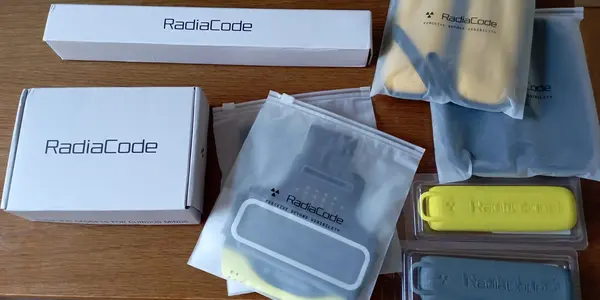
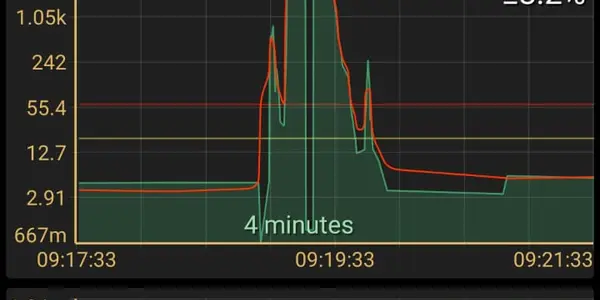
This is the second post reporting a few tests of the Radiacode 110 spectrometer, an extra-cool pocket dosimeter/radiation counter/spectrograph sold by RadiaCode.
This is the second post reporting a few tests of the Radiacode 110 spectrometer, an extra-cool pocket dosimeter/radiation counter/spectrograph sold by RadiaCode.

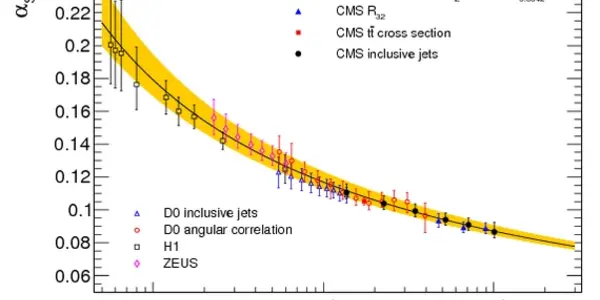
The Large Hadron Collider at the CERN laboratories in Geneva is currently in shutdown, finalizing the upgrades that will allow it to restart next year at the centre-of-mass energy of 13 TeV - over 60% more than the last 8 TeV run. ATLAS and CMS have collected no more proton-proton collisions since almost two years ago; yet the collaborations are as busy as ever producing physics results from the analysis of the 2012 data.Rather than focusing on any single result, below I give some highlights of the most recent publications by CMS. Another post will discuss ATLAS results in a few days.

I am spending a few days in Aix Les Bains, a pleasant lakeside resort in the French southwest, to follow the works of the second ECFA workshop,
titled "High-Luminosity LHC". ECFA stands for "European Committee for
Future Accelerators" but this particular workshop is indeed centred on
the future of the LHC, despite the fact that there are at present at
least half a dozen international efforts toward the design of more
powerful hadron colliders, more precise linear electron-positron
colliders, or still other solutions.
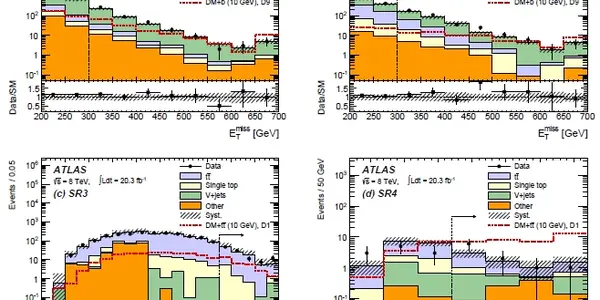
Yesterday the ATLAS collaboration published the results of a new search for dark matter particles produced in association with heavy quarks by proton-proton collisions at the CERN Large Hadron Collider. Not seeing a signal, ATLAS produced very tight upper limits on the cross section for interactions of the tentative dark matter particle with nucleons, which is the common quantity on which dark matter search results are reported. The cross section is in fact directly proportional to the rate at which one would expact to see the hypothetical particle scatter off ordinary matter, which is what one directly looks for in many of today's dark matte search experiments.

Do you remember the E-Cat ? That is an acronym for "energy catalyzer", the device invented by the Italian philosopher Andrea Rossi. The E-Cat is claimed to produce nuclear energy through the heating of a "secret" powder made up of nichel, hydrogen, and lithium plus some additives. A new chapter was added to the saga of the E-Cat this week, with the publication of a new study by an allegedly independent group of Italian and Swedish researchers.
"Fermilab has very actively tried to scoop us by press release, even though their uncertainties are under serious challenge and they knew our measurements even before they released theirs."Michael Riordan, a member to the Mark II collaboration, in an interview by David Perlman on the San Francisco Chronicle, July 21st 1989
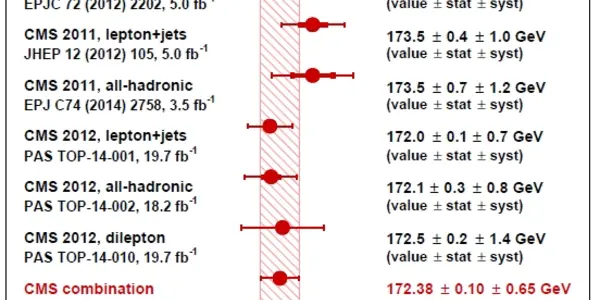
I wonder how interesting can be to an outsider to learn that the mass of the sixth quark is now known to 0.38% accuracy, thanks to the combination of measurements of that quantity performed by the CMS experiment at CERN. In fact, the previously best measurement was the one recently published by the DZERO collaboration at Fermilab, which has a relative 0.43% accuracy. "So what" - you might say - "this 14% improvement does not change my life". That's undeniably true.
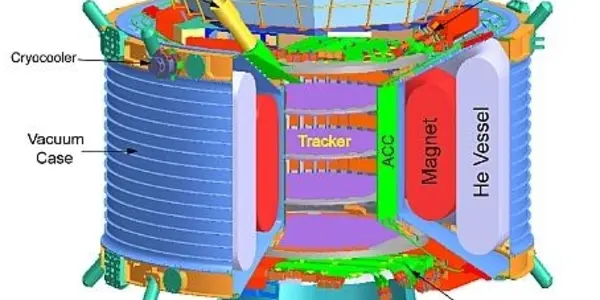
Last Friday Samuel Ting, the winner of the 1975 Nobel prize in Physics for the co-discovery of the J/ψ particle, gave a seminar in the packed CERN main auditorium on the latest results from AMS, the Alpha Magnetic Spectrometer installed on the international space station.
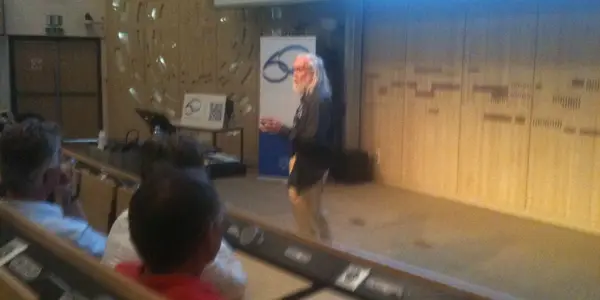
Being at CERN for a couple of weeks, I could not refrain from following yesterday's talks in the Main Auditorium, which celebrated the 90th birthday of Herwig Schopper, who directed CERN in the crucial years of the LEP construction.A talk I found most enjoyable was John Ellis'. He gave an overview of the historical context preceding the decision to build LEP, and then a summary of the incredible bounty of knowledge that the machine produced in the 1990s.
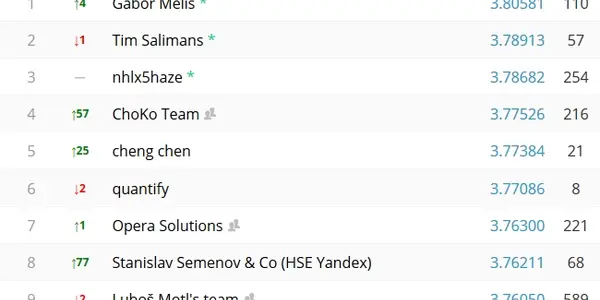
After four months of frenzy by over 1500 teams, the very successful Higgs Challenge launched by the ATLAS collaboration ended yesterday, and the "private leaderboard" with the final standings has been revealed. You can see the top 20 scorers below.
I just read with interest the new paper on the arxiv by my INFN-Padova colleague Massimo Passera and collaborators, titled "Limiting Two-Higgs Doublet Models", and I thought I would explain to you here why I consider it very interesting and what are its conclusions.
One year ago I had the pleasure to spend some time with George Zweig during a conference in Crete (ICNFP 2013). He is a wonderful storyteller and a great chap to hung around with, and I had great fun in the after-dinners on the terrace of the Orthodox Academy of Crete overlooking the Aegean sea, drinking raki and chatting about physics and other subjects.
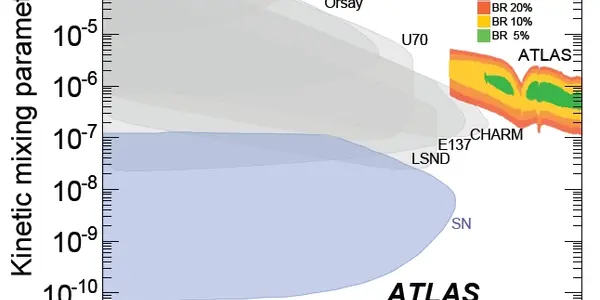
Among the viable extensions of the standard model, an intriguing class of models involve the concept of a "hidden sector" of new particles only weakly coupled to the standard model one. These particles could be produced in the decay of heavy standard model particles, be invisible, but unstable, and thus soon decay back into standard model bodies, giving funny experimental signatures that our detectors could spot -if we looked for them carefully enough.