More on Radiacode 110
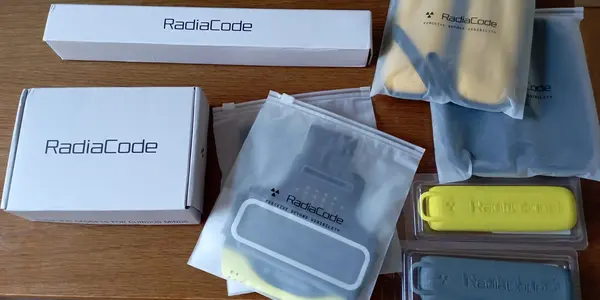
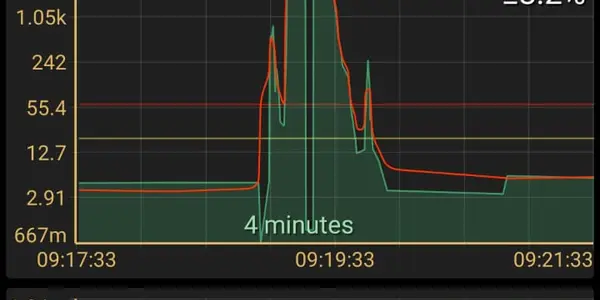
This is the second post reporting a few tests of the Radiacode 110 spectrometer, an extra-cool pocket dosimeter/radiation counter/spectrograph sold by RadiaCode.
This is the second post reporting a few tests of the Radiacode 110 spectrometer, an extra-cool pocket dosimeter/radiation counter/spectrograph sold by RadiaCode.

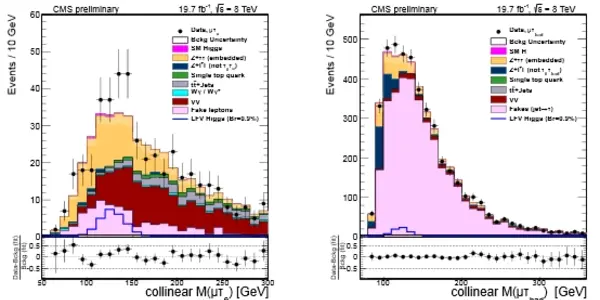
Two years have passed since the discovery of the Higgs boson (on July 4th, 2012), and the young particle still causes excitement. Originally it was the excess of Higgs decays to photon pairs as seen by the ATLAS experiment - but that anomaly has vanished with more data and more careful analyses. Then, it was the turn of the twin peaks: ATLAS again saw an inconsistent mass measurement with photon pairs and Z boson pairs.
Among the many more-or-less boring news from the ICHEP conference (International Conference on High Energy Physics), which is presently going on in Valencia (Spain), one bit today is sending good vibrations through the spine of many of the few phenomenologists who have chosen to remain faithful to the idea of Supersymmetry all the way to the bitter end. It is the excess of diboson events that ATLAS has just reported there.

A couple of weeks ago I reported here about the new measurement of the Higgs boson mass produced by the ATLAS experiment. That determination, which used the full dataset of Run 1 proton-proton collisions produced by the LHC in 2011-2012, became and remained for two weeks the most precise one of the Higgs mass. Alas, as I wrote the piece I already knew that CMS was going to beat that result very soon, but of course I could not say anything about it... It ached a bit!
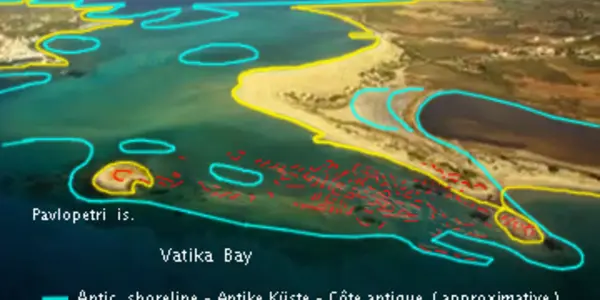
Forty-eight centuries ago, a bronze-age settlement flourished on the southern coast of Peloponnese, about 30 miles south of what would two thousand years later become the important town of Sparta. The city had a harbour facing east on calm waters, and had a few dozen buildings, roads, a burial site, and probably more. We do not know its ancient name, so the place has been called with the name of the modern-times place, Pavlopetri.

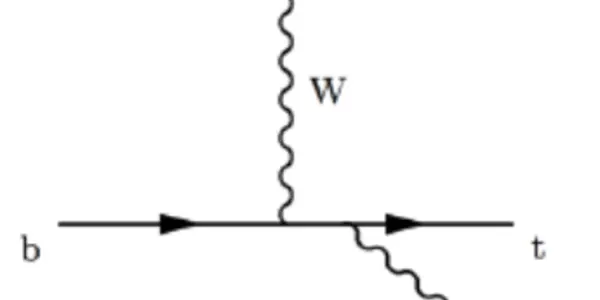
Do you remember the top quark asymmetry measurements of CDF and DZERO ? A few years ago they caused quite some excitement, as both experiments were observing a departure from standard model expectations. This could really be the place where one would first observe new physics associated with top quark production, so the analyses triggered quite some theoretical investigations, deeper studies, and model building.

When I was five years old I used to be sort of an attraction to relatives. One of my mother's brothers is an engineer, and he was amazed by my ability to do complex calculations by heart. But to me it was only amusing to observe their amazement for what I considered a triviality.On one occasion - I remember it as it was yesterday - my uncle picked me up and while he kept me with his arms he asked me "Ok, let's see this. Tommaso, what is the square root of 5968?". Mind you, I do not remember the exact number; I only recall it was between 5000 and 7000. I watched up into the void for two seconds, and I replied "77.3". Uncle Ciccio put me down and ran for the pocket calculator - he did have one, although they were a real novelty those years.
The Cornell arxiv is known to not accept preprints without a minimal screening of their contents. Still, I am sometimes led to wonder if a similar attention is paid to the liberty that authors at times take with the titles of their papers. I am officially on vacation since yesterday, so you should not expect the list below to be a very comprehensive one. I just offer four examples of titles that might have been considered for some form of moral suasion toward the author by the arxiv managers, but apparently haven't. I just quote some titles below which struck me as kind of odd.
The muon is a remarkable particle, and its characteristics continue to be of interest eighty years after its discovery despite the fact that we have measured them better than almost anything else around. So, for instance, the muon lifetime is known to better accuracy than that of any other unstable particle; and the muon anomalous magnetic moment remains at the top of our list of things to determine more precisely nowadays.

One and a half years ago ATLAS produced measurements for the Higgs boson mass using their selected sample of H->gamma gamma and H->ZZ*-> 4-lepton decay candidates, based on data collected in 2011 and 2012. That preliminary measurement was rather surprising as the two independent determinations appeared to disagree with one another at the 2.5-sigma level. The matter even spurred some online debate (see e.g. my blog entry) and a few gambling addicts waged $100 on the fact that those might be two distinct particle states.

With still three months to go and 663 teams participating, the Higgs challenge has not even entered a hot phase yet, and still there is a lot to watch in the leaderboard at the kaggle site.In the last few days, there has been a total revolution in the leading position, and a considerable increase in the best scores. And Lubos Motl is again third (and he would be first if there had been no movement in the other positions), implicitly answering some detractors who wrote comments in a previous post on the matter here. See the standings below.
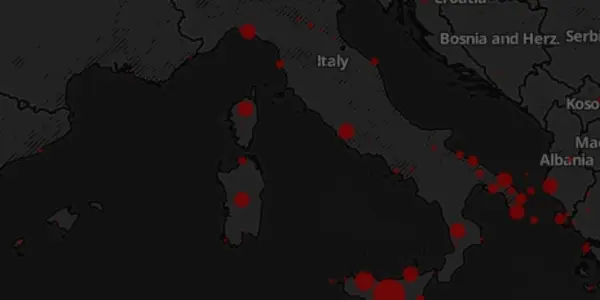
On my first day at the Erice School of Science Journalism this past week I attended a lecture by Alessio Cimarelli, who discussed "When Data Journalism meets Science: a "Hackathon"". The speaker (who owns the site called "dataninja") showed several examples of how to mine the web to construct databases and display results on several topics. It was quite interesting to see the techniques he used, but I felt compelled to interrupt him at some point, in the interest of the school participants.

I have spent the last few days at a School of Science Journalism in the pleasant town of Erice, in western Sicily. The school, held at the Ettore Majorana Centre for Scientific Culture, brought together science communicators, freelance writers, magazine editors and press office consultants to listen to a small set of lectures, which this year (the fifth of the school) centered on the topic of "the digital world".