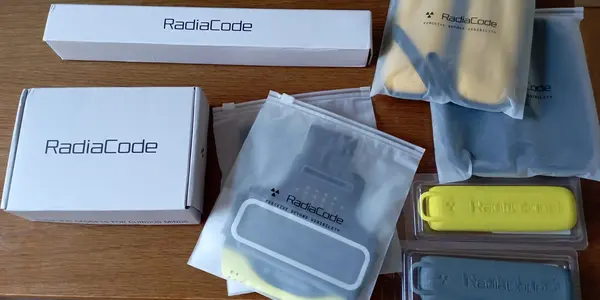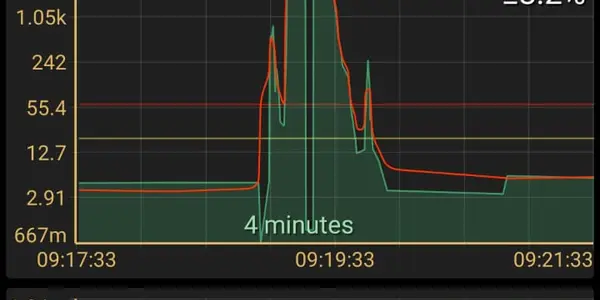
More on Radiacode 110
This is the second post reporting a few tests of the Radiacode 110 spectrometer, an extra-cool pocket dosimeter/radiation counter/spectrograph sold by RadiaCode.
This is the second post reporting a few tests of the Radiacode 110 spectrometer, an extra-cool pocket dosimeter/radiation counter/spectrograph sold by RadiaCode.


The ATLAS collaboration at the Large Hadron Collider, CERN's 8-TeV proton-proton collider now being recommissioned to run at the close-to-design energy of 13 TeV in 2015, has published a few days ago on the Cornell ArXiv the result of a search for Higgs bosons decaying to Zγ pairs.

A new paper by Davison Soper and Michael Spannowsky has been sent to the Cornell preprint ArXiv last week. It proposes a new technique to reconstruct the decay of heavy particles within hadronic jets, and shows how this can improve the sensitivity to heavy new particles by studying in particular the case of a heavy Z' boson decaying to boosted top quark pairs. I believe the technique is very interesting and I will try to give a few impressions of it here; before I do, let me introduce the topic for outsiders.

On January 25th 1996 the CDF collaboration submitted for publication to Physical Review Letters the result of their measurement of the rate of jet production as a function of jet transverse energy, performed on 20 inverse picobarns of data collected by the experiment in the 1992-93 run of the Tevatron collider. That measurement deviated at its high-energy tail from predictions of quantum chromodynamics, suggesting that the underlying model -and most likely, the parton distribution functions (PDF) which describe the probability of finding partons with given fractions of their parent momentum- was at fault.

Black holes are all the rage these days, with theorists arguing about firewalls and Hawking's paper being handled by the press in rather improper ways. Meanwhile at the Large Hadron Collider ATLAS and CMS are furthering their searches for microscopic versions of the same objects, which could exist if the energy scale at which quantum gravity effects make themselves felt is orders of magnitude smaller than the place where they ought to be -i.e., at the Planck energy.

I received yesterday a copy of the brand-new book by Ilya Narsky and Frank Porter, "Statistical Analysis Techniques in Particle Physics" (Wiley-vch 2014), and I would like to offer here my impressions and thoughts on the material.

Chapter 10 of the report on the 2013 community summer study held at Snowmass, titled "Communication, Education, and Outreach" is available since Jan 24th in the Cornell ArXiv. It is a 26-pages document describing the importance of outreach activities to foster the development of particle physics, and offering ideas and strategies to improve the communication between scientists and policy makers. This is none other than the problem I have often referred to as the one of "filling the gap" between science and the general media.

Tetraquarks are hypothetical particles made up by four quarks (two quarks and two antiquarks). Unlike mesons (quark-antiquark pairs) and baryons (three-quark or three-antiquark systems), the quarks in a tetraquark are quite loosely bound within their confinement volume by strong interactions, as can be calculated with the help of quantum chromodynamics. Their tendence to separate into two quark-antiquark systems should yield a very short lifetime, making their observation quite difficult. However, some tentative evidence for their existence exists.
In a guest post written three years ago Giorgio Chiarelli told us the story of how the CDF detector saw its first proton-antiproton collisions, during the night of October 13th 1985. It was a very important moment for the history of the collaboration, the start of a data collection campaign that would last over a quarter of a century. Below I wish to tell you the story of one of the worst radiological incidents in the history of the experiment, which happened a few months after those first collisions were recorded.---

The DZERO experiment is one of the two multi-purpose detectors that have collected 1.96 TeV proton-antiproton collisions at the Fermilab Tevatron collider until two years ago, when the machine was decommissioned. Experiments of this kind out-live the demise of the hardware, since the extraction of precise physics measurements from the large datasets accumulated may take several years to complete. And in fact, it is not a surprise to see two new preprints in the Arxiv (here and here) which describe in detail the experimental techniques that the collaboration uses to extract jet physics results from the data.
In 1989 the CDF experiment was sitting on its first precious bounty of proton-antiproton collisions, delivered by the Tevatron collider at the unprecedented energy of 1.8 TeV. One of the first measurements that was produced was the measurement of the mass of the Z boson, which was at the time known with scarce precision by the analysis of a handful of candidates produced by the CERN SppS collider, at a third of the Tevatron energy.

No, this is not an article about top models. Rather, the subject of discussion are models that predict the existence of heavy partners of the top quark.
Last Tuesday I was in Mantova, a pleasant little town in northern Italy, rich of monuments and treasures like the Palazzo Ducale, which hosts a vast collection of paintings and frescoes from reinassance artists. But I was not there for a private visit; I was in fact invited to comment and provide answers to questions that the audience of a movie, "The Hunt for the Higgs", were invited to ask after seeing it. The host of the event was the "Cinema del Carbone", a small movie theater near the center of the town. The organizers called me there because they knew me from my previous participation to last years' Festivaletteratura, a literature festival which takes place yearly in September, where authors of books and other media get in touch with their public.