More on Radiacode 110
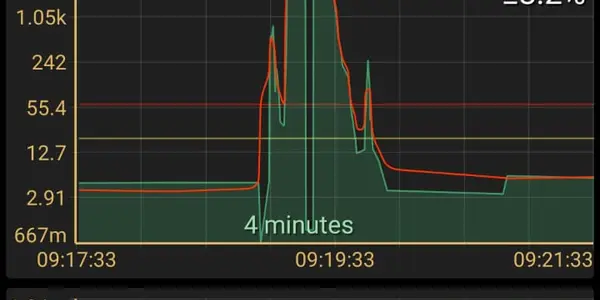
This is the second post reporting a few tests of the Radiacode 110 spectrometer, an extra-cool pocket dosimeter/radiation counter/spectrograph sold by RadiaCode.
This is the second post reporting a few tests of the Radiacode 110 spectrometer, an extra-cool pocket dosimeter/radiation counter/spectrograph sold by RadiaCode.


Note: this is the third part of a four-part article on the Five-Sigma criterion in particle physics. See part 1 and part 2 to make more sense of the discussion below.

In the previous installment of this longish article, I have introduced some of the issues that may affect the correct interpretation of a statistically significant effect.
A pre-emptive warning to the reader: the article below is too long to publish as a single post. I have broken it out in four installments. After reading the text below you should continue with part II, part III, and part IV (which includes a summary).
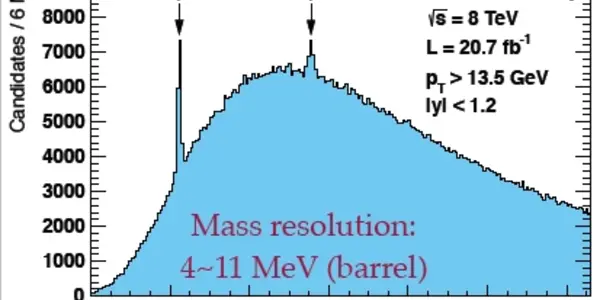
Do you remember the X(3872) ? This is a hadron containing charm and anticharm quarks, which was observed to decay into a J/Psi meson, a positive, and a negative pion. When it was discovered, by the Belle experiment in 2003, the X caused a lot of interest among spectroscopists, because it is an "exotic" charmonium state: its nature is not totally clear, as it might be interpreted as a "molecule" of two charmed mesons loosely bound together. Or maybe a four-quark system ? Or just conventional charmonium, a bit at odds with the expected set of spin-parity states but otherwise just a honest meson ?
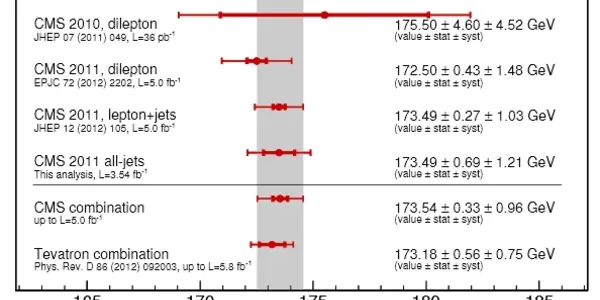
In the past few weeks the Tevatron and LHC experiments have updated their results on some of the most important Standard Model parameters. Of these, notably the top quark mass is one where the Tevatron is still doing slightly better than the LHC, due to the longer running time of the CDF and DZERO experiments, which allowed for a more precise calibration of the jet energy scale - the largest systematic uncertainty in this kind of business.
I have updated you on the matter tangentially in the previous two posts, where I discussed the overall compatibility of top and W boson masses with the Standard Model predictions, where the latter depend on the now well-known mass of the Higgs boson. Here instead I want to focus briefly on the top quark mass.
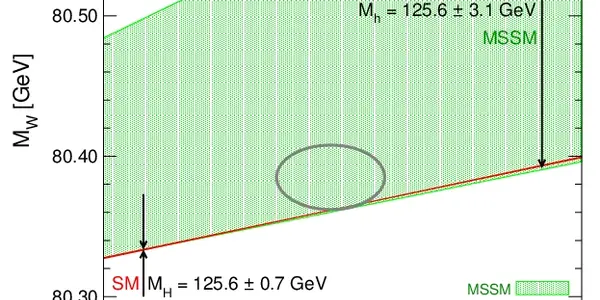
Two days ago I showed how the measurements produced in the course of the last decade have allowed us to "zoom into" the parameter space of the Standard Model, pinpointing the W boson, top quark, and Higgs boson masses to a very narrow 3-D volume of phase space.
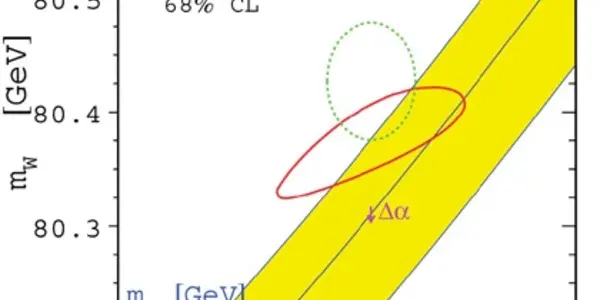
The CDF and DZERO experiments recently produced a combination of their precision measurements of the W boson mass, and proceeded to include the LEP II results to obtain a "world average" of that very important parameter of the Standard Model.The measurement is described in detail in a paper which explains the combination procedure (not trivial, since there are a number of systematic uncertainties that are partly correlated between the experiments). The Tevatron inputs are as follows:CDF Run I (107/pb, 1.8 TeV): M_W = 80432+-79 MeVCDF Run II (2.2/fb, 1.96 TeV): M_W = 80387+-19 MeVDZERO Run I (95/pb, 1.8 TeV): M_W = 80478+-83 MeV
Today I received news of an interesting measurement of angular distributions of the decay products in the rare decay of the B meson to a K* and a muon pair - one of the specialties of the LHCb collaboration, which has more horse-power in some of these low-energy measurements than ATLAS and CMS.
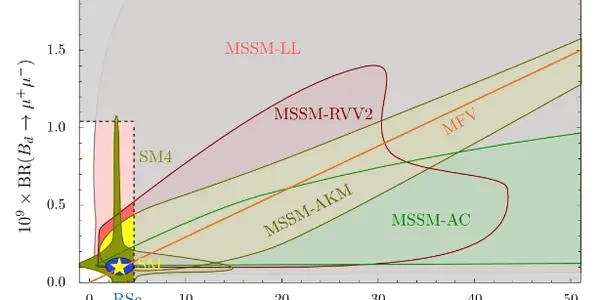
I reported two days ago on the new measurements by the CMS Collaboration of the decay of B hadrons into muon pairs, revealed at the opening of the EPS 2013 conference in Stockholm and in a preprint. Funnily, I wrote the piece oblivious of the LHCb result, which is basically equivalent (in importance, precision, and sensitivity) to the CMS one; when I found out that LHCb had also a comparable result, I made up for that by pointing out the LHCb result in a "UPDATE" at the end of the post - I did not want to rewrite half of the piece!
Today I am quite happy to report of a new groundbreaking result from the CMS collaboration at the CERN LHC - the experiment to which I devote 100% of my research time. We published overnight a report on the Cornell arxiv, and will present this week at the EPS conference in Stockholm, of the observation of B_s meson decays to muon pairs, an exceedingly rare process which is of extreme importance for the searches of new physics beyond the standard model. And in so doing, CMS now leads this race, with better results than LHCb and ATLAS. (UPDATE: but see below, at the bottom of the article).
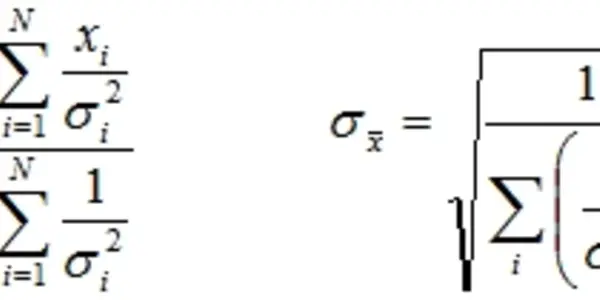
When we want to combine several estimates of a physical quantity, to obtain a more precise one that accounts for all inputs in the correct way, we routinely rely to the weighted average: we take each of the N independent, Gaussian-distributed measurements x_i +- σ_i (i=1,...,N) and compute with them the quantityto which we associate the error shown on the right above. The recipe above is simply the result of applying the method of least squares, or -equivalently- of a likelihood maximization.
When we want to combine several estimates of a physical quantity into a more precise one that accounts for all in the correct way, we routinely rely to the weighted average: we take each of the N independent, Gaussian-distributed measurements x_i +- σ_i (i=1,...,N) and compute with them the quantityto which we associate the error computed asThe recipe above is simply the result of applying the method of least squares, or -equivalently- of a likelihood maximization.