Antonio Rosino, a Life for Chess
It is with quite a bit of sadness that I received this evening the news of the passing of Antonio Rosino.
It is with quite a bit of sadness that I received this evening the news of the passing of Antonio Rosino.


Carlo Rubbia discussed the prospects of constructing a muon collider to produce large amounts of Higgs bosons and study their properties in detail, crucially measuring the natural width of the particle, and testing couplings to a precision that LHC can't arrive at, to verify whether the particle is the Standard Model Higgs or if there are anomalies. The talk is discussed in detail in this report.Here I just recall a question I asked Rubbia after the talk:
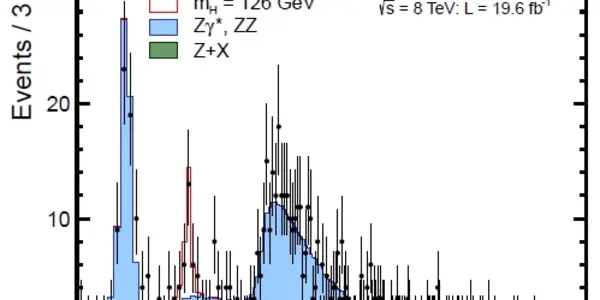
Now that the first of the Moriond conferences is over, and just as the second one starts, it is time to have a detached view at the Higgs boson results presented there this far by the CMS and ATLAS collaborations, to summarize where we stand and what new information we have gained since last fall, when some new results appeared for the HCP conference.
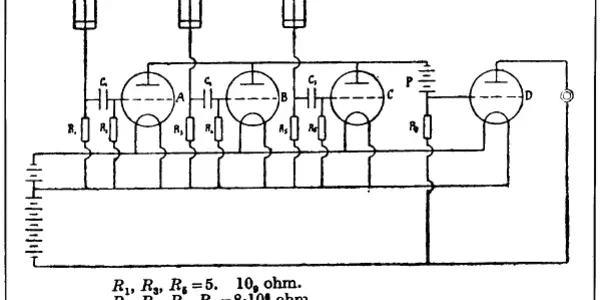
Nel 1929 Bruno Rossi, ricercatore presso l’istituto di fisica sperimentaledell’Università di Firenze [...] intuì quella che sarebbe stata la sua ragione di vita: indagare sulla natura di questi corpuscoli ionizzanti provenienti dall’alto. Doveva realizzare un circuito che permettesse di rivelare e contare le coincidenze che si verificavano in una certa unità di tempo e realizzò uno strumento molto semplice, il circuito a coincidenze.L’involucro dei tubi Geiger è collegato al polo negativo di una batteria da 1200 volt (nondisegnata). La scarica nei tubi genera un impulso di tensione negativa sulle resistenze da
Understanding and explaining how the Universe works has always been a ultimate goal for mankind. It is impossible to live our conscious existence without asking ourselves whether there is a meaning, a design, or if our existence is just the result of chance; and to avoid asking ourselves what happens after we die, if we will live again, and similar questions. Accepting our mortality is really hard without embracing a potential explanation, a hope, or some kind of faith.
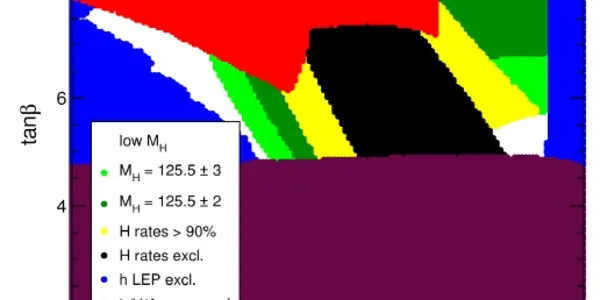
Last week a new important paper appeared in the Arxiv: "MSSM Higgs Boson Searches at the LHC:Benchmark Scenarios after the Discovery of a Higgs-like Particle", by M.Carena, S.Heinemeyer, O. Stal, C.Wagner, and G.Weiglein. The paper fills a void that was created after the discovery of the Higgs particle last July by the ATLAS and CMS experiments: a thorough assessment of what constraints on the allowed chunks of SUSY parameter space in the light of the existence of a neutral scalar at 125 GeV.
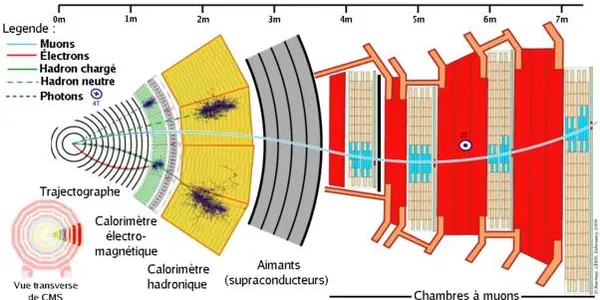
CMS is one of the two huge detectors built to study the high-energy collisions of protons produced by the Large Hadron Collider at CERN. As all previous collider detectors, CMS is a redundant multi-purpose collection of dozens sub-detector components, which use different physics mechanisms to detect everything that comes out of the collision point, from protons to muons to photons, neutrinos (using the energy imbalance in the calorimeters), neutral hadrons.
Today I spent the better part of the afternoon in the company of 150 high-school students at the Liceo Fermi in Padova, giving a seminar on particle physics in the context of a project called "Masterclasses" which has been active since 2005 and is a big success.
The project aims at students in the last years of their high school and attempts to involve them in the experiments undergoing at the CERN laboratories. Sets of lectures on particle physics and cosmology at the schools are followed by a "hands-on" session at the Physics Department, where students are taught and then tested in recognizing heavy particle decays from event displays.
Next Sunday Italians will vote to change the composition of the two houses of parliament: the "lower" Camera dei Deputati and "upper" Senato della Repubblica. And as often happens with Italian politics, things are complicated. So, despite this site is mostly visited for other reasons than trivialities about politics in foreign countries, I thought I would provide here my own short-sighted, biased panorama of the situation.
Every two years physicists and astrophysicists who work in the area of neutrino physics get together in the wonderful setting of Palazzo Franchetti, a historical palace on the Canal Grande in Venice, Italy, to discuss the latest results of experiments and theoretical ideas, and to plan for the future.

Quite some time ago I discussed here the tentative Y(4140) resonance claimed by the CDF collaboration in their Run II data. This was a peak which was found in B-decay data containing a J/Psi signal, a phi meson, and an additional kaon track, and it resulted from the study of the mass difference of the J/Psi + phi signal and the J/Psi alone.Confused ? You have all rights to be. I will explain everything in good order, but be sure that the matter was puzzling not only for laymen but also for insiders: because the find was mysterious, not predicted by existing models, and potentially controversial.B Decays and the CDF Claim

The Omega_b particle is a quite peculiar baryon, made up by three heavy quarks: a b-quark, and two s-quarks. Because of this composition, where only down-type quarks appear, the phenomenology of the decay of this particle is really spectacular: both the b-quark and the strange quarks take quite some time to decay, and as they take shifts to do it the Omega_b first transmutes into a Omega (a particle made up by three s-quarks!), then into a Lambda, and finally into a proton. Each of these decays generates a reconstructable decay point, so one can reconstruct the whole chain perfectly. A sketch will clarify matters - see below.

Nowadays whenever I set out to write about CMS I turn on a self-censorship co-processor in the back of my mind, one which is instructed to check that all the sentences I write are completely free from any possible misinterpretation or slant that may cause some colleagues to complain. Oh, strike that, we're a big family and we all love each other.The topic of today is in fact potentially explosive - how experiments perform their blind searches and the potential bias that results from the detailed procedures they employ. However, you will be disappointed by reading this article if you search for scandal and flame: I am going to explain why CMS does excellent science.