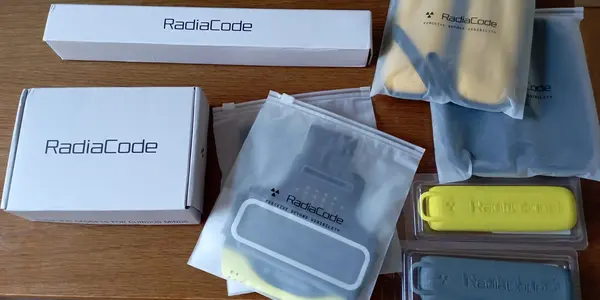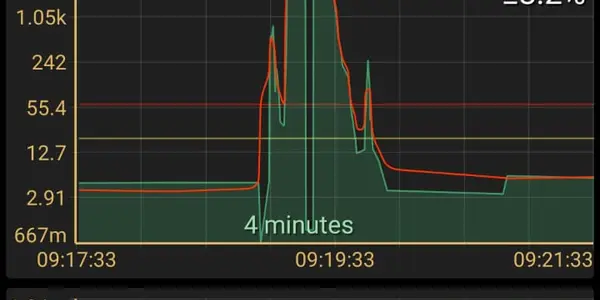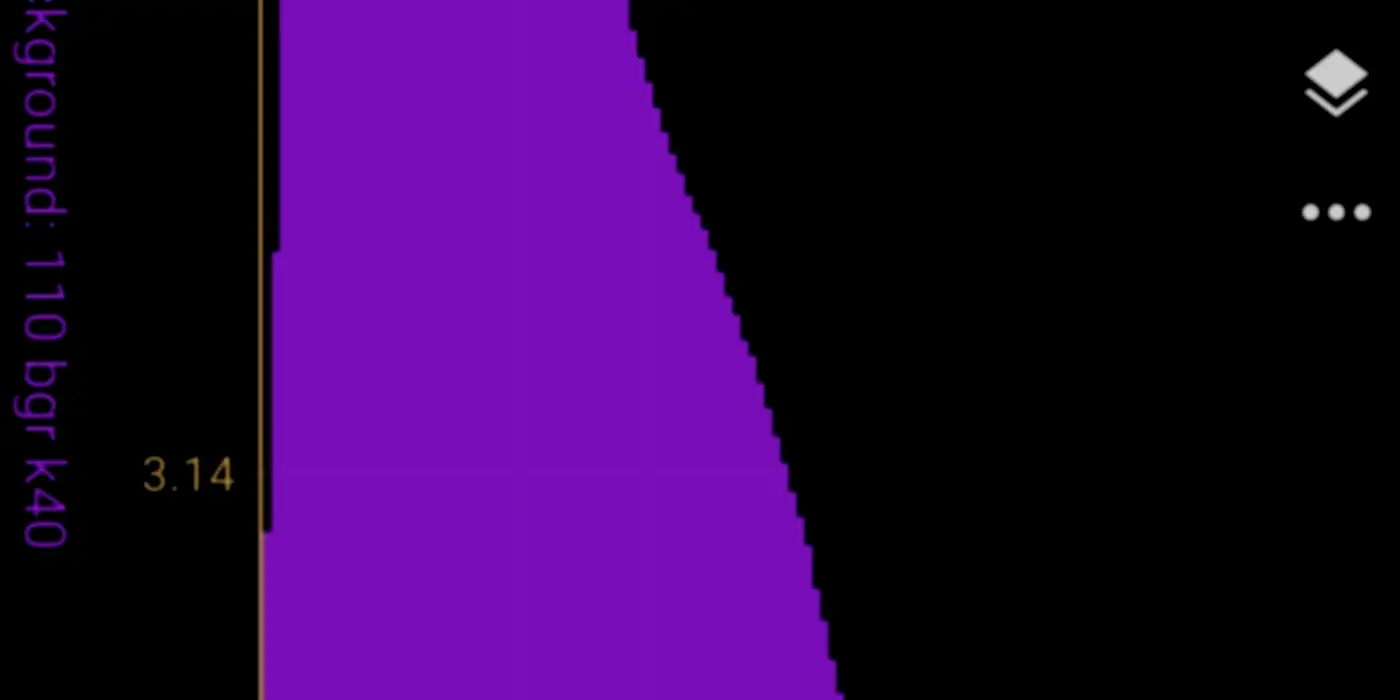
More on Radiacode 110
This is the second post reporting a few tests of the Radiacode 110 spectrometer, an extra-cool pocket dosimeter/radiation counter/spectrograph sold by RadiaCode.
This is the second post reporting a few tests of the Radiacode 110 spectrometer, an extra-cool pocket dosimeter/radiation counter/spectrograph sold by RadiaCode.


The new PDG - a full-size copy of the glorious "Review of Particle Properties"- is on my desk since its arrival a few weeks ago, but only today did I get some time to browse it. It is always awesome to observe how much information is contained in it. It is 1526 pages long, and I wonder how many typos and mistakes are contained in the data-thick pages... Probably much fewer than an ordinary book. Some of the review articles are of exceptionally good quality, because they have been passed from hand to hand in the last few dozen years, and constantly improved. If you want an example, for instance, go to the "Statistics" section - you will find a lot of new material which, along with the old one, still meets the highest standards.

I may have been unattentive to recent papers on Supersymmetry, but I got the impression that during the last few months the majority of SUSY phenomenologists have been keen on speculating on the few apparently non-standard features of the recently discovered Higgs boson, as published last June (such as the alleged copious decay of photon pairs, or the dearth of decays to tau lepton pairs or b-quark pairs - note: all are mostly back to what the standard model predicts, after the analysis of more data following the discovery announcements), but rather improductive on the front of taking the new signal as a pivot point for new global fits.

I just read with interest and awe the nice article appeared today in the arxiv about the search for dark matter annihilation in the sun's core by the Baksan Underground Scintillator Telescope (BUST), a facility operating since December 1978 (!) in the Caucasian valley of Baksan.
I am glad to see that the Higgs signal we have discovered last July continues to raise the interest of well-learned laypersons around the world. The confirmation this time comes from the fact that three readers of this blog have decided to challenge my bet that the two signals found by ATLAS in the gamma-gamma and ZZ decay modes, which presently have a discrepant measured mass, are no hint of two distinct resonances, but rather a systematic effect.

Occasional readers of this blog, I reckon, have time and again been left wondering what is the matter with these lower mass limits on new particles that physicists so copiously produce with their subnuclear physics experiments. How are they determined ? Why always lower mass limits and (almost) never upper limits ? And why do we care ?

It is with some delay that I decide to write about Aldo here. The reason is simply that after a house move I still have not been reconnected to the internet at home, and my absence from work for christmas holidays makes things even harder, and my presence online a sporadic break rather than a constant of motion.
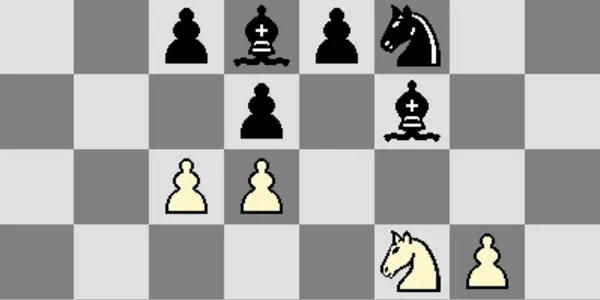
Last week I spent my time playing in a strong chess tournament in Padova. The tournament had 50 participants, among which 11 grandmasters and 10 international masters, and was definitely the strongest event I took part in during my amateur chess career.
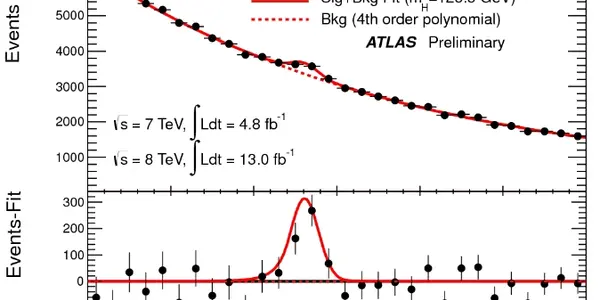
UPDATE: for more on this, I only now realize that my friend at Resonaances had written about it yesterday... It is nice to see that he agrees with my conclusions, anyway. Also Peter has news on it, and as usual additional links...---My ATLAS colleagues will have to pardon me for the slightly sensationalistic title of this article, but indeed the question is one which many inside and outside CERN are asking themselves upon looking into the new public material of ATLAS Higgs boson searches using the 2011 dataset in conjunction with the first part of 2012 data.
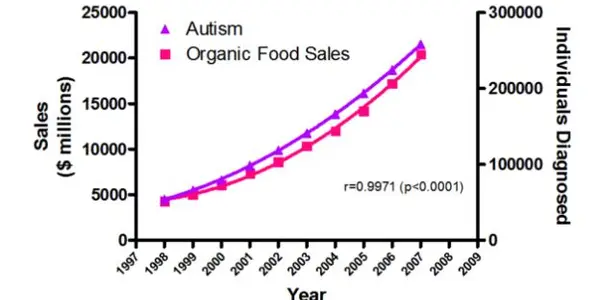
This is a post about basics. That's because I think a point needs to be made which is surprisingly not as well-known as its elementary nature would have you guess.Correlation -in its most used version, due to Pearson- is a measure of how two quantities can be observed to be in linear dependence on one another. It is a very common quantity to report the results of scientific studies, particularly but not exclusively in the social sciences. Researchers try to evidence the presence of a correlation between two phenomena as a preliminary step to investigating whether one can be the cause of the other.
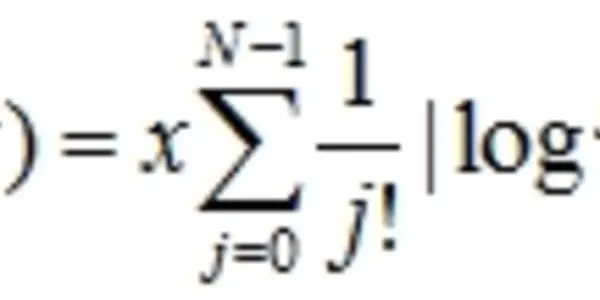
In High-Energy Physics the small p-value of an observation may be the first hint of a discovery about to be made. Here by p-value I just mean the probability, just to be fancy (or brief). Because we rely on the assessment of the rarity of observations to decide whether we have discovered something or not, we physicists are (or should be) really careful with p-values. Today's article aims at demonstrating how easy it is to be carried away into giving more relevance to an observation than we should.
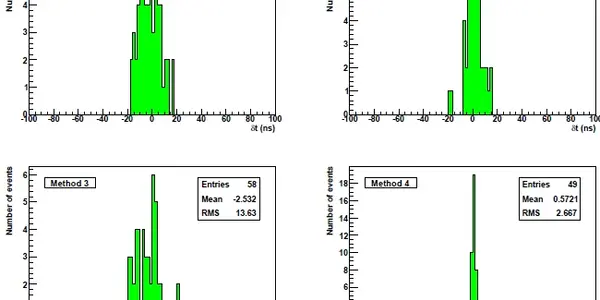
A new preprint is out in the arxiv today, detailing the results of a new analysis of neutrino speeds performed by the OPERA collaboration using proton spills of the CNGS beam produced during dedicated runs in May this year.
The conceptual design report of the Mu2E experiment at Fermilab is out in the arxiv for you to browse. Mind you - it is a rather thick document, 562 pages in all, so if all you have is 15' of lunch break you have better try something lighter.