More on Radiacode 110
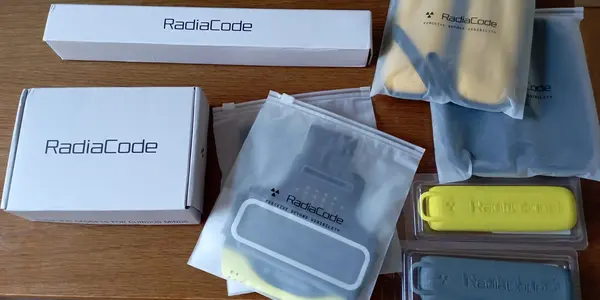
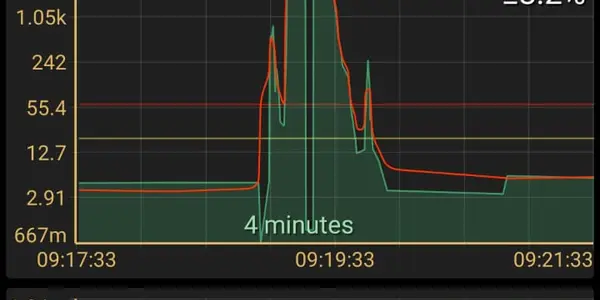
This is the second post reporting a few tests of the Radiacode 110 spectrometer, an extra-cool pocket dosimeter/radiation counter/spectrograph sold by RadiaCode.
This is the second post reporting a few tests of the Radiacode 110 spectrometer, an extra-cool pocket dosimeter/radiation counter/spectrograph sold by RadiaCode.


Update: I got a confirmation that at the latest INFN board of directors meeting the news was given that the Super-B factory to be built outside Rome is no more. Super-B joins other remarkable projects in high-energy physics -notably the SSC, the American 40-TeV super-collider to be built in Texas, and killed by Congress in 1993- in the dust bin.With this move the Italian government shows again how little they care for basic research in Italy, and provides further fuel to the escape of bright researchers to other countries.
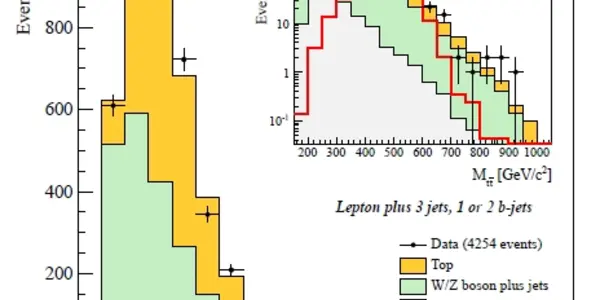
The top quark is the heaviest of the six known hadron constituents, discovered at the Fermilab Tevatron collider in 1995. Because of its quite large mass -over forty times more than the second-heaviest bottom quark- and because of a few additional interesting properties, the top quark has stimulated in the past two decades a large amount of theoretical work, well matched to the Tevatron investigations.In fact, one of the explicit goals of the CDF and DZERO experiments for Run II of the Tevatron, which lasted from 2002 to 2010, was to study extensively the top quark both as a standard model object, subjected as it is to electroweak interactions which can be studied and compared to predictions, and as a portal to new physics of various kinds.
UPDATE: BBC radio contacted me to let me know they corrected their mistake. I am very glad to hear that! So you can continue reading BBC after all!Probability inversion is one of the nastiest mistakes one can do handling the results of a statistical analysis, invalidating to the roots the interpretation of the data to the point that the whole work effectively becomes useless. Unfortunately, it is a very common entertainment for journalists reporting scientific results, and oftentimes scientists themselves fall in the trap.
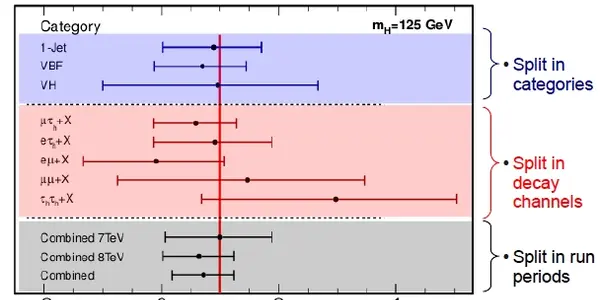
Maybe more interesting than the just reported result of searches for the Higgs boson into four-lepton final states (ee, eμ, μμ) are the result presented by CMS and ATLAS on the searches for the Higgs decay into tau-lepton pairs. The reason for the interest comes from the fact that last July the rather high rates of Higgs decays to photon pairs had suggested to some that this new particle might have reduced couplings to fermions, and could thus be a non-Standard Model particle after all.
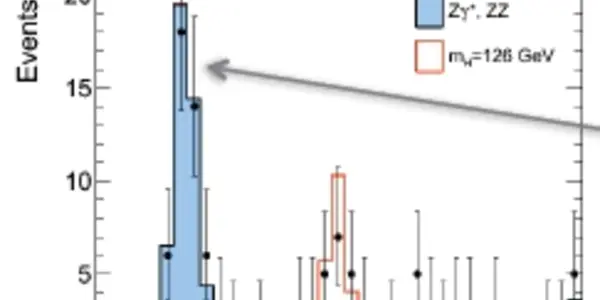
Today new results of Higgs searches have first been shown in Kyoto, at the Hadron Collider Physics conference. Let us see the CMS and ATLAS updates of their measurements in the ZZ-> 4 leptons final state, which constitutes the best signal-to-noise channel to study Higgs properties cleanly and measure mass and spin-parity of the new found particle.
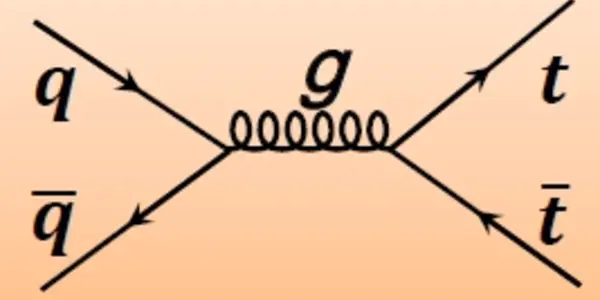
The Hadron Collider Physics symposium opened yesterday in Kyoto. I am not following the works very closely, but I did give a peek at today's talks, which were on the topic of top quark physics.

It has taken a while, but the rare decay of B_s mesons (particles composed of a bottom and an anti-strange quark) to muon pairs has finally been seen. The authors of the find -we cannot yet call it an observation given the scarce statistical significance of the signal- are the members of the LHCb collaboration, one of the four experiments working with the proton-proton collisions delivered by the Large Hadron Collider at CERN.
I read the text below in the Facebook page of a colleague and friend, Christopher Hill. The text was meant as a facebook rant - sort of - but it raises important points. I liked what he wrote and I asked him if I could repost it here to the benefit of a larger audience. He graciously agreed. NB: the title of the post is mine.Now that the election and Sandy is (sort of) over, I want to post a rant that I didn't think was appropriate before now. First, Nate Silver. I have heard him called everything from a genius to a wizard to a witch in recent days. He is none of the above. He is a guy who understands mathematics (in particular statistics) enough to be able to use it to predict elections.

The CDF and DZERO collaborations at the Fermilab Tevatron collider just saw published on Physical Review D (PRD 86, 092003) their final combination of their most recent and precise measurements of the mass of the top quark. This result, which is probably going to be the definitive one by the Tevatron experiments, reaches a precision in the top mass which is comparable to the precision of the scale you have in your bathroom, despite the fact that measuring your body weight is a quite simpler matter than determining the mass of an elementary particle, let alone one which exists for less than a trillionth of a trillionth of a second.A digression
A journalist I am following on twitter just posted the question in the title of this post. I felt bound to try and give an answer with as simple concepts as I found meaningful. So, what makes a unstable particle unstable ?One answer is this: a particle is unstable if there is a way, not forbidden by any physical law, to convert its rest-mass into other forms of energy. One may understand this by thinking of entropy: any system left free to evolve will do so in the direction of maximum entropy. So since a single particle state is a very low-entropy system, while the decay products of its disintegration have a multitude of possible configurations and a higher entropy, the system will naturally evolve in that direction.
Researchers and academics below the full-professor level in Italy are currently busy with an idle exercise - putting together their applications to a selection for would-be assistant and full professors. By the way, this is happening to me as well, so you may understand why this blog has received little attention from me this past week: the occupation is extremely time-consuming.Becoming university professors in Italy in the last few decades has been a rather complicated business, where the merit of candidates was often overshadowed by favouritisms and private interests.
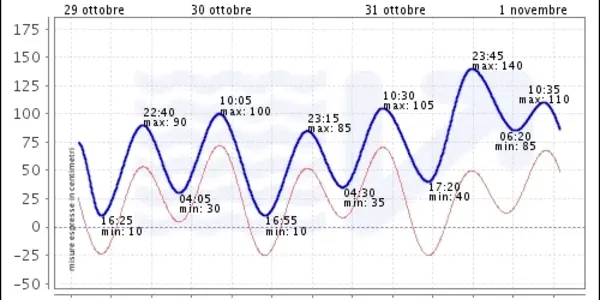
While New Yorkers (and others on the east US coast) prepare to deal with hurricane Sandy and the possible water surge resulting from the very strong winds and low pressure of the system, a similar situation is expected in Venice on Wednesday; unlike New Yorkers, Venetians are rather accustomed to the phenomenon - familiarly called "acqua alta" (high water) by residents. However, when the level of water is exceptionally high, normal protection systems to shops, offices, and ground floors of homes prove insufficient. That is probably going to be the case in the evening of October 31st, when the tide is expected to reach to the level of +1.40 meters above average sea level, due to a combination of factors -low pressure, full moon, winds.