More on Radiacode 110
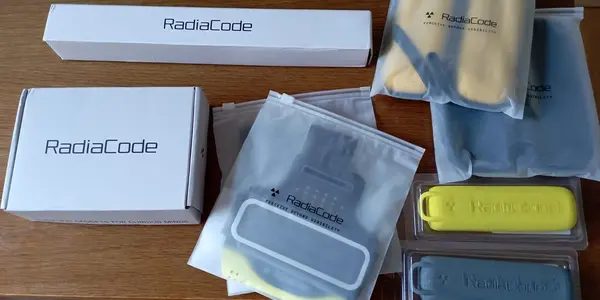
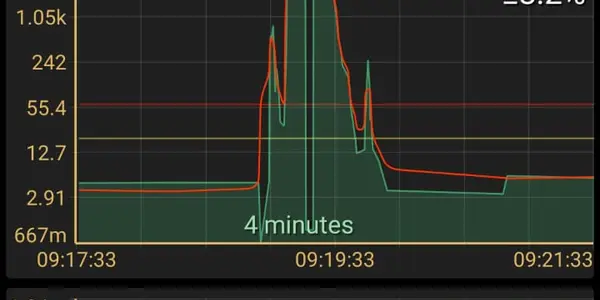
This is the second post reporting a few tests of the Radiacode 110 spectrometer, an extra-cool pocket dosimeter/radiation counter/spectrograph sold by RadiaCode.
This is the second post reporting a few tests of the Radiacode 110 spectrometer, an extra-cool pocket dosimeter/radiation counter/spectrograph sold by RadiaCode.


Last Saturday night Gian Francesco Giudice and I discussed the discovery of the Higgs boson and its aftermath in front of a wide audience gathered in the Aula Magna of Mantova University. The event was #173 in the wide program of the town's literature festival, a week of seminars, interviews, performances by authors of books, journalists, and intellectuals in a broader sense.

On Friday evening I will be talking in the wonderful Piazza Mantegna, in downtown Mantova (see picture below). It is an event organized by Festivaletteratura (literature festival), where I will be armed with blackboard and chalks, plus a mike, and where I will explain the way a discovery of a new particle comes about.On Saturday instead I will be at the aula magna of the Mantova University, where in company with Gian Francesco Giudice (a CERN theorist) I will discuss the Higgs boson discovery and the aftermath. That is a more "serious" event and we will be discussing in front of a paying audience. I hear that the event is already sold out, so it will (should) be interesting!

A new ATLAS search for supersymmetric signatures in 2011 LHC data has appeared last week in the arxiv. The result ? No hint of a signal, not even for ready money. So if you are on a hurry, you can just have a glance at the graph below, which summarizes the measurement in terms of excluded regions of a slice of the complicated parameter space of SUSY theories. Otherwise, if you want to know a bit more of what this is about, I can provide some detail.

Everybody seems to be talking about this new would-be particle, allegedly observed in diphoton decays in this paper by Kh. Abraamyan et al. at JINR, and consistent with an earlier claim of two physicists (van Beveren and Rupp) who had considered several distributions published by different collaborations.

Perhaps a bit too simple, but certainly appealing. Extensions of the Standard Model which imply the existence of a new U(1) gauge group to complement the SU(2)xU(1) structure of electroweak interactions have been put forth in a number of slightly different versions. All imply the existence of a new Z' boson, a heavier version of the Z0. For those not yet introduced to the latter, the Z0 is the neutral vector boson hypothesized by Glashow, Salam and Weinberg in the sixties to complete a triplet of weak currents and thereby allow the unification of weak and electromagnetic interactions.

Little less than one year ago the world of fundamental physics was shaken by the bold claim of the OPERA collaboration, which produced a measurement of the time of flight of neutrinos traveling underground from Geneva to the Gran Sasso mine in central Italy. The beam of neutrinos, produced by the CERN SpS proton synchrotron, was observed to produce interactions in the large mass of the OPERA detector with about 60 nanosecond anticipation with respect to what would be expected for a particle traveling at exactly the speed of light (2439096.1+-0.3 nanoseconds, since the flight path is of 731221.95+-0.09 meters).

The Large Hadron Collider is delivering as expected a large amount of integrated luminosity of proton-proton collisions to CMS and ATLAS, running at a centre-of-mass energy of 8 TeV. The total collected in 2012 by CMS has just now crossed the mark of 10 inverse femtobarns: this is twice as much data as that collected in 2011. And the CMS detector is working like a charm, with all subsystems collecting data flawlessly.Physicists need large integrated luminosity to explore rare phenomena, and high energy to probe processes which may only "turn on" above a certain threshold. So given the x2 luminosity so far collected (but we will get to x5 by the end of the year!) and x1.14 energy, the discovery potential of 2012 data is already several times larger than that of 2011 data.
I am very happy to have been invited, by Matteo Polettini, to two events that will take place at Festivaletteratura (literature festival), an important cultural event that takes place in Mantova, a beautiful town in northern Italy, from the 5th to the 9th of September.

ATLAS has just released a note which summarizes the searches for the standard model Higgs boson in 7-TeV and 8-TeV data. Since July 4th the main improvement is the addition of the WW channel, which had not been shown back then. With it, the combined local significance of the 126 GeV Higgs boson excess in the WW, ZZ, and γγ channels grows to 5.9 standard deviations. In the words of a Facebook friend who's in ATLAS: "if this is not a discovery, I don't know what is".

The Tevatron experiments have jointly published on the arxiv two days ago a paper which is titled "Evidence for a particle produced in association with weak bosons and decaying to a bottom-antibottom quark pair in the search for the Higgs boson at the Tevatron collider". You can get the paper in the arxiv.

The communication of science to the general public is a subject dear to me, but unfortunately one that the majority of my colleagues neglect to consider as one to which to devote time and efforts. In the last decade blogs have started to fill the huge gap that exists between scientific journals and general news media, a gap that no popularization magazine can bridge, given their restricted scope. More recently, I see efforts that employ video and graphics more heavily than before, and this is of course a step in the right direction - reading is harder, or at least less immediate, than watching an image or following a video clip.
The following text has been offered as a followup of the Higgs observation by the LHC experiments, which finds a signal at a mass compatible with the pre-discovery predictions made some time ago by Vladimir Khachatryan - ones which I published in this blog. - T.D.Considerations following the Higgs boson discovery - Ashay Dharwadker