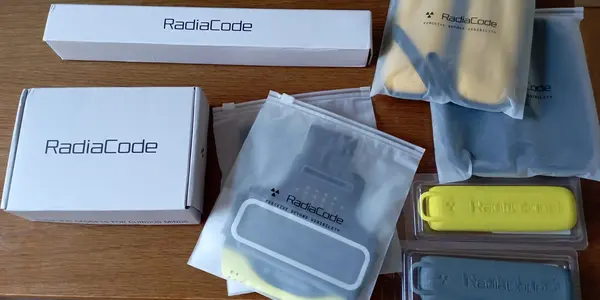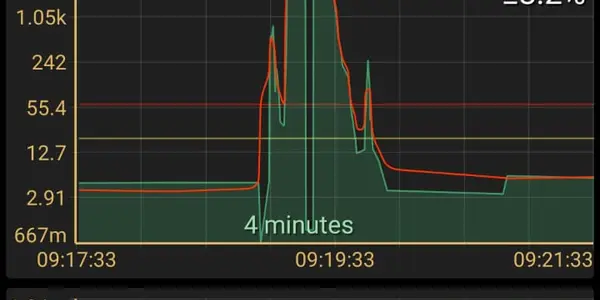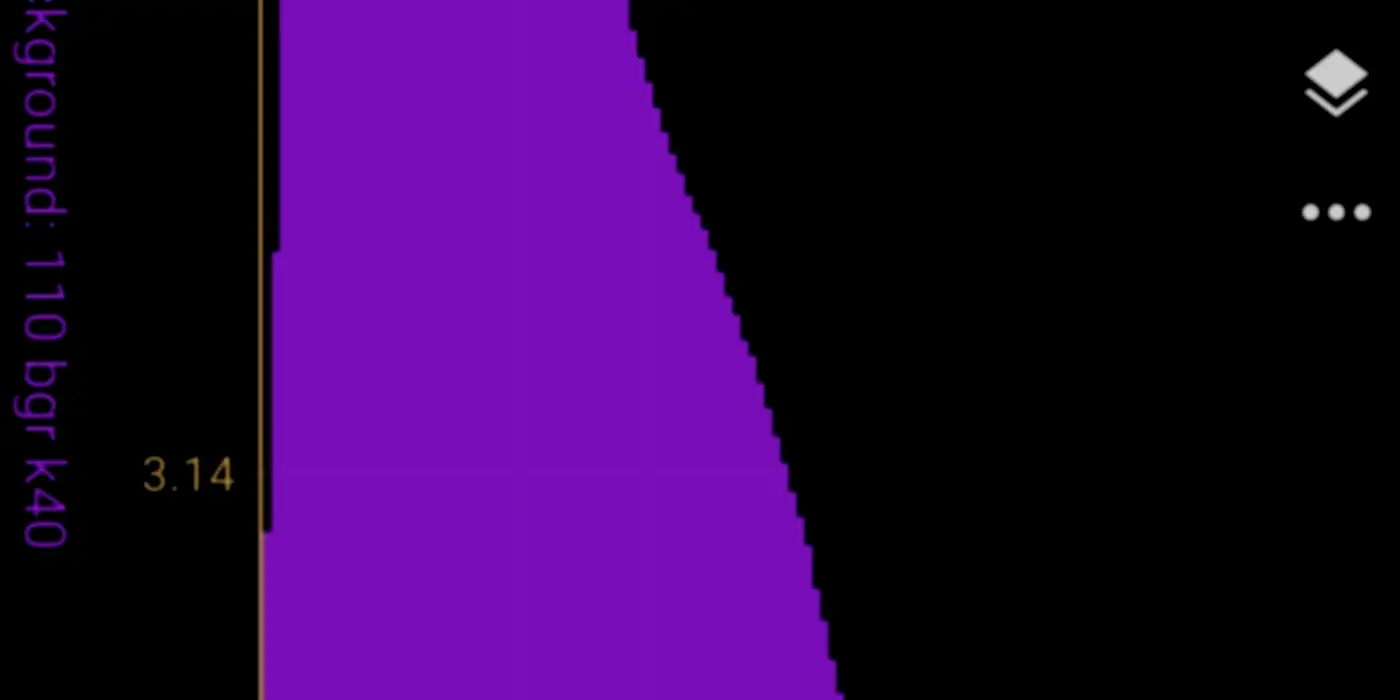
More on Radiacode 110
This is the second post reporting a few tests of the Radiacode 110 spectrometer, an extra-cool pocket dosimeter/radiation counter/spectrograph sold by RadiaCode.
This is the second post reporting a few tests of the Radiacode 110 spectrometer, an extra-cool pocket dosimeter/radiation counter/spectrograph sold by RadiaCode.

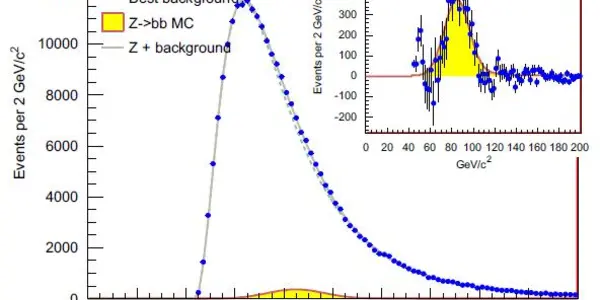
When I started a career in particle physics, joining the CDF experiment at the Fermilab Tevatron proton-antiproton collider about two decades ago, the search for a particle decay signal into hadronic jets was not something one would undertake lightly at a hadron collider: jets are omnipresent when you collide hadrons at high energy, so they constitute a irreducible background. Just as a detective looking for a blonde thief with swedish accent in Sweden, you would be close to clueless.
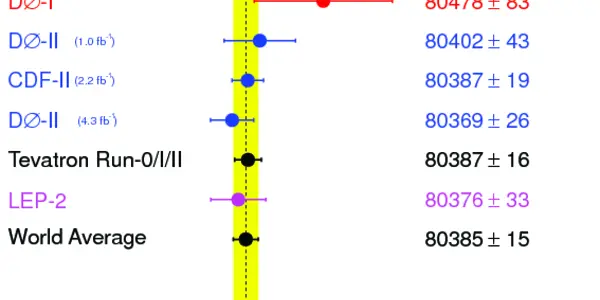
A couple of weeks ago the CDF and DZERO experiments have produced a combination of their measurements of the W boson mass. Besides two older determinations of this fundamental parameter of the Standard Model, the new 2.2/fb measurement by CDF and the 4.3/fb measurement by DZERO have been averaged together, accounting for correlated systematics. [x/fb is a shorthand for the amount of collisions from which the W boson datasets have been extracted by the experiments: 1/fb is about 80 trillion proton-antiproton collisions.]
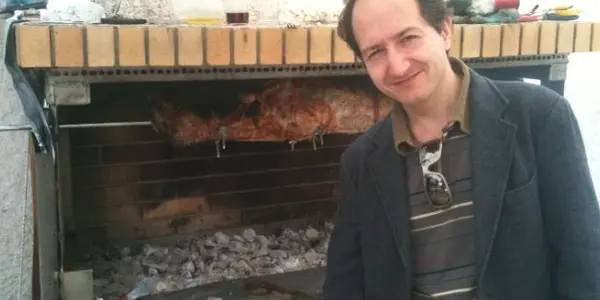
I am just back from a vacation to Greece, where last Sunday was orthodox Easter. My fiancee Kalliopi is Greek, and it was about time for me for me to experience a bit of Greek customs. So we flew to Athens, and then headed to Salamina, where I had a lot of fun the Greek way in the company of a very cheerful dozen of relatives and friends.Among the obligatory ingredients of a Greek Easter is the roasted lamb. It is cooked all in one piece, on a huge skewer, by rolling it for hours over hot coals. Its appearance is a bit disturbing at first, that is until the smell start to turn from that of a corpse to that of delicious food. Below you can see me in front of the thing as it was already in the good-smelling and edible-looking phase.
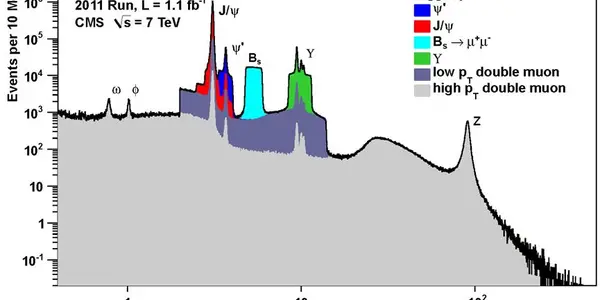
For once I allow myself some self-advertising... I just published on the Cornell arXiv the preprint of a proceedings paper I wrote for the Bormio 2012 conference on Nuclear Physics, where I presented the most recent results from the CMS experiment in a review talk. The paper is titled "Recent Results of the CMS Experiment".The paper is 33-pages long, and thus configures as a general review of the results that CMS produced from the analysis of data collected during 2011, the 5 inverse femtobarns of proton-proton collisions, which among other things granted a first feeble but trustworthy evidence of a Higgs boson when read together with similar ATLAS results.
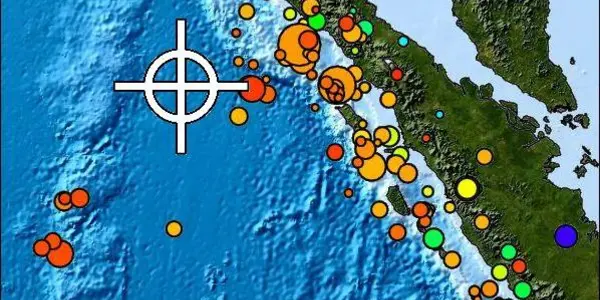
A powerful earthquake has struck an hour ago, at 8.30UT, very close to the place where a similar event occurred on December 26th 2004. The earthquake has an estimated magnitude of 8.7 and occurred at a depth of 33km, according to NOAA. The map below shows the location of the event and the potentially affected areas.
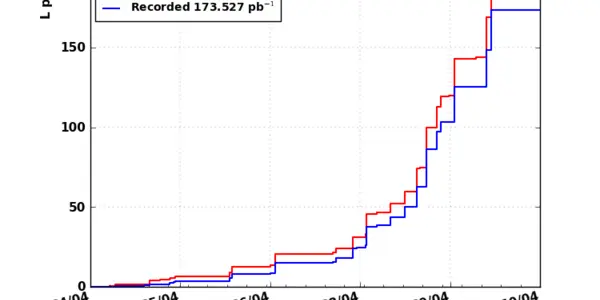
Last week the Large Hadron Collider has started producing collisions at the record high 8-TeV centre-of-mass energy to the ATLAS and CMS detectors. In the course of the first week of run almost 200 inverse picobarns have been delivered to CMS, which is absolutely satisfactory. The integrated luminosity versus time is shown below.And here is the peak instantaneous luminosity reached during these first few days of running:(NB: I believe the above figure lacks a "s^-1" units).
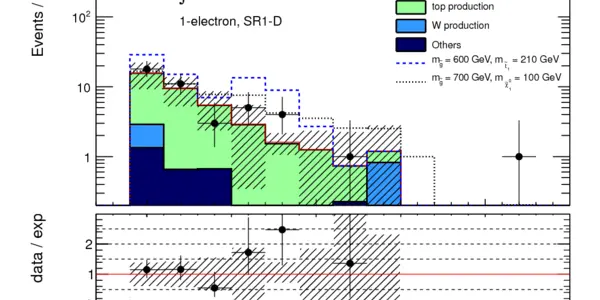
And after all I said about Supersymmetry being an invention, I fear I now have to eat it all with my hat to boot ! The ATLAS Collaboration has just released results of a very striking search for gluinos, which increases the sensitivity over past analyses by employing a much improved and cleaned-up version of missing transverse energy along with a higher-resolution version of the effective mass variable used in the past, and has found a first strong evidence for Supersymmetric decays !!
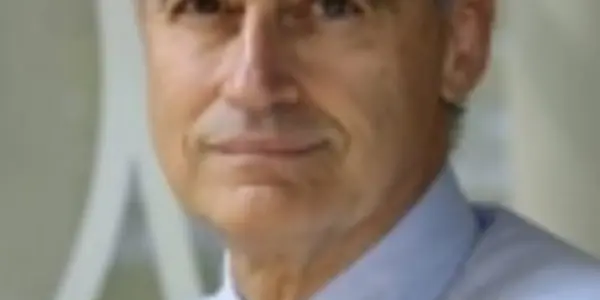
Antonio Ereditato (left), spokesperson of the Opera collaboration, announced today he stepped down. He is no longer leading the Opera experiment. The Opera experiment last September made headlines around the world with their announcement that neutrinos sent from the CERN laboratories to the Gran Sasso cavern appeared to be moving at superluminal speed.
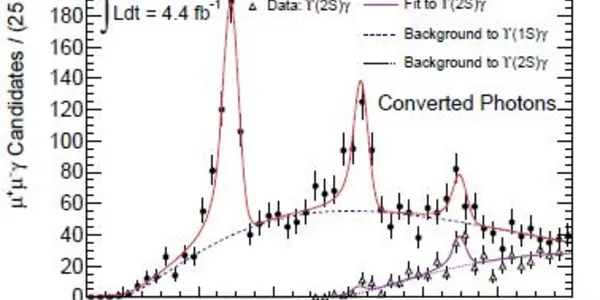
While most High-Energy Physicists nowadays are kept busy with the idle search for non-existent new physics beyond the standard model in the form of improbable Supersymmetric particles, phantom leptoquarks, fairy Z' resonances, putative colorons, invented gravitinos, and what not, the subset of lucky experimentalists who decided to go against the flow and kept their feet on the ground are provided with endless entertainment in the study of resonances that are as real as your breakfast today.
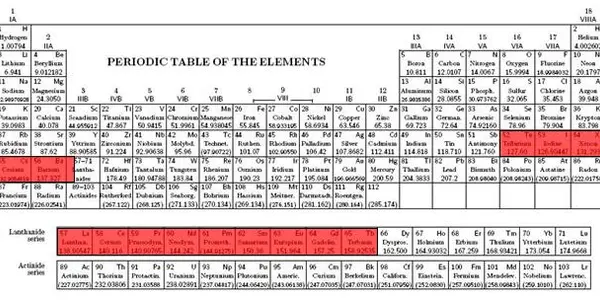
Whenever I try to explain something about particle physics to a layman, I run into the problem of mass/energy units. A Giga-electronVolt is not something you may expect people to be familiar with, and on the other hand it is not appealing to explain directly how it is defined: "if you take an electron and accelerate it by passing it through a potential difference of one billion Volts, that's the energy it has at the end: one GeV": this distracts the listeners by forcing them to focus on electrostatics, with the potential outcome that the conversation may diverge due to additional questions, like "Does the electric field need be uniform ?" or even, "What is a potential difference ?".
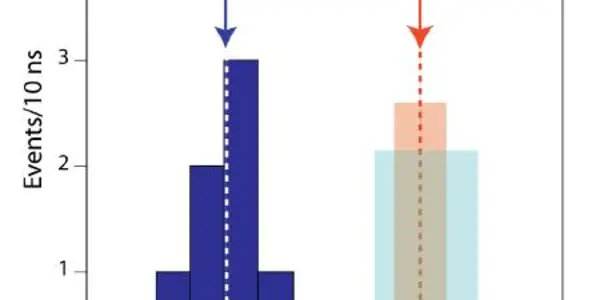
The ICARUS collaboration - operating a neutrino detector sitting not far from the OPERA experiment in the underground Laboratori del Gran Sasso in Italy - produced a refutation of the superluminality of neutrinos a while ago. That refutation was based on studying the energy spectrum of the neutrinos in the CNGS beam, coming from CERN through a trip of 700 km under the Earth's crust: superluminal neutrinos should have lost some energy due to electroweak radiation, which was not borne out by the data.
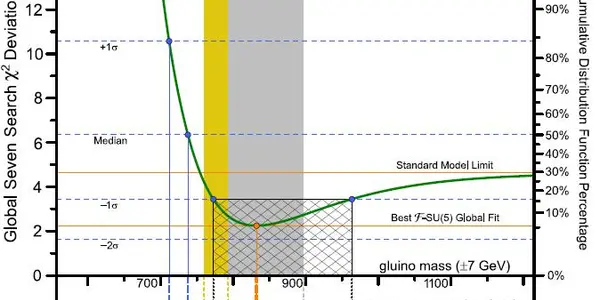
It is a gloomy winter for most SUSY phenomenologists: as they sit and watch, the LHC experiments continue to publish their search results for Supersymmetric particles, producing tighter and tighter direct bounds on the masses of squarks and gluinos for a variety of possible choices of the many free parameters defining the models under test. It looks as if the general feeling is "Today it's your preferred model going down the drain, tomorrow it might be my own".