More on Radiacode 110
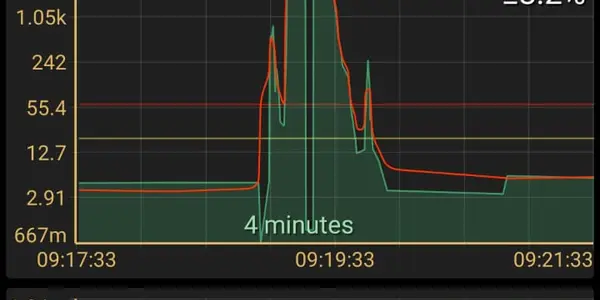
This is the second post reporting a few tests of the Radiacode 110 spectrometer, an extra-cool pocket dosimeter/radiation counter/spectrograph sold by RadiaCode.
This is the second post reporting a few tests of the Radiacode 110 spectrometer, an extra-cool pocket dosimeter/radiation counter/spectrograph sold by RadiaCode.

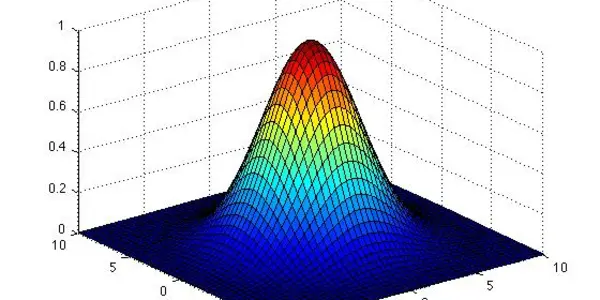
For you today here is a test of whether you shoud trust your intuition when confronted with an apparently simple problem. Incidentally, this article is the answer to the "Guess The Plot" riddle I posted a few days ago here.Suppose you are given two measurements of the same physical quantity. Make it something easy to visualize, such as the length of a stick. They tell you that when measured with method 1 the result was x1=10 cm, with a estimated uncertainty s1=0.1 cm, and when measured with method 2 the result was x2=11 cm, with estimated uncertainty s2=0.5cm. Here is a question for you today: What is your best guess of the length of the stick ?
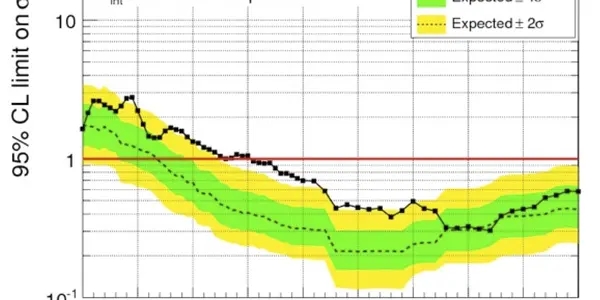
Totally overshadowed by the news of the new Opera measurement of neutrino speeds, yesterday CERN officially released the combined result of ATLAS and CMS searches for the Higgs boson. The news has been given already in two prominent particle physics blogs (Resonaances and Not Even Wrong), so I think I am not obliged to do anything more than point you to those, who cover the matter quite accurately.

After a more careful reading of the paper, the listening to a seminar on the result, and some discussions, I can share with you a few more details on the Opera measurement.
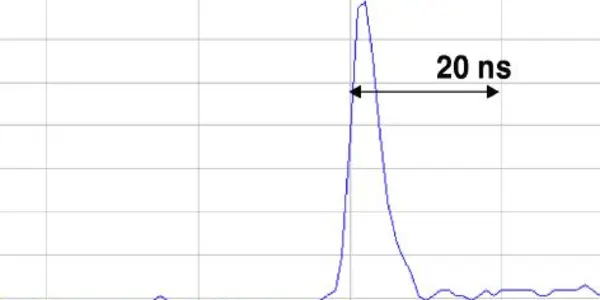
UPDATE: some technical considerations on the measurement are available in a followup post I wrote after attending a seminar on the new result today. In particular, one startling consideration emerges - if the reading of the 20 MHz Opera clock were off by just one tick, the result would be compatible with v=c. UPDATE: you can download the new Opera paper at this link. You will need to use the username and password "neuvel".
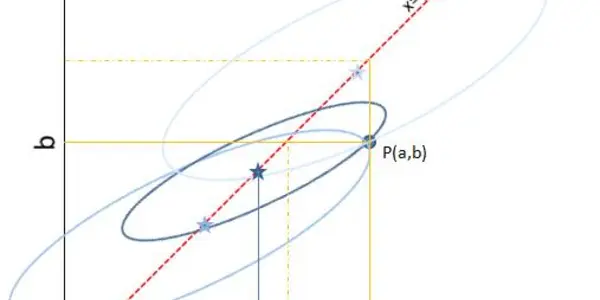
It's been a while since my last "guess the plot" posting. The simple explanation is that I did not happen to run into any fancy graph in the last month or so. Now, today I have one for you to guess, but I must add that I believe it is rather easy to understand what it represents. Less obvious is to completely understand the math behind it, and the implications of the construction.
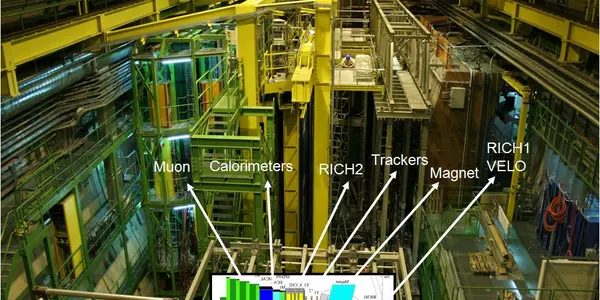
Today I wish to briefly discuss a recent important measurement produced by the LHCb collaboration, a measurement of CP violation in the decay of charmed mesons. Before I do, I think I need to explain some details of the LHCb experimental arrangement, because it is different from what most readers here are familiar with.And, update: rather than putting it at the end, I prefer to link Resonaances' post on the same subject here this time - he wrote about the matter yesterday and did a much better job than I do below. Sorry for noticing it after posting mine!Some pedestrian kinematics
These days I am preparing a three-hour course of statistics for particle physicists which I will give at a winter school in a couple of months. This stimulating task forces me to find nice and simple examples of good and bad applications of basic statistics. Stuff with high didactical value, and hopefully also entertaining.
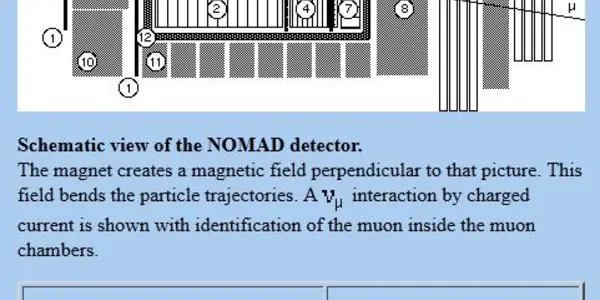
The Arxiv today features a quick-and-dirty study of the occurrence of electron-positron pair signal in the NOMAD detector, which obtains very strong bounds on the superluminal behaviour of energetic muon neutrinos like the ones whose speed has been recently and famously measured by OPERA.
The following is an excerpt from a book I am working on intermittently. I do not know whether the project will ever see the light, and it just occurred to me that I could share a tiny bit of it with you in my blog. Enjoy!----
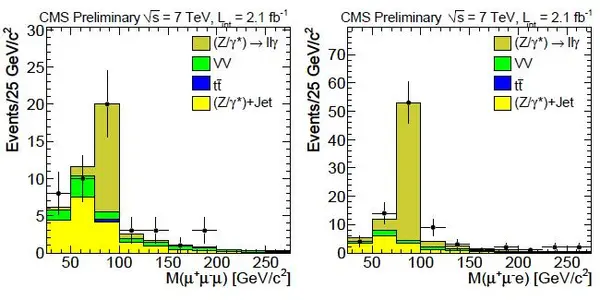
A process which caught some of the LHC Higgs analysts by surprise in the recent run of analyses for summer 2011 conferences is the production of multiple-lepton events by a process called "internal photon conversion in Z events". What is it, and how can we size it up ?
The conversion of a real, energetic photon into a fermion-antifermion
pair readily occurs when the particle traverses a medium: the process is also known as "pair production", and is the leading form of energy loss of energetic photons in matter. It is thanks to it (and to the related process called "bremsstrahlung" of energetic electrons) that our electromagnetic calorimeters can measure electrons and photons!
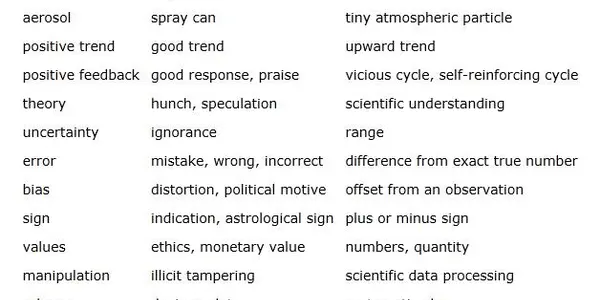
This morning I read with interest a paper on Physics Today, titled "Communicating the Science of Climate Change", by R. Somerville and S. Hassol. In it, there is a table worth pondering about. Here it is:
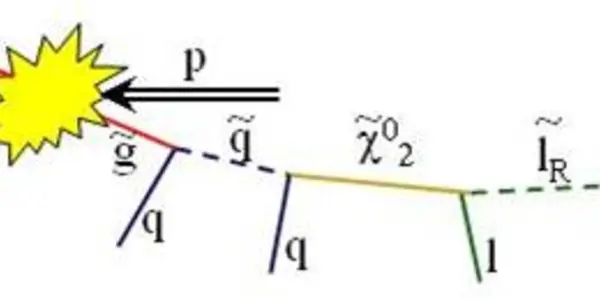
October is passing and the neutrino saga continues to make headlines here and there, but I know that the excitement is bound to slowly dampen, as the preprint claiming superluminal speeds ages in the Arxiv without being sent to a scientific magazine.