I once was an active chessplayer, but work duties have long taken tournaments off my plate - I simply do not have the time to sit through long hours of chess battles. So I play blitz online on chess.com (my handle is "tommasodorigo", in case you wondered).
Professor Tommaso Dorigo is an experimental particle physicist, who works for the INFN at the University of Padova, and collaborates with the CMS experiment at the CERN LHC. He is currently a RECAT Guest Professor at Lulea University of Technology, a…
The presentation of data is a very rich subject, on which there is a whole lot to discuss, even by restricting to the issues relevant to our dear field of experimental high-energy physics. Usually too little thought is given to it, even by expert researchers, so I thought that maybe today I would offer here some ideas on one very basic issue, the one of how to choose the width of the bins of a histogram.
The measurement of the production rate of top quark pairs at the Tevatron is by now a very well developed technology, where it is hard to invent anything new. Eight years ago, however, there was still the chance to develop new techniques and explore new land.
The measurement of the production rate of top quark pairs at the Tevatron is by now a very well developed technology, where it is hard to invent anything new. Eight years ago, however, there was still the chance to develop new techniques and explore new land.
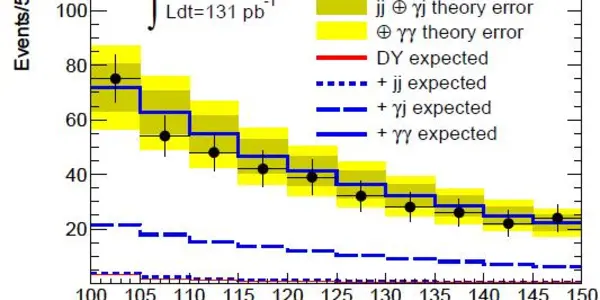
In a display of nonchalance that should teach us a thing or two, the ATLAS collaboration has put an end to the Easter Higgs Rumour (EHR), which brought the blogosphere in an excited state for at least a week, and experimentalists and theorists for even more time. They did so by publishing a very narrow-focused document, totaling less than five pages, where they discuss the backgrounds to Higgs boson decays in the diphoton final state.
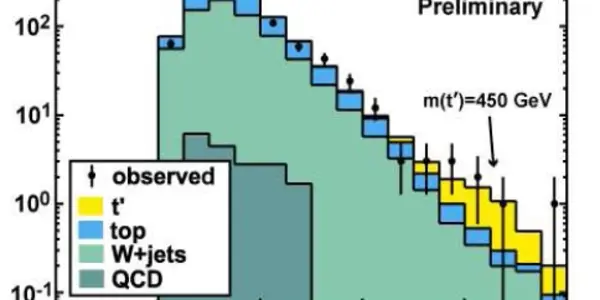
Spring is my favourite season in Batavia, watching peaks blossom in every distribution... A comment by Lubos Motl (in the thread of a post of mine on Higgs searches in ZZ decay modes) alerted me of a new result by the DZERO collaboration, where a significant (2.5 standard deviations) fluctuation of the data in the mass distribution of t-prime quarks makes its ephemeral appearance. Lubos already covered it in his blog.
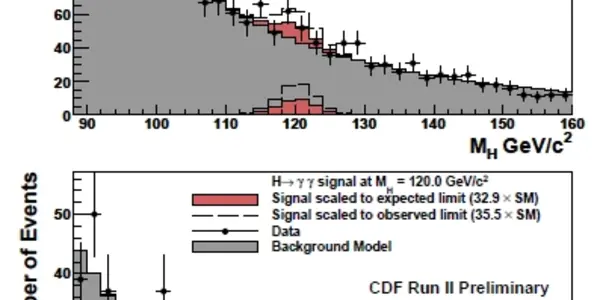
Note: updated list of links at the bottom.(Older Note: Bet on this signal! See at the bottom of the article! Odds are two to one in your favour now!)(Older note: Update at the bottom.)It seems I am late on this one -an internal note by the Atlas collaboration seems to contain the discovery of a bump in the diphoton mass distribution from data collected in 2010 and 2011. They find a signal that seems consistent, in mass and resolution, with what one would expect from a Higgs decay, if the Higgs were sitting at 115 GeV, the value at which LEP II found some hint (a 1.7 standard deviation signal) before being shut down in 2001.
That's because you never learn anything new.[By the way: if you were coming here to learn the solution of my riddle about the mysterious plot I posted here yesterday, be patient - I will publish an answer tomorrow on that issue.]
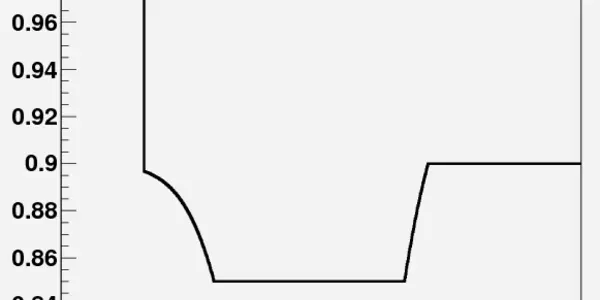
After the disturbance created by the Higgs rumour in ATLAS, I think we can go back to normal business - in this case, keeping my word on discussing things that were left hanging.Your response to my small riddle was quite good, forcing me to provide a timely and exhaustive explanation of what is in the plot I posted a few days ago.
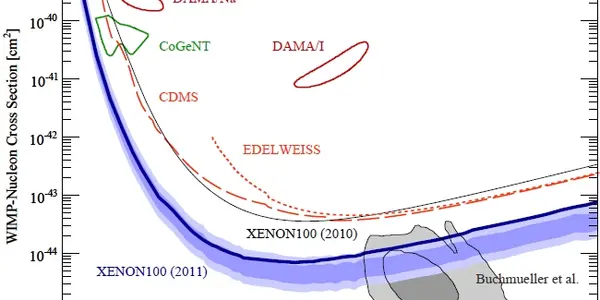
The Xenon 100 collaboration has finally released the results of their data analysis, and the results are saying that there is no Dark Matter in sight so far. Since we live in an age where time is precious, I think many of you are only interested in the bottomline. I can give it to you straight away, in the form of the plot which summarizes the results. Xenon 100 finds three events compatible with a dark matter signal, with a background expected from more mundane sources amounting to 1.8+-0.6 events. The limit they extract on the cross section versus mass of the hypothetical particle are shown below by a thick blue curve, which cuts into the flesh of the preferred parameter space of constrained minimal supersymmetric theories (in grey), pushing them farther away.
In the comments thread of one of the posts I wrote recently, where I discussed the new tentative signal of a new jet-decaying particle discovered by the CDF collaboration in their data, a reader asked me if hadronic signals of single vector bosons had been seen before by CDF.
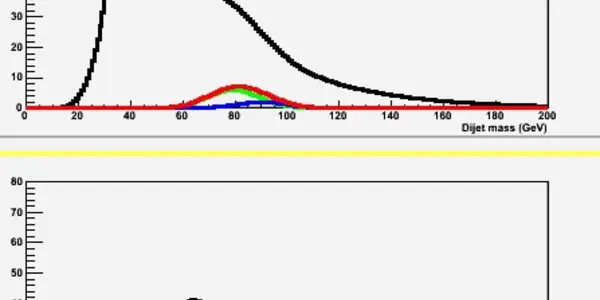
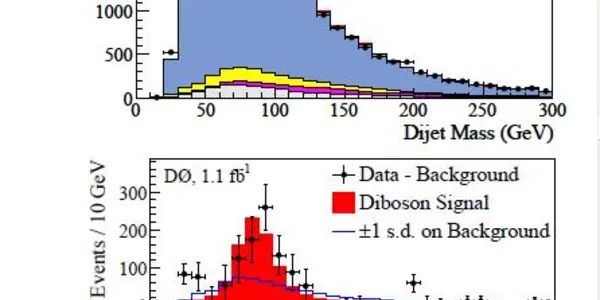
Given the wide interest (about 20k readers in a day) that the new article by the CDF collaboration has attracted (see my original post here), I think I should collect in a separate post some auxiliary information, concerning past searches which might have been sensitive to such a signal in the past.
UPDATE (4/7): I posted a link to a nice animated GIF which shows the (approximate) effect of scaling up the MC/data jet energy scale factor on the CDF new particle signal. See here.UPDATE (4/7): I added some considerations on the tentative CDF signal in a separate post today (4/7). You can find there a comparison with older semileptonic diboson searches at CDF and DZERO.