More on Radiacode 110
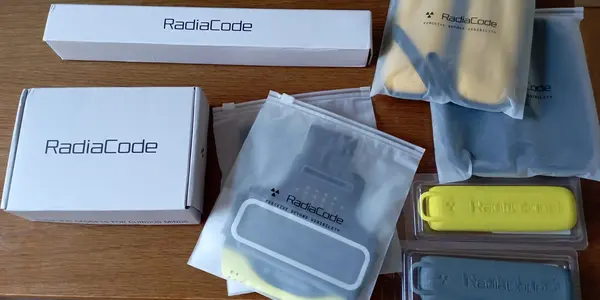
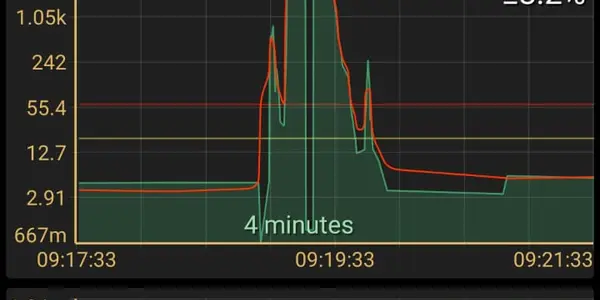
This is the second post reporting a few tests of the Radiacode 110 spectrometer, an extra-cool pocket dosimeter/radiation counter/spectrograph sold by RadiaCode.
This is the second post reporting a few tests of the Radiacode 110 spectrometer, an extra-cool pocket dosimeter/radiation counter/spectrograph sold by RadiaCode.

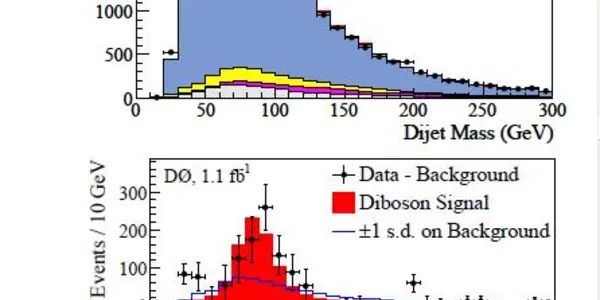
Given the wide interest (about 20k readers in a day) that the new article by the CDF collaboration has attracted (see my original post here), I think I should collect in a separate post some auxiliary information, concerning past searches which might have been sensitive to such a signal in the past.
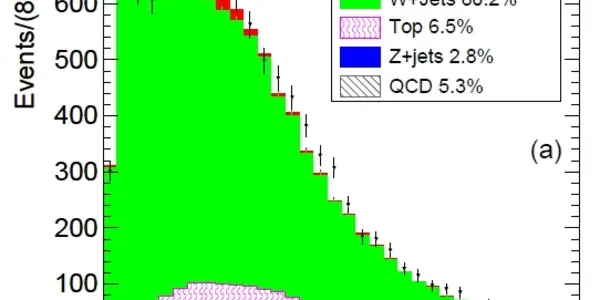
UPDATE (4/7): I posted a link to a nice animated GIF which shows the (approximate) effect of scaling up the MC/data jet energy scale factor on the CDF new particle signal. See here.UPDATE (4/7): I added some considerations on the tentative CDF signal in a separate post today (4/7). You can find there a comparison with older semileptonic diboson searches at CDF and DZERO.
I have recently dusted off an algorithm I had invented eight years ago, one I dubbed "Hyperball algorithm". It might come handy for predicting the b-tagging rate in CMS events with jets, for an analysis I am thinking of doing. Since saying more would violate a dozen rules so let's leave it at that, and let me instead describe the old idea... Just for fun.Predictions for the Higgs at the Tevatron
It has been a while since I last wrote about results from the DZERO collaboration, and I am happy to be given a chance to do so by my casual Monday morning browsing of the most recent Arxiv preprints.

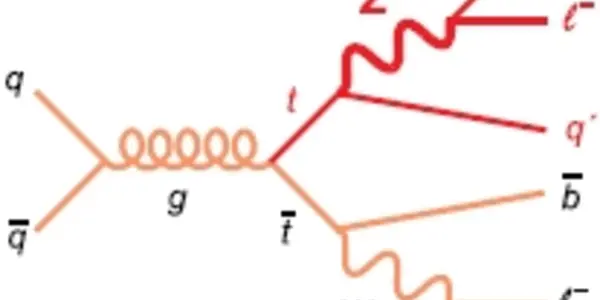
The CDF collaboration sent to the preprint arxiv a new paper a few days ago. In it, they report on a measurement of the mass difference of top and anti-top quarks. The result would not be worth discussing in detail, if it did not show a 2-sigma discrepancy which might be the first hint of a CPT violation. So let me discuss it here.
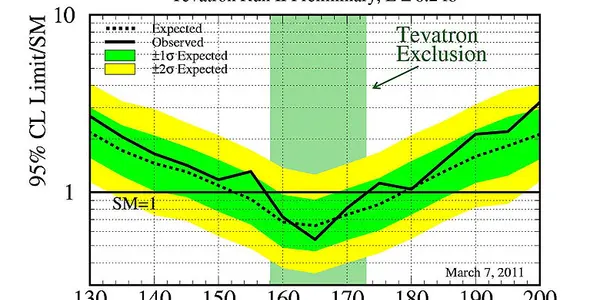
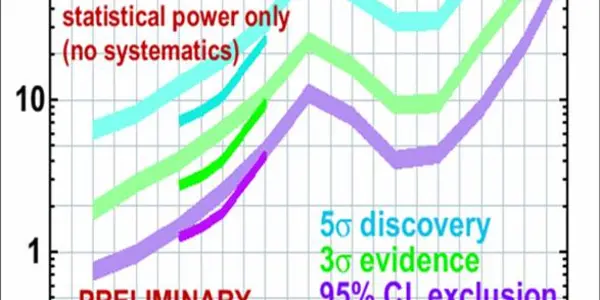
... Not really.What startled me most was that a colleague of mine at the University of Padova even sent a message to my departments' mailing list, saying that the new result is very important. But it clearly isn't! In fact, the exclusion at 95% CL in the range of Higgs boson masses that CDF and DZERO could put together from the analysis of additional data is almost exactly the same as the one that they published last Summer.But maybe I should make a step back and explain the matter from the start, to let you judge by yourself the relevance of the new Tevatron bounds on the rate of Higgs boson production in proton-antiproton collisions.CDF and DZERO are analyzing the proton-antiproton collisions at 2 TeV that the Tevatron collider is producing since 2001.
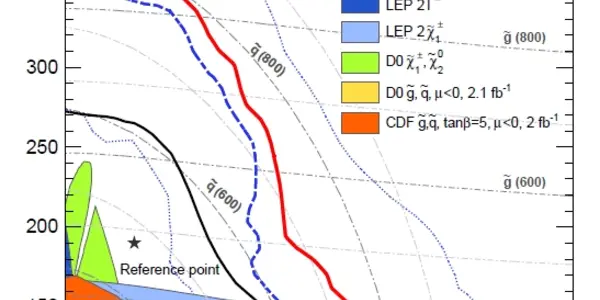
Readers of this blog know that I often discuss here the latest results of searches of Supersymmetric (SUSY) particles -nowadays furthered by the CDF and DZERO experiments at the Fermilab Tevatron collider, and by the ATLAS and CMS experiments at the CERN LHC.

I just became aware of a letter that is being sent to a couple of US Senators by a large and illustrious collection of scientists, and I decided to put my signature below it. The letter is clear and I will not comment it here - suffices to just paste it here. By the way, I do not think that more signatures are necessary to it, but if you agree with the contents and wish to participate your support, please do so by adding your name below, in the comments thread. It will just take you thirty seconds of your valuable time, but it might have an impact here too.-----------Senator Dianne FeinsteinChairmanEnergy& Water Appropriations Subcommittee SenatorLamar Alexander
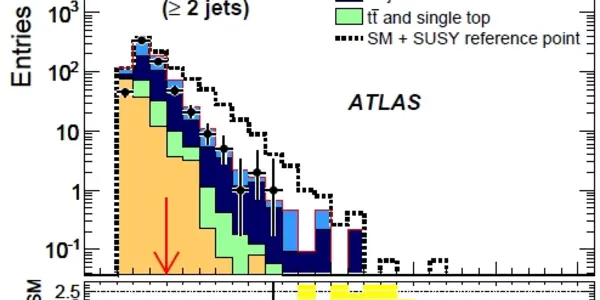
The results of a new Supersymmetry search have been released a few days ago by the ATLAS collaboration. They come from an analysis of events with large missing transverse energy and jets -the most classical signature of SUSY at hadron colliders, as well as the most sensitive one in a wide range of the complicated space of SUSY parameters.

Ben Allanach is a professor of theoretical physics at the University of Cambridge. Before that he was a post-doc at LAPP (Annecy, France), CERN (Geneva, Switzerland), Cambridge (UK) and the Rutherford Appleton Laboratory (UK). I noticed a recent article of his in the arxiv, and asked him to report on it here, given the interest that the recent LHC results have stirred in the community. He graciously agreed.... So let us hear it from him! Blimey, I'm tired. I'm also elated and excited and grateful to my lovely girlfriend, who's not only putting up with my long hours, distracted head and general ensuing grumpiness, she's even looking after me.
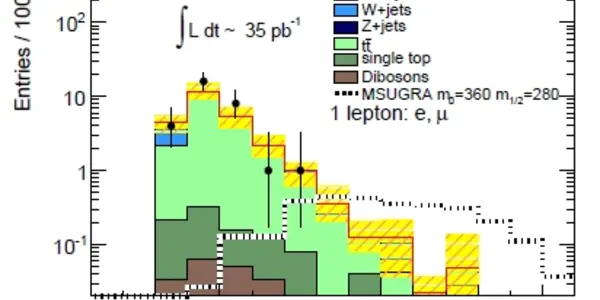
Both the CMS and ATLAS collaborations have already started to exclude meaningful regions of the parameter space of Supersymmetric models with the data they collected in 2010. And Physics World is on the news today with a online article by Kathy Mc Alpine, the famous rapper physicist who wrote the lirics and interpreted one of the biggest Youtube hits in the category of science popularization. If you have not watched it yet, please rush to do so now. Six million people (and counting) have done so before you already.
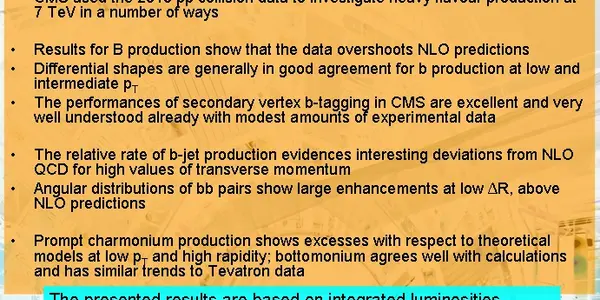
Today I spoke at a conference on "QCD advances" which is being held in Les Houches, an amiable small town near Chamonix, on the french slopes of Mont Blanc. The content of my talk is accessible from the conference web site, but I guess that I should provide here a summary of what I discussed.