More on Radiacode 110
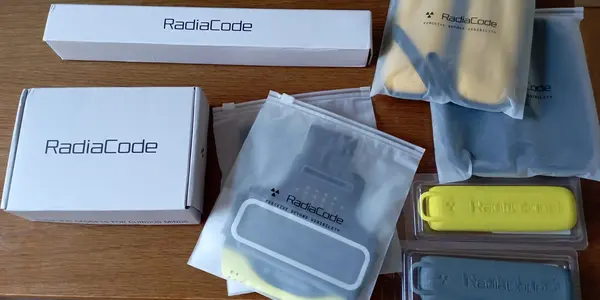
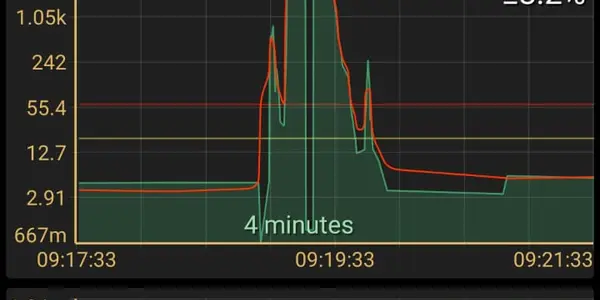
This is the second post reporting a few tests of the Radiacode 110 spectrometer, an extra-cool pocket dosimeter/radiation counter/spectrograph sold by RadiaCode.
This is the second post reporting a few tests of the Radiacode 110 spectrometer, an extra-cool pocket dosimeter/radiation counter/spectrograph sold by RadiaCode.

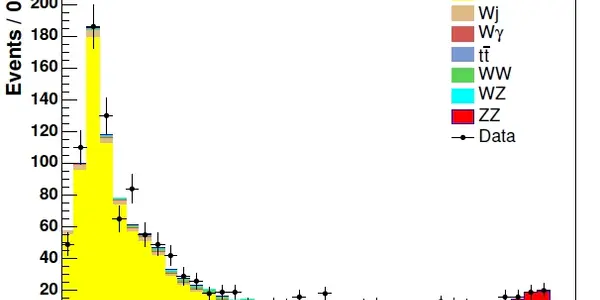
A new result for the production cross section of Z boson pairs in proton-antiproton collisions at the 2-TeV Tevatron collider is now public, thanks to the efforts of the CDF collaboration. The measurement, in a nutshell, confirms Standard Model predictions nicely: the cross section is determined to be 1.45 picobarns, with an asymmetric error bar of of +0.60-0.51. The Standard Model, on the other hand, predicts that the cross section is 1.21 picobarns. The agreement of the two numbers, within uncertainties, says that all is well in the searched final state, and no unforeseen effects are at work.
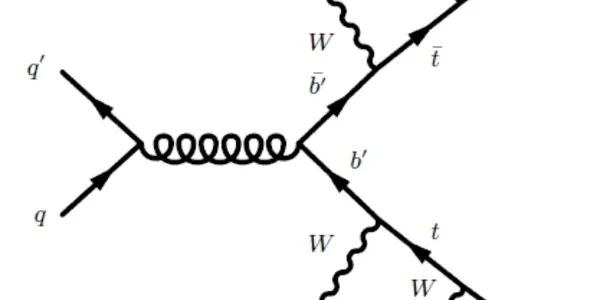
Our present understanding of fundamental physics implies the existence of three generation of matter particles, which we consider structureless and "elementary", both in the sense that they cannot be divided into smaller entities, and in the sense that they are the building blocks of all observed manifestations of matter.

The time is now. If you are going to fantasize about the possibilities of an extended Tevatron running and how likely it is that your favourite physics model may be tested by CDF and DZERO, you are advised to get in the game.
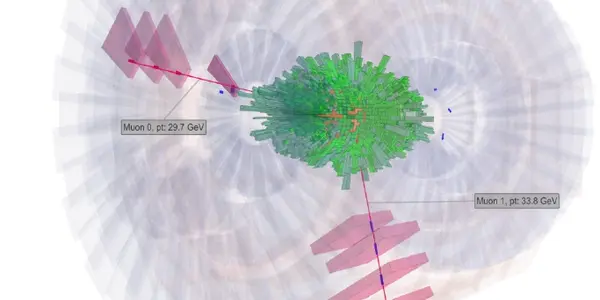
A really interesting piece of news comes from the CERN laboratory today. The CMS experiment has detected a handful of Z boson decays in events featuring the collision between heavy ions, accelerated to energies of hundreds of GeV per nucleon.

Scientific American features an excellent article by Garrett Lisi and James Owen Weatherell, with title "A Geometric Theory of Everything". It is a rather clear explanation of the ideas behind the recent articles published by Lisi on the E8 group and how this exceptionally rich mathematical structure could embed the representation of all particles and forces of nature.
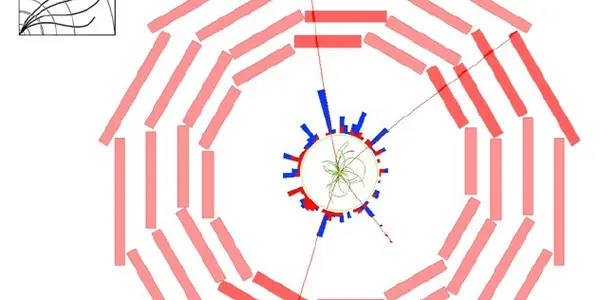
As beautiful as they get, or even more so. It is hard to express the beauty of the event that the CMS collaboration published today. CMS, which stands for "compact muon solenoid", is one of the two main detectors operating at the CERN Large Hadron Collider (the other is ATLAS). The duo is seeking evidence for the Higgs boson, the only elementary particle predicted by the Standard Model that still awaits to be discovered.

Giorgio Chiarelli is a particle physicist. His research activity has been based largely at the Fermi laboratory near Chicago, US, at the CDF experiment. In 1994-96 he actively participated in the discovery of the top quark and in the first measurements of that particle's properties. Later, after directing the construction of a part of the new CDF detector, he moved its research interests toward the search for the Higgs boson. Currently he is a INFN research director in Pisa, where he leads the CDF-Pisa group. In the most recent years he dealt with problems connected with the communication of science.
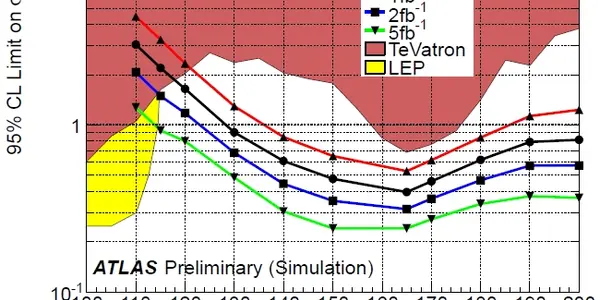
The ATLAS collaboration has just released an important study of the sensitivity to a standard model Higgs boson. For the first time precise predictions are made for LHC running at a centre-of-mass energy of 7 TeV (but also 8 and 9 TeV are considered, given the possibility that next year the energy is bumped up a bit), and for most of the sensitive channels together.The public document is long and detailed, and I have no time to discuss its intricacies with you here, nor do I believe that you would actually want me to. But I do want to discuss one of the most significant figures in the note. It is shown below.

News from the LHC: the integrated proton-proton luminosity at 7 TeV centre-of-mass energy has generously passed the mark of 40 inverse picobarns yesterday. The CMS experiment alone has integrated over 42 inverse picobarns, as shown in the graph below (the blue curve shows the data collected by CMS, the red one the data produced by the LHC).
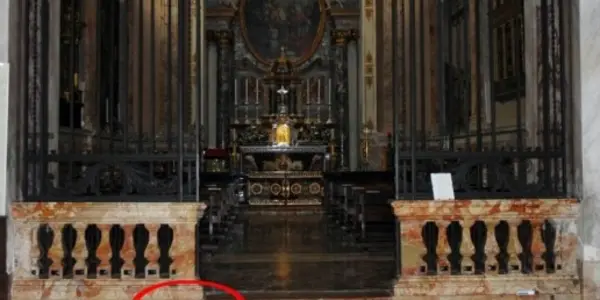
The priest of Vigevano's Duomo must have been startled to realize that by far the most faithful presence at mass, ever since the altar was built, is not nonna Pina but a real dinosaur -a glaring testimony of the falsity of catholic-diffused pseudoscience and of the true origin of life on Earth. The red circle in the picture on the right shows the location of the marble slab in the altar.
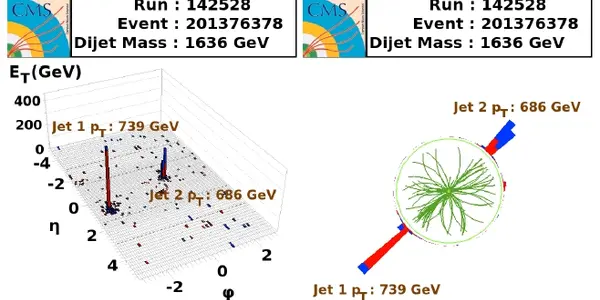
The CMS experiment has just released a new result which excludes the possibility that quarks have a substructure at energy scales below 4 TeV. The result comes from the analysis of just a handful of inverse picobarns of collision data -2.9 to be precise- and shows excellently just how well suited are the LHC collisions for this business. The limit is extended by over one TeV above the former result of the Tevatron experiments, and some 600 GeV above the results of the ATLAS collaboration, who also recently reported on their search for of quark compositeness in 7 TeV collisions, finding a limit at 3.4 TeV.

Week number one of my course on Subnuclear Gauge Physics is over. I think that in the first five hours of lesson I have given to my students a reasonable picture of the early experimental attempts and theoretical developments aimed at understanding the structure of atomic nuclei and individual nucleons with electron scattering. So I thought I might try and simplify the picture further, to reach a wider audience here. Of course, the topic is not terribly entertaining, unless one understands fully just how important these studies are for fundamental physics even nowadays -despite having started over 60 years back.