More on Radiacode 110
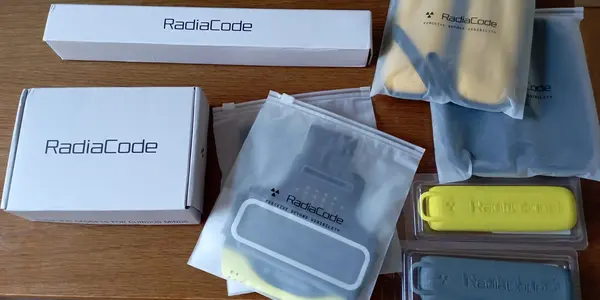
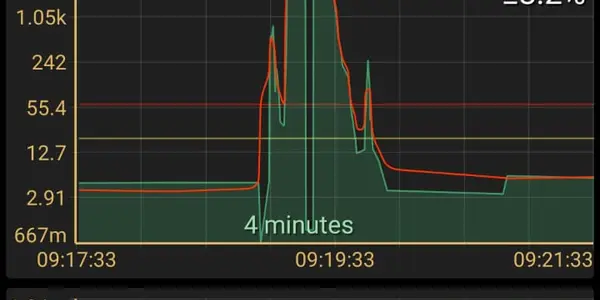
This is the second post reporting a few tests of the Radiacode 110 spectrometer, an extra-cool pocket dosimeter/radiation counter/spectrograph sold by RadiaCode.
This is the second post reporting a few tests of the Radiacode 110 spectrometer, an extra-cool pocket dosimeter/radiation counter/spectrograph sold by RadiaCode.


The CDF Collaboration has recently produced results of a search for Supersymmetric Higgs bosons in events with three or more bottom-quark jets. Here I wish to give just the highlights of this analysis, but before I do I will try to spend 5' on making sense of the previous sentence.In good order, below I explain first of all 1) what is CDF, 2) what is the Tevatron, 3) what are Higgs bosons from Supersymmetry, 4) how can these be sought with bottom quarks, and 5) what are bottom quark jets. After I am done with these five explanations, those of you who are still here will no doubt appreciate the results I am showing today. Can I make it in 5 minutes ? Sure, but can you read forty lines of text in the same amount of time ?

Today is a good day: I can rest in peace without working out my daily share of science popularization here, because I have something better to do, which will have a much more sizable positive effect for the diffusion of particle physics. In fact, I hold in my hands a brand new copy of Gian Francesco Giudice's book, "A Zeptospace Odyssey - A Journey into the Physics of the LHC". All I have to do is to explain to you why you really should buy, read, and give as a present this book to all your friends.Gian Francesco Giudice

Ah, the joy to see bosons in our first 7-TeV proton-proton collisions at LHC! The CMS experiment has released two days ago its first results on W and Z bosons, plus many other riches. Of course, these plots are only demonstrative, since the statistics is still ridiculously poor if compared with the wealth of data available at the Tevatron. But still, these are collisions at 3.5 times more energy, and the machine is doubling its luminosity every week or so, so I expect that very soon the distributions will stop looking rough and will start containing real information, to be converted in meaningful measurements of the relevant physical quantities.J/Psi mesons

It is Sunday morning, and I am about to leave for a day on the beach, the first of this busy 2010; so this post will be shorter than I would like it to be... There would be lots to say about exclusive physics at colliders. But I still want to share with you a figure extracted from a recent 4-page preprint article by James Pinfold, who nicely summarizes the signals and searches for exclusive processes at the Tevatron proton-antiproton collider.

Not even a week has passed since the announcement by Carlo Rubbia that the ICARUS experiment is collecting its first neutrino interactions, that another experiment at the Gran Sasso Laboratory claims the international scene of neutrino physics. And this time with a real reason. Not the observation of the first events - the experiment in question, OPERA, has been active for more than three years now- but for the observation of a fundamental process that had never been seen before!

In a mail message sent to the INFN president Roberto Petronzio and a few other distinguished particle physicists (not me, I got it third-hand), Carlo Rubbia announced today at 3.53 PM that the ICARUS experiment has begun operations. Below is the unamended text, which I excuse myself if I distribute freely, given the scientific value of the information and my conviction that I am not harming in any way the experiment nor the people involved (leave alone my own employer, INFN):"We have the pleasure to announce that today at 12:14. immediately after turn on of the detector, tracks have been observed by one of the cryostats of T600 triggered by the internal phototube counters.

And after all, it is just a matter of language. I am convinced that 99% of the reason why a person with no scientific background cannot follow the developments of a particular research topic, despite a strong will, is language. Not the lack of ten years of specialization, nor the dearth of basic knowledge. Anything that can be explained in plain English -anything- can be understood by an English speaker willing to listen.So why is it so hard then? Cannot we, the scientists, just make that little extra effort and step down a bit from our self-erected podium? Or is it not really needed, given the number of science reporters out there, who actually do a pretty good job in most cases?
I read with pleasure today a proceedings writeup of the Moriond 2010 talk given by S. Andringa on behalf of the Pierre Auger Observatory. It is too bad that I did not visit La Thuile this year: the venue of the Moriond conferences is always a very pleasant place to spend a week, with talks scheduled in the morning and evening which leave the central hours of the day free for skiing. My last trip there was in 2005: I need to make the case for another visit next year!

Finally, the Bose-Einstein Correlations article by CMS to which I have personally contributed during the last few months is now an arxiv entry, and has been sent to Physical Review Letters. This is a success for the CMS collaboration, since we are the first to measure this effect in the new LHC proton-proton collisions, at 0.9 and 2.36 TeV of center-of-mass energy.

If you follow the blogosphere as a source of information on cutting-edge high-energy-physics results, you certainly by now know that the DZERO collaboration has produced a new exciting result. They find a 3.2 standard deviation effect in a study of charge asymmetry of muon pairs, which can be due to a unexpected, large source of CP violation -one which constitutes a very good shot at explaining the origin of the matter-antimatter asymmetry of the Universe!

While around the world particle physicists are working frantically to produce important new results to be shown at ICHEP 2010 -the International Conference on High-Energy Physics, which is held every two years and is arguably the single most important meeting for this branch of science-, new discoveries get claimed in an asynchronous way. And some of them in a very asynchronous way, I should say, since they are based on 40-years-old data.
Academics pay a lot of attention to the quality of their writings. It is generally a point of pride to publish flawless documents, and this is felt in scientific disciplines just as much as in literary ones. If I told you how much time the members of a scientific experiment such as CDF at the Tevatron or CMS at CERN (the ones I work in) spend in the review of their articles before these are sent to the publishers, you would be startled.