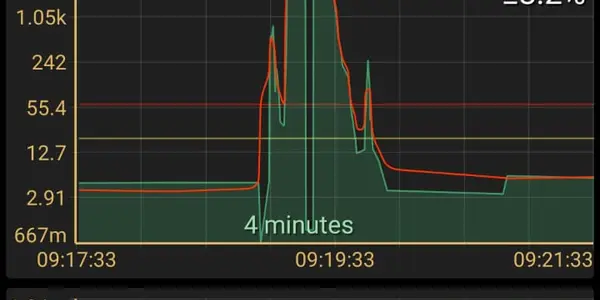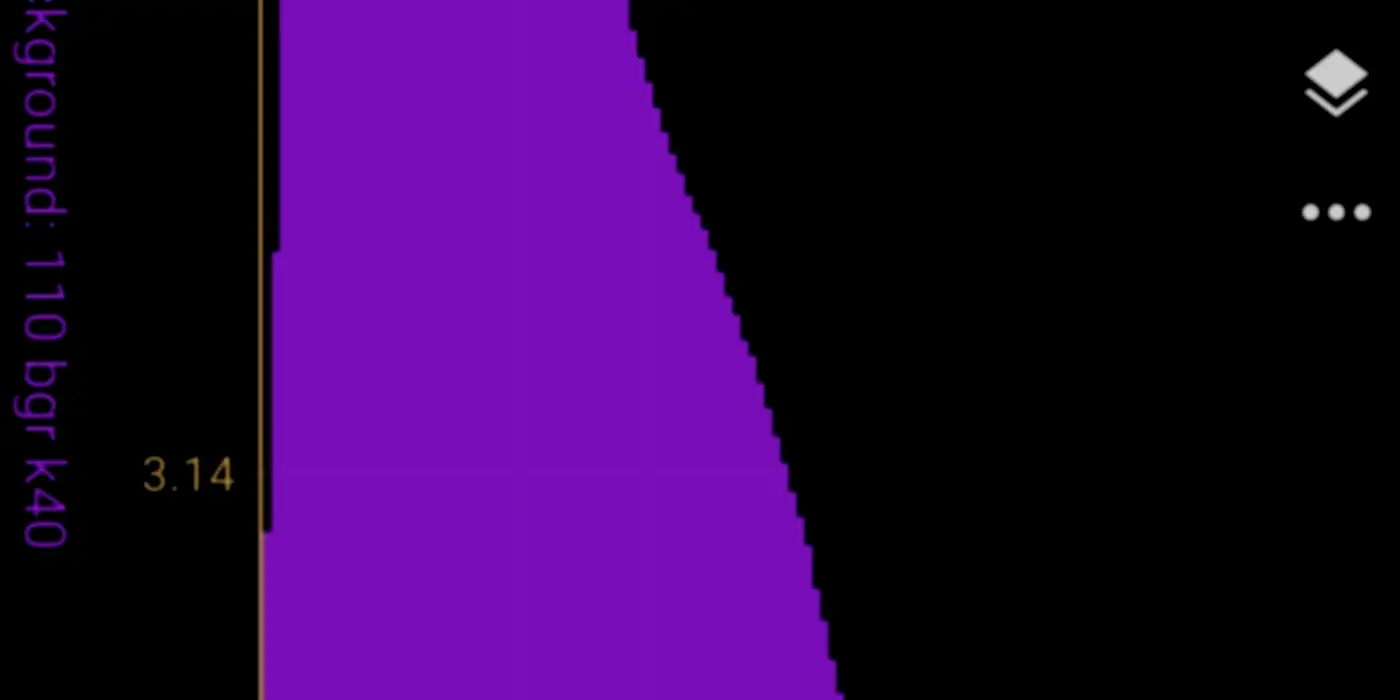
More on Radiacode 110
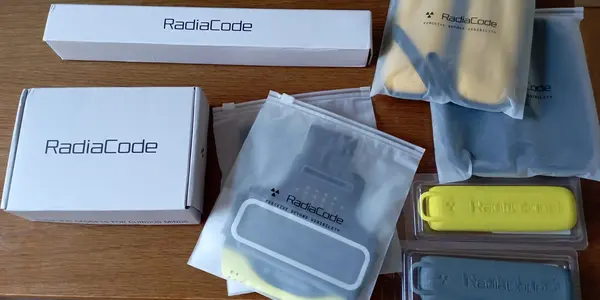
This is the second post reporting a few tests of the Radiacode 110 spectrometer, an extra-cool pocket dosimeter/radiation counter/spectrograph sold by RadiaCode.
This is the second post reporting a few tests of the Radiacode 110 spectrometer, an extra-cool pocket dosimeter/radiation counter/spectrograph sold by RadiaCode.


A video on youtube documents a remarkable feat -the Australian motorbyker Robbie Maddison jumping the Korynth channel in Greece. A 85-meter jump!

The CDF Collaboration blessed yesterday afternoon the results of a search for massive Gravitons decaying into pairs of Z bosons. And it is a startling new result!Usually after a blessing (which is the result of a collaboration-wide presentation when the analysis is given a final scrutiny) the results are not immediately made public: this non-written rule has the purpose of allowing the analysis authors to be the first to present the results at a conference or other public event. But the rule written in the CDF bylaws, on the other hand, say that after a blessing the result is public, so for this time I will stick to the written one, and fair play be darned this time... The chances to announce what might be the first evidence of gravitons is too appealing!

We are on. This afternoon just after 1PM the LHC beams have started to produce proton-proton collisions in the heart of the experiments, at the never-before achieved energy of 7 TeV.It was a long journey to get here -the project is twenty years old- but this is just the start of a new, more exciting one: In the course of the next two years, the Large Hadron Collider will gradually increase its power, allowing the CMS and ATLAS detectors to collect enough data to significantly extend into discovery territory.

Marco Silva (right) is an amateur astronomer since the 1997 Hale-Bopp comet passage. He is also an amateur scientist. His studies can be found in his web site. When I knew of his interesting measurements of cataclysmic variable stars, I invited him to write about the matter for us here.... Cataclysmic Variables

The number in the title, interpreted in units per square centimeters per second, is a flux rate, and it is a new world record set by the Tevatron collider last night on the number of protons and antiprotons forced to cross each other within a tiny interaction region in the core of the CDF and DZERO experiments.
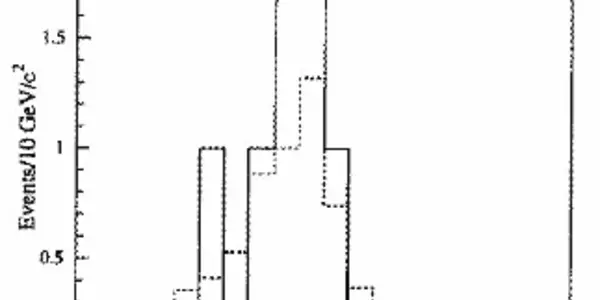
It makes me very happy when I see new precise results on the mass of the top quark being produced by the CDF collaboration (to which I still proudly belong). CDF, one of the two hadron collider experiments operating at the 2-TeV Tevatron proton-antiproton synchrotron in Batavia, IL, has been measuring the top quark mass since 1994, one year prior to its discovery. The figure with the top candidates (histogram) from which the mass measurement of 174+-12 GeV was obtained in 1994 is shown on the right below; backgrounds and top expectation are shown by hatched lines.

A brand new result in Higgs boson physics has been presented by my old-time CDF colleague Wei-Ming Yao at the Moriond QCD conference two days ago. It is the combination of CDF and DZERO limits on the Higgs boson, and it constitutes a significant advancement in our knowledge of the standard model.The result is simple to state in a single sentence, although it will take me several pages to explain it acceptably. The Higgs boson is excluded at 95% confidence level in the 130-210 GeV mass range, if there are four generations of matter fields.

Have you ever seen a galaxy ?I mean, not a picture of one. The real thing. A picture is a representation of reality, and as such it conveys to our senses only a pale suggestion of the stimulation that experiencing the real thing provides. In a world where images, still and in motion, have a dominant role in our lives, we tend to forget how different are some things when we experience them directly.
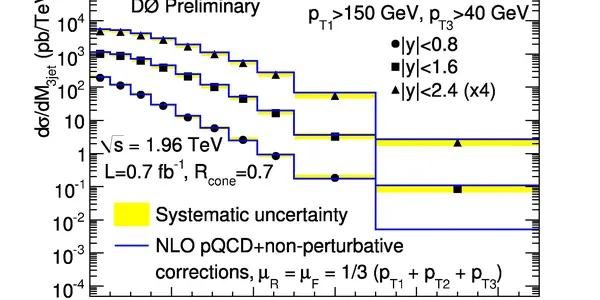
I was delighted to receive news this afternoon of three new interesting results produced by the DZERO collaboration in the analysis of Quantum Chromodynamics (QCD) processes.QCD, the theory of strong interactions between quarks and gluons, is the "boring" part of the physics of high-energy hadron-hadron collisions. It used to be more more exciting twenty years ago, when the theoretical calculations were not as refined as they are now, and there was still a lot to understand in the physics of strong interactions between quarks and gluons. But nowadays, things are much more clear.

How do we fix science journalism ? Simple: we don't. We let it sink, and be reborn in a different form.It is rather utopic to insist that in a world of changing means of communications, a world where printed matter is losing ground to the advantage of electronic media, the diffusion of scientific information may or shall stay the same.

Yesterday somebody asked me here if I could explain how does a muon really decide when and how to decay. I tried to answer this question succintly in the thread, and later realized that my answer, although not perfectly correct in the physics, was actually not devoid of some didactic power. So I decided to recycle it and make it the subject of an independent post. Before I come to the discussion of how, exactly, does a muon choose when and how to decay, however, let me make a few points about this fascinating particle, by comparing its phenomenology to that of the electron.

The CDF collaboration has recently released new results from a search for what is probably the clearest signature of Higgs boson decay: pairs of high-mass photon candidates. I am very glad to see this new analysis out for publication, since so far only DZERO, CDF's competitor at the Tevatron, had produced results on this particular final state.