More on Radiacode 110
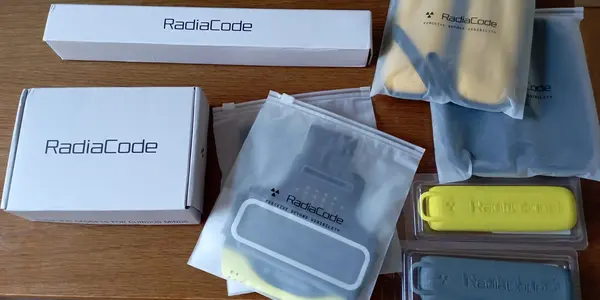
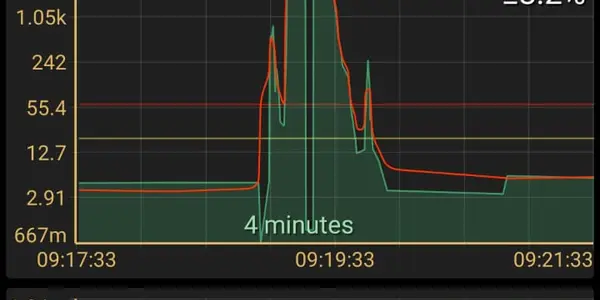
This is the second post reporting a few tests of the Radiacode 110 spectrometer, an extra-cool pocket dosimeter/radiation counter/spectrograph sold by RadiaCode.
This is the second post reporting a few tests of the Radiacode 110 spectrometer, an extra-cool pocket dosimeter/radiation counter/spectrograph sold by RadiaCode.

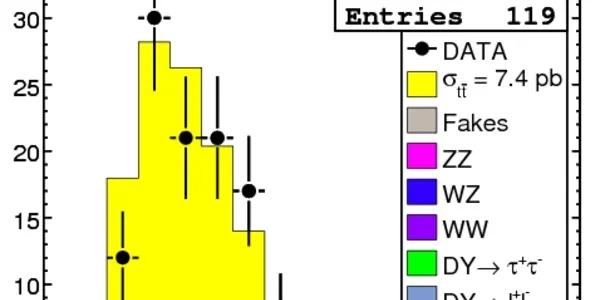
I do not know about you, but top quarks fascinate me. Since my early years as a student in particle physics I participated in the top search, and then the top discovery, with the CDF experiment at the Tevatron collider; and I then worked for many more years with top quark samples. And that particle is fascinating for many different reasons: its phenomenology, the richness of its decays, its mass close to the scale of electroweak symmetry breaking. I feel honored by having had a chance to study the first few tens of top quark events that physicists have been able to produce, and yet I regret that during the last few years I have been unable to put my hands on the much larger datasets collected by the CDF experiment.

Tomorrow morning Venice will sink under a maximum tide predicted to reach 1.30 meters above average sea level. The event will occur at 8.35AM, a time when Venetian residents are in the streets trying to bring children to school or to reach their workplace. You can see the predicted evolution of the tide in the graph below, where the red curve shows the time variation of the season's average, and the blue one the actual prediction for tomorrow. The peak of 130 cm above average sea level is predicted to occur at 8.35AM -which is 2.35AM in New York, or 5.35PM in Tokyo.
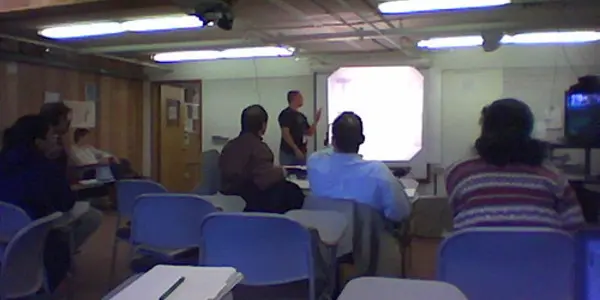
This is the second part of a two-part collection of tips for particle physics graduate students. The first part is here.Three: be a fool today if you want to be a guru tomorrowThe third advice I have in store for Jane is maybe the toughest to follow, at least at first. But I do believe it is of critical importance for her to grow, become knowledgeable, and distinguish herself from the rest of the pack.
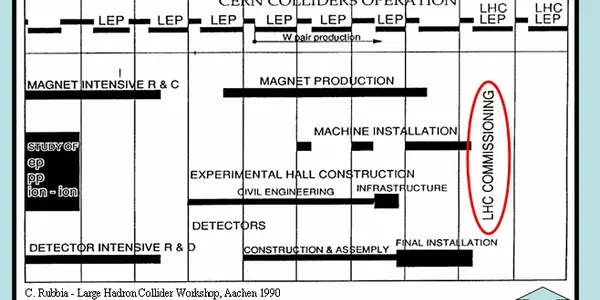
My blog is not a place for hot-off-the-press news - in it you are more likely to find discussions on material well digested and thought over. Nevertheless, I do not have the guts to sit on today's news. The Large Hadron Collider at CERN has produced its first high-energy proton-proton collisions, in the core of the experiments instrumenting its underground caverns.It has been a long way since the first design of this extraordinary machine. I was reminded of just how much effort the construction and commissioning took by a slide shown by Ives Sirois at a workshop in Turin today: it is a schedule of the construction of the LHC dated 1989!
Being a graduate student in particle physics is a tough, stressful job. I know it because I once was one, and I still remember the burden of giving exams, carrying on single-handedly a difficult analysis, and desperately struggling to learn the job of particle physicist, all the while trying to prove my worth to my colleagues. On the personal side, further trouble compounds the situation: one is usually fighting with tight money, stranded away from her family and boyfriend, and finds herself in the company of people whose similar priorities make the otherwise natural impulse of "having fun whenever possible" the last of their thoughts.
It happens in the best families, so they say. Two experiments work 24/7 to produce an improved result on the Higgs search, and the result is disappointing, to say the least.I am talking about the Tevatron, of course. For a little while longer, CDF and D0 will have the exclusive on Higgs boson searches. Last March, we all rejoyced when we saw that the Tevatron was starting to become sensitive to a high-mass Higgs, and indeed it excluded its existence in a range of masses between 160 and 170 GeV. We were waiting for more exclusions for the winter conferences of 2010, when more data would be used to produce improved results. Instead, no improvement, but actually, a retractatio. How is that possible ??
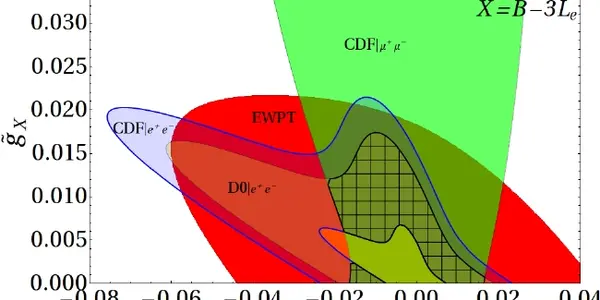
I recently discussed here the Tevatron results of searches for new Z bosons in electron-positron or dimuon samples collected by CDF and DZERO, pointing out that there seem to be a couple of intriguing upward fluctuations in the data. One of the dielectron fluctuations sits at a mass of 240 GeV, the other, also in the dielectron spectrum, is at about 720 GeV. Neither is compelling.
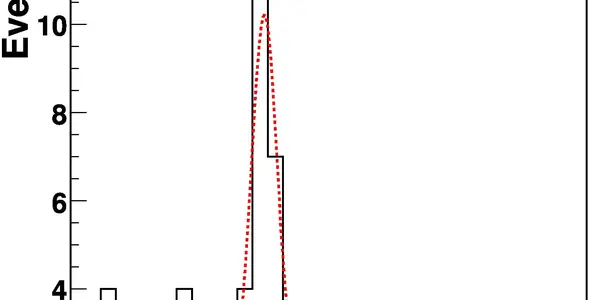
Last May the CDF collaboration published their observation of the baryon, a particle made by a very exotic "bss" quark triplet. The CDF result came almost one year after a similar measurement was published by the competitor experiment, D0.
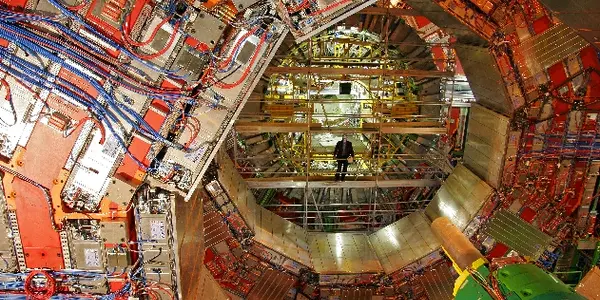
Today I got access to a collection of very cool pictures of the CMS detector, one of the two experiments designed and built to study proton-proton collisions delivered by the Large Hadron Collider at CERN. Many of those pictures, which were taken by Michael Hoch (CERN/CMS) in the last couple of years, have circulated in the web for a long time, and individual ones have been used in several places. However, they are very nice to browse one after the other. And I think they are even more interesting to watch if one has not had the privilege of visiting the giant detector in its underground cavern, during its assembly last year. So I take the liberty of showing them to you here, in case you missed them - or just like to refresh your memory on this technological marvel.
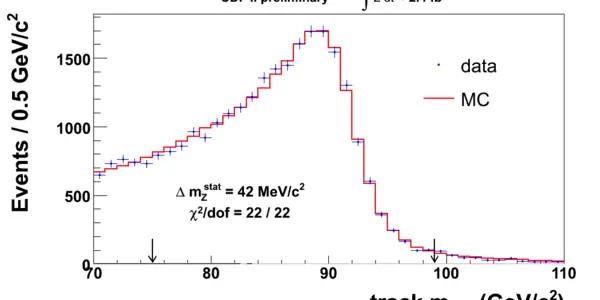
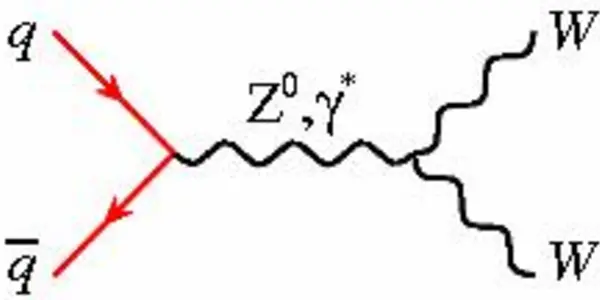
A good part of basic research in fundamental physics focuses on the definition, the prediction, and the measurement of quantities which put the current theory -the standard model- to the test in the most stringent way possible. The choice of the quantities on which to base our comparisons between theory prediction and measurement is critical: it entails understanding what may make the comparison imprecise (i.e. experimental systematics affecting the measurement) or fruitless (i.e. theoretical assumptions or a bad definition of the quantity to measure).One clear example, which I used last week in my lessons of Subnuclear Physics to undergraduates in Padova, is the measurement of the W and Z boson cross sections at the Tevatron proton-antiproton collider.
I am presently into the second week of my lessons of Subnuclear Physics for the 2nd year of specialization in Physics, and I have just finished a lesson discussing the current searches for the Higgs boson at the Tevatron collider. Since the course has a focus on experimental techniques, I found it useful today to give as an exercise the determination of an order-of-magnitude estimate of cross section limits that the CDF experiments can set on a 160 GeV Higgs boson, with the data so far analyzed. It is an exercise I worked out by heart during my walk to the Physics Department: this should tell you it is not of overpowering difficulty.
These days the Higgs boson search is a bit over-hyped, with the impending competition between Tevatron and LHC on the discovery of the fabled boson making headlines every time there is a new, even minor, update in the results of the CDF and D0 experiment. But the hunt is on for many other, maybe even more interesting, rare processes.