More on Radiacode 110
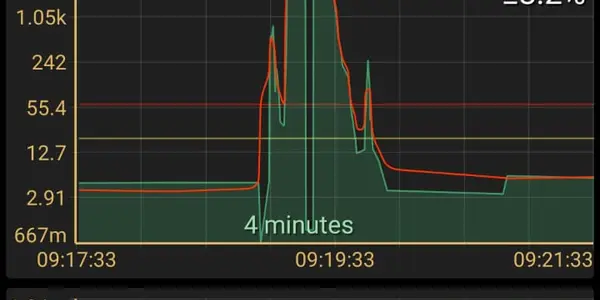
This is the second post reporting a few tests of the Radiacode 110 spectrometer, an extra-cool pocket dosimeter/radiation counter/spectrograph sold by RadiaCode.
This is the second post reporting a few tests of the Radiacode 110 spectrometer, an extra-cool pocket dosimeter/radiation counter/spectrograph sold by RadiaCode.


Today I wish to offer you the preview of a poster which I am going to show on September 1st in Kobe, Japan, at a session of the 29th edition of the Physics in Collisions conference.

Today I wish to offer you the figure attached at the bottom of this article, which shows a combination of recent determinations of the rate at which the Tevatron proton-antiproton collisions produce single top quarks.

Today, although fully submerged by an anomalous wave of errands which had been patiently waiting for my return at work, I heroically managed to dig out of the ArXiv a paper worth a close look.

The figure shown below represents the best measurement of the top quark mass ever obtained by a single experiment, and it is a determination with a less than 1% total uncertainty. It has been approved last week by the CDF experiment at Fermilab.The CDF experiments collects proton-antiproton collisions delivered by the Tevatron collider, which imparts the projectiles with 1 TeV of energy each, for a center-of-mass energy of 2 TeV. This is still the highest energy ever achieved by a collider, although the record is going to be soon stripped off Fermilab by the Large Hadron Collider, which is due to start colliding protons with other protons at 7 TeV of energy this coming fall.

The World Conference on Science Journalism held in London 2009 has its own web site, of course. Today they were so kind to let me know they had published there the recordings of all sessions, among which was the one where I gave my speech. The session title was "Blogs, Big Physics, and Breaking News", it featured Matin Durrani as chair, and Matthew Chalmers, myself, and James Gillies as speakers. The abstract ran as follows:How are blogs changing the way science news develops and is reported?The commissioning of the Large Hadron Collider at CERN will offer atelling case study over the next few years. Who will be first with news

A couple of months ago I wrote here about the first observation of a process called "diboson production", a quite rare occurrence in hadronic collisions: for the first time, the CDF collaboration could observe that rare process in events containing hadronic jets, which are usually riddled by enormous backgrounds.

Tonight you have a chance to contribute to science -namely, the knowledge of our solar system- and have a lot of fun at the same time. Do you want to know how ? Then please read on.Comet Swift-Tuttle (left, courtesy NASA) may be far away by now, but the debris that gets thrown out in space during each of its passages in the proximity of our Sun traces the full elliptical orbit of the comet, like droplets of sweat of an athlete running the 10,000 meters in a stadium. And tonight, the Earth is going to plunge in the core of the filament of debris following the comet's orbit.

Amateur astronomers fond of visual observation of faint galaxies and other fuzzy treasures of the night sky are always in search of the best observative site, where to drag their large Dobsonian telescopes.Unfortunately, their road is always uphill - also in a metaphorical sense: light pollution is growing everywhere at a disturbing rate, and it has already erased all but the brightest stars from our urban and suburban skies.Many of our kids grow without having seen the Milky Way, and the few who are drawn to astronomy are surprised to realize, from the tales of older dogs like me, that it did not use to be that way.

Readers familiar with this blog know that I am a die-hard skeptic on the issue of physics beyond the Standard Model. However, today I am wearing my fluctuation-enthusiast hat, and I will be trying to argue in favor of the possible signal of new physics that is coming out of the Tevatron data. Please do not get confused: everything is still in order. Maybe.
Detailed balance is a simple and powerful rule to describe the dynamics of two-state systems.If you know the probability of a transition from a state A to the other state B of a physical system (in some appropriate time unit), and you also know the probability of the reverse reaction , then you automatically know what is equilibrium condition for N bodies distributed in the two states: .
Besides the usual share of random readers who google something and get directed here by mere chance (to be read: by the sheer amount of valuable information I have posted here), this blog is read by an interesting mix of particle physicists, students, experts in other fields of Physics, and Science amateurs -plus a small number of science reporters looking for news.Of course I love each and every one of my faithful readers like good teachers love their pupils, but among the varied crowd, the readers which I am most happy to host here are students and amateurs, because they provide me with true motivation for spending my time writing popularization articles. Without them, many of my posts would lose their meaning.

One year ago, a paper by a distinguished group of theorists announced first evidence of new physics from measurements of the properties of B_s mesons performed at the Tevatron by the CDF and DZERO experiments. They had combined all the available information, obtaining a result which disagreed with the Standard Model (SM) prediction by more than three standard deviations.