More on Radiacode 110
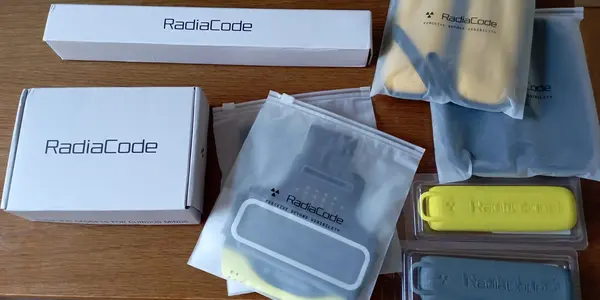
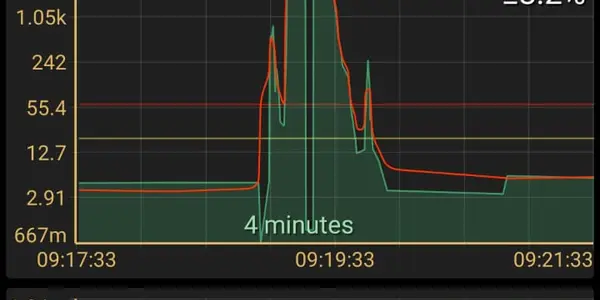
This is the second post reporting a few tests of the Radiacode 110 spectrometer, an extra-cool pocket dosimeter/radiation counter/spectrograph sold by RadiaCode.
This is the second post reporting a few tests of the Radiacode 110 spectrometer, an extra-cool pocket dosimeter/radiation counter/spectrograph sold by RadiaCode.

A Sunday morning browsing through preprints recently posted in the Cornell Arxiv revealed interesting reading material. If you have a couple of hours to kill next week, why not having a look at the following papers ? It will definitely hurt you less than spending the time on your WII or watching Jerry Springer.
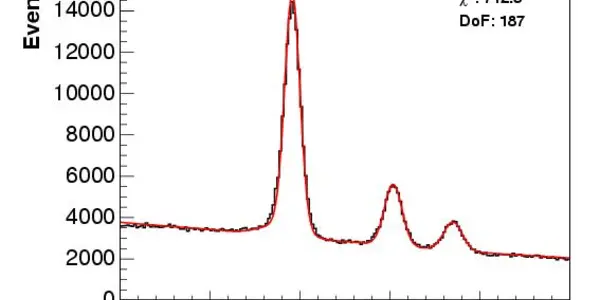
My statistics page depressingly shows that a large fraction of readers who visit this site do so for an average of 30 seconds. Maybe they were looking for something different, or maybe they do not like the content offered here. In any case, I have decided that my long, detailed articles about particle physics are not exactly meeting the demand of the audience. I am not going to change my writing style because of that, of course, but I will try to also offer some thirty-seconds physics bits here, every once in a while. So let me make a dry run, using a recent result by the CDF collaboration. The clock may start.

I have known Marco Cardin for a couple of years because besides being an accomplished amateur astro-imager he is also an avid visual observer. His encyclopedic knowledge of the night sky wonders is a great help on the field during the monthly night-long observations in dark, moonless nights we spend on the eastern Alps, trying to squeeze the most out of the 16" Dobson telescopes we carry with us. These instruments have no fancy "go-to" features, but with Marco's help and organization we can frame close to 100 rarely seen objects per night.
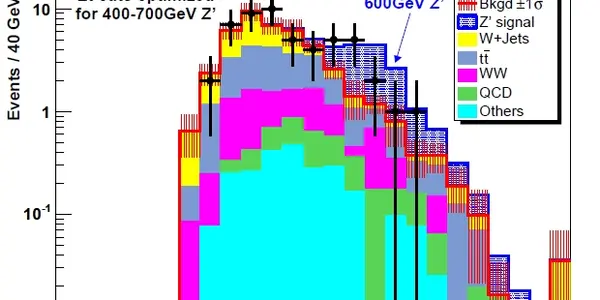
Ready for another turn into National-Enquirer mode of particle physics reporting ? I have a figure to discuss. It is a result now a few months old, but one which received little attention -less than it should have, perhaps. I myself got to see it only a few weeks ago in a presentation given by Jacobo Konigsberg, CDF spokesperson, at a workshop in Bologna.The scandalistic cut of this article is manifest in the title: facing a dearth of exciting reports of new physics discoveries, we are bound to now and then swerve off the path of our usual responsible handling of two-sigma effects, odd deviations, and assorted zoology. It is, I believe, a necessary resource to rely on, if we are to keep the interest of Science readers on particle physics.

As Hank explains in a recent article, when he visits a Casino he plays the Roulette. His simple strategy consists in betting on a single colour, doubling the bet every time he loses; when he wins, he starts back with the minimum bet.
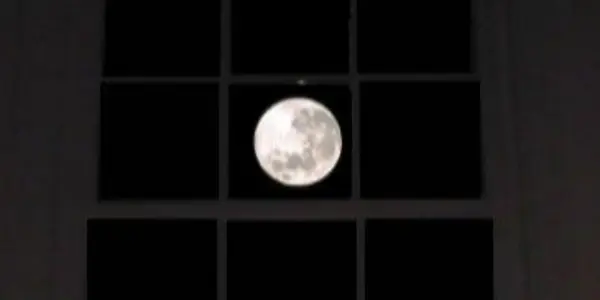
Have you ever caught yourself wondering, upon observing a seemingly utterly unlikely coincidence, whether there was anything supernatural at work that made it happen ? I would guess that all of us, even the most rational thinkers, have caressed that thought for a minute, at least once. A few typical examples can be given of situations which one apparently fails to ascribe to natural causes:1) Grandma dreams of her deceased husband spelling a sequence of numbers, and the following day she sees the same sequence coming out at Lotto. Was grandpa trying to let her win a large sum ? It will be quite hard to convince her otherwise.
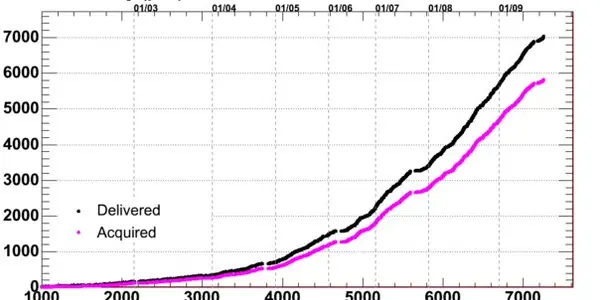
Americans, but in general scientists, and science-lovers of any country, should be proud of the achievements of the Tevatron collider, the 2-TeV proton-antiproton collider build over a quarter of a century ago under the prairie of Batavia (IL), and which is still the world's most powerful, and may I say successful, particle accelerator ever built by humans.
The web site of the Cornell preprint archive, arxiv.org, says it best: successful submissions to the preprint archive are a source of considerable pride (darn it, the page with the exact statement is only available just after you submit a paper, so I cannot quote it literally here since my browser has by now forgotten it!).
Ah, the pleasure of study! I had forgotten the immense intellectual pleasure one may derive by reading a stimulating, informative book. And if half a lifetime has passed from the last time you studied something, and what is left in your brain of it is just Culture, then reading it back again combines the pleasure of the discovery (a rediscovery, in this case) with the one of putting things in perspective, combining the bits of information you recollect with all the knowledge you have acquired since the last time you put the book down.

Carl Brannen is well known to the regulars of this blog. He is an independent researcher and my favourite non-professional theorist, because he gives me the hope that brilliant minds, who were diverted from the natural path of doing basic research, may return to it for good. And Carl provides us with another important proof: that institutionalized science does sometimes listen to the voice of those who have something to say regardless of who signs their monthly paycheck.
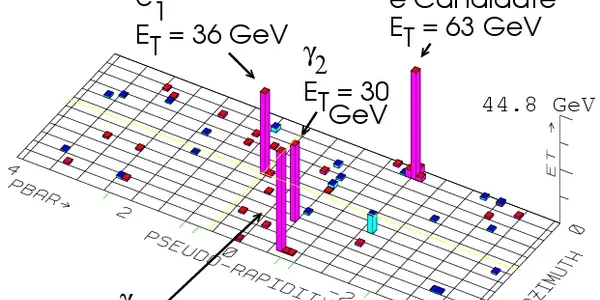
Do you remember the "e-e-gamma-gamma-met" event ? I am sure you do not. It is an incredibly striking event that appeared toward the end of the Tevatron Run I in the CDF data. One event that was so incredibly striking, so impossible to produce through standard model processes, that many in my experiment felt sure that it was going to be the portal through which we would enter the realm of Supersymmetry, or other fancy new physics scenarios.
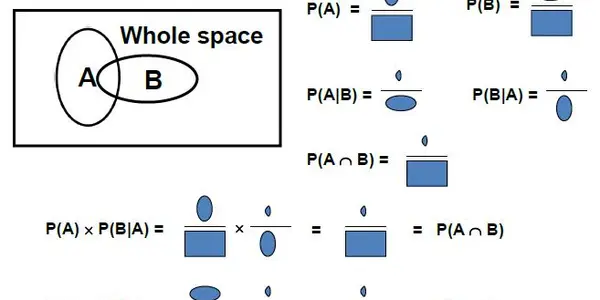
Everyday use of a mathematical conceptThe concept of probability is not alien to even the least mathematically versed among us: even those who do not remember the basic math they had in primary schools use it currently in their daily reasoning. I find the liberal use of the word "probability" (and derivates) in common language interesting, for two reasons. One, because the word has in fact a very definite mathematical connotation. And two, because the word is often used to discuss the knowledge of a system's evolution in time without a clear notion of which, among either of two strikingly different sources, is the cause of our partial or total ignorance.