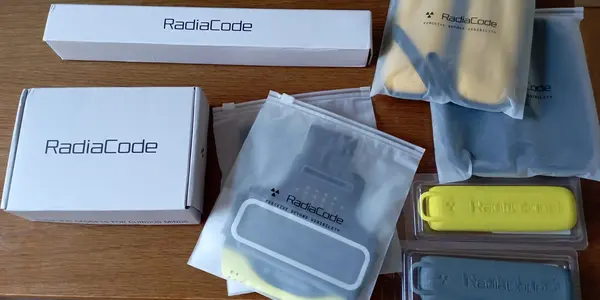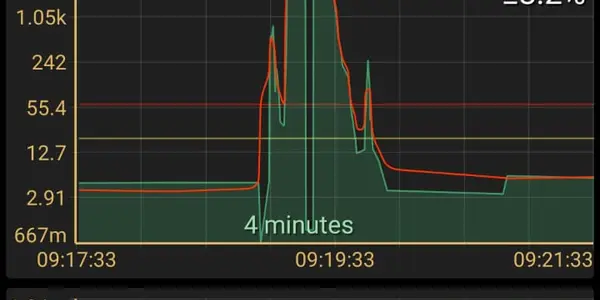
More on Radiacode 110
This is the second post reporting a few tests of the Radiacode 110 spectrometer, an extra-cool pocket dosimeter/radiation counter/spectrograph sold by RadiaCode.
This is the second post reporting a few tests of the Radiacode 110 spectrometer, an extra-cool pocket dosimeter/radiation counter/spectrograph sold by RadiaCode.

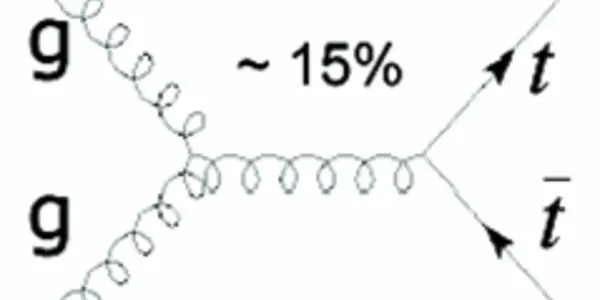
Today's visit to the Cornell Arxiv, the repository where scientific papers on physics, astrophysics, mathematics, and a few other disciplines are made publically accessible before getting published on paper, was a productive one. Some casual browsing allowed me to learn a few random things on topics I know little or nothing about; but what really made my day was reading study by a few distinguished theorists (Vernon Barger, Wai-Yee Keung, and Brian Yencho), who considered a collider signature I had been fantasizing about in the past.

Being capable of asking the right question is a crucial skill. Dick Feynman tells a story in his book, "Surely you're joking, mr. Feynman": at a meeting with a bunch of military big shots he is shown the blueprint of a building meant to store radioactive material, he sees a symbol that he guesses represents a ventilation opening in the wall, and risking his reputation points the finger at it, asking what happens if the opening is occluded. The question turns out to be right on the money, and as a result his reputation gets a boost, plus the building does not blow up.

After re-emerging from a rather debilitating new years' eve banquet, I feel I can provide my own answers to the second batch of physics questions I proposed a few days ago to the most active readers of this column. Be sure about one thing: the answers to the three questions have already been given in some form by a few of the readers in the comments thread; I will nonetheless provide my own explanations, and in so doing I might pick a graph or two to illustrate better the essence of the problems. But first, there was a bonus question included in the package, and nobody found the solution to it. Here is the bonus question again:"What do you get if you put together three sexy red quarks ?"The answer is
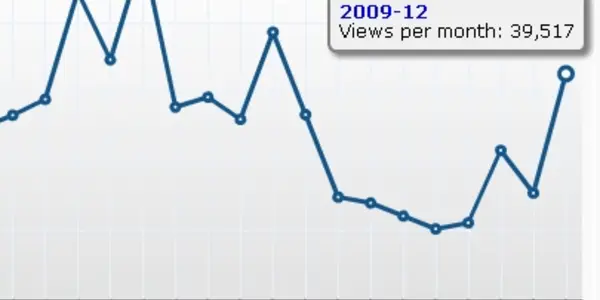
Okay, the year is not over just yet, but it is already time for a little accounting of the traffic on this site in the course of the last eight-and-a-half months -that is, since I moved my blog to Scientific Blogging.For this year's summary I have been inspired in part by Alex Antunes, who decided to pick his least read articles to draw some conclusions about what really does not sell well here. But I have of course also given a close look at what appears to appease your taste, dear readers.
The turnaround of the three physics questions I offered a few days ago, to stimulate your neurons and extract you from the chocolate and alcohol flood caused by the usual string of Christmas parties and dinners, was rather scarce. Despite that, I wish to repeat the offer today, making some adjustments to reach a wider public. The questions I offer here are easier but still not accessible to everybody. However, my plans are that at least the answers I will give in a couple of days will be understandable. Further, anyone can try the bonus question I ask at the bottom of this piece...

Two days ago I offered you three problems in experimental particle physics, of varied complexity. Three readers tried answering the test in the comments thread: a rather underwhelming turnaround, but what did I expect - we are deep in Christmas vacations after all. I will give below my own answers to the questions, and then comment some of those I received. For ease of reading, I paste here again the three questions.
Scared by the void of Christmas vacations ? Unable to put just a few more feet between your mouth and the candy tray ? Suffocating in the trivialities of the chit-chat with relatives ? I have a solution for you. How about trying to solve a few simple high-energy physics quizzes ? I offer three questions below, and you are welcome to think any or all of them over today and tomorrow. In two days I will give my answer, explain the underlying physics a bit, and comment your own answers, if you have been capable of typing them despite your skyrocketing glycemic index.
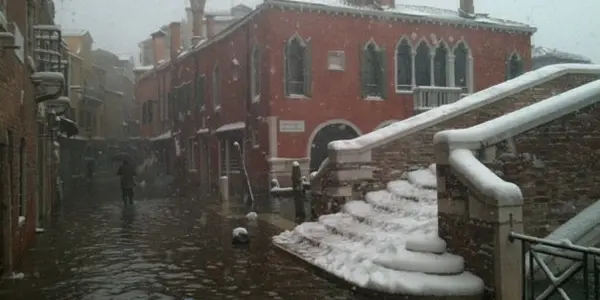
Yesterday morning Venice awoke in the middle of a snowstorm. It is a very rare phenomenon to see snow in sizable amounts in the island, and the times that I have seen four inches build up on the ground are probably no more than a handful.But the morning was also marked by another phenomenon -less unusual, but still rare: a strong acqua alta. The sea rose to 1.15 meters above its average level, and flooded calli and campi with up to ten inches of water.
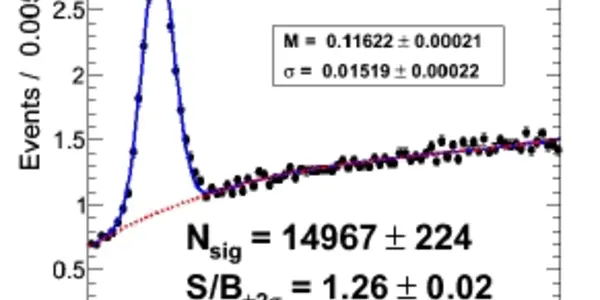
This morning LHC machinists, experimentalists from the LHC experiments, as well as other CERN personnel gathered in the Main Auditorium at CERN to give their end-of-year report. After a LHC status report the spokespersons of ALICE, ATLAS, CMS, LHCB, and TOTEM briefly flashed their first experimental results, obtained from 900 GeV and 2.36 TeV collisions acquired in the course of the last three weeks.
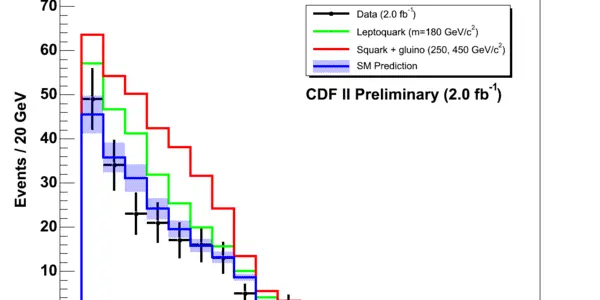
The signature of large missing energy and jets is arguably one of the most important avenues for the study of potential new physics signatures at today's hadron colliders. The above concept marks an interesting turn of events: the years of the glorification of charged leptons as the single most important tools for the discovery of rare production processes appears behind us. The W and Z discovery in 1983 by UA1 at CERN, or the top quark discovery by CDF and DZERO in 1995 at Fermilab, would have been impossible without the precise and clean detection of electrons and muons. However, with time we have understood that missing energy may be a more powerful tool for new discoveries.

Tomorrow I will be packing up and leaving CERN to fly back home, after a quite eventful, productive, extenuating, exhilarating week. The reason for my coming to Geneva was the CMS week, an event that takes place four times a year, and where a good fraction of the members of our 2400-strong collaboration gather to listen to updates of the experiment, the detector, the analyses, and to discuss rules, appointments, organizational issues.
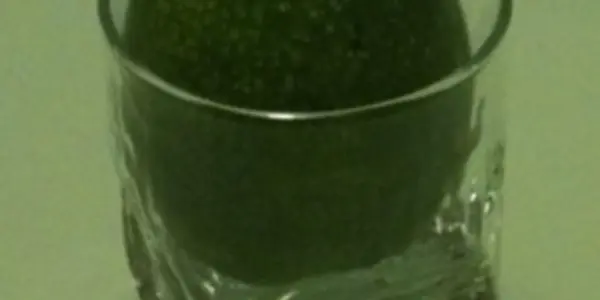
One of the cool things I have learned to do, through years of experience in data analysis at particle colliders, is to visualize the complex kinematics of a signal process in a multi-dimensional space, and imagine ways to separate it from backgrounds by selecting in the hyperspace the signal-rich region. I came across a very simple example of the above rather abstract statement yesterday, and I wish to share it with you.To help you visualize what I am going to discuss, here is the example: an avocado in a square tumbler. The avocado is top pair production, and the glass is Z plus b-antib production. ... Confused ? Let me explain.