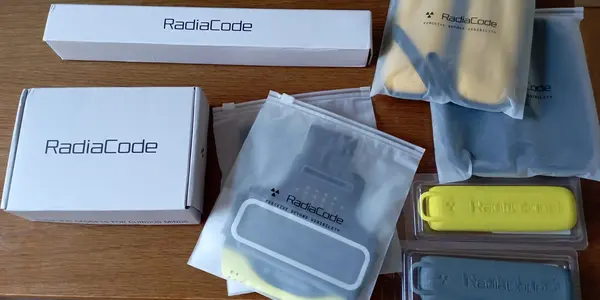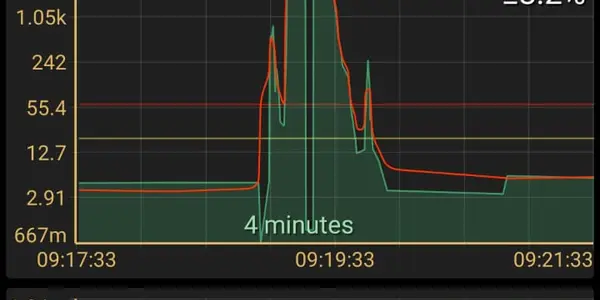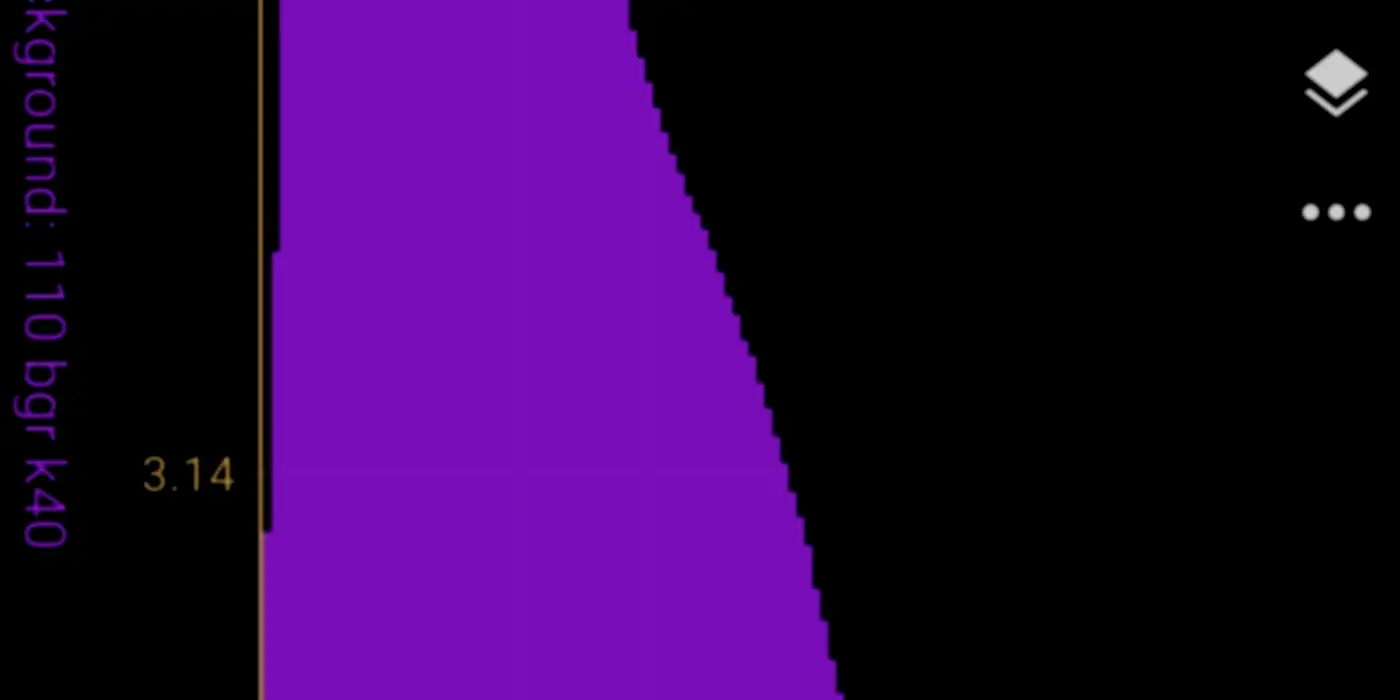
More on Radiacode 110
This is the second post reporting a few tests of the Radiacode 110 spectrometer, an extra-cool pocket dosimeter/radiation counter/spectrograph sold by RadiaCode.
This is the second post reporting a few tests of the Radiacode 110 spectrometer, an extra-cool pocket dosimeter/radiation counter/spectrograph sold by RadiaCode.


A new paper on the ArXiV caught my attention this evening for several reasons. First of all, because two of its five authors (J.Ellis, J.R.Espinosa, G.F.Giudice, A.Hoecker, and A.Riotto) are (or have been) my colleagues in Padova University; second, because the title is quite catchy; third, because indeed the results it presents are valuable food for thought.

In this two-parts article I wish to describe in some detail, but still at an elementary level, the characteristics of one of the most important probes of the physics of subnuclear collisions at today's particle physics experiments: jets of hadrons originated from energetic bottom quarks, or more familiarly, b-jets. By posting a dedicated article on b-jets, I hope I will be able to describe in more detail elsewhere other physics topics, such as Higgs boson decays or top quark signatures, without being hampered by having to introduce the phenomenology and detection of b-jets from scratch every time.

As silly as it may look, I am going to start this post by publishing for the third time in a row the same figure. That is because I want to keep the promise I made earlier that I would explain in terms as simple as possible (although not simpler) the details hidden behind the coloured curves and functions pictured there. I will also take this chance to come down a little from the level of technicality of the recent posts: after all, this blog is supposedly for everybody, and not just for Ph.D. students and recipients.
Yesterday I posted a short article whose main purpose was to show a figure I had received from Sven Heinemeyer, a phenomenologist who specializes in the study of Minimal Supersymmetric extensions of the Standard Model (MSSM).Besides predicting a mirror copy of Standard Model (SM) particles, MSSM models are characterized by containing not just one, but five distinct Higgs bosons; over much of the space of possible parameters of these theories, one of the five Higgs bosons is quite similar to the one and only SM Higgs, so that one can discuss the SM Higgs and the lightest neutral scalar of the MSSM together without generating confusion.
...waiting for a piece I will post tomorrow, to stimulate your curiosity -and allow me to travel from Venice to Patras by ship, with no internet connection.The subject is not only the Higgs mass, but the top quark mass. Which top mass ? The "pole" mass -the real part of the pole in the perturbative top-quark propagator. Have I lost you ? Ok, do not worry -definitions are for theorists. Let us just say that the top quark, being a complicated coloured object which thus cannot live free of the influence of strong interactions,is measurable at a hadron collider like the Tevatron only within uncertainties of the order of a constant called "Lambda QCD", which is of the order of 200 MeV.

A new public document has been made available on the CMS public web page yesterday morning. It reports on a study of the reach of the CMS detector, with data collectable in 2010, for a signal of large extra dimensions, using the very distinctive signature of a high-energy jet recoiling against -well, recoiling against nothing; or better, something which left our world and entered into another dimension of space.

The Arxiv is an online repository of scientific papers in physics, astronomy, maths, cosmology, computer science, and a few other topics, where papers due to be published on scientific journals are submitted by the authors, and become quickly accessible for free to anybody before the peer-review process ran by the journals is over and they get printed there.

Patrick Draper is a graduate student in physics at the University of Chicago and Argonne National Lab. He is a native of Illinois and lives in Hyde Park, Chicago with his wife Karen and parrot Felix, to whom he is grateful for their love, patience, and correcting his sign errors. He is a supporter of the international effort to put a muon collider on Mars, and is waiting for NASA to return his phone calls.I asked Patrick to write here about his studies on the discovery reach for a MSSM Higgs boson after I saw his paper on the arxiv a month ago, and am now glad I did. Enjoy!

The 2009 World Conference on Science Journalism took place last week in heat-wave-struck London, at the convenient location of Westminster Central Hall (see below). More than 900 delegates got together from 90 countries to discuss the future of science journalism, understand the challenges the field is facing, and finding strategies to face them. An impressive event, excellently organized.

As I promised a week ago, I am posting answers to a few of the 42 questions which constituted the first part of an the exam selecting experimental particle physicists for the INFN (the italian institute of nuclear physics) four years ago. Next week, a similar exam will take place to "qualify" post-doctoral scientists which aspire at a temporary position with INFN.

In a few days, scores of Italian post-doctoral researchers in experimental particle physics will get tested on their knowledge of the matter, without any promise of a position, but just to get one further "stamp" on their curriculum, testifying that they are competent enough to be worth offering a temporary position by INFN, the Italian Institute for (sub)Nuclear Physics. So this is a national exam, with the sole purpose of giving a green light to be admitted to two-year positions , which are typically paid less than 1400 euros a month, and which are so far not available. Frankly, I feel ashamed, since I myself work for INFN, and I strongly disagree with its current recruitment policies.

If you have followed this blog for long enough, dear readers, the words "multi-muons", "anomalous muons", or even "lepton jets" are not foreign to you. They all refer to a paper appeared on the ArXiv on the evening of Halloween last year. In the paper the CDF collaboration published the results of a detailed analysis which described how a component of collider data containing two or more muons could not be explained by known Standard Model processes.