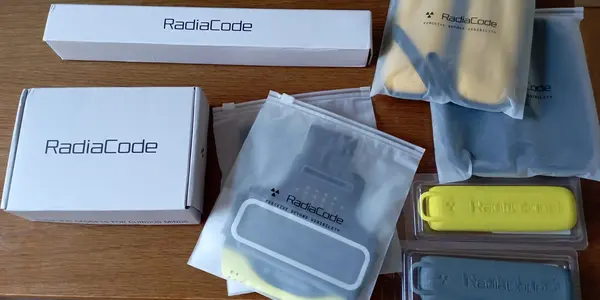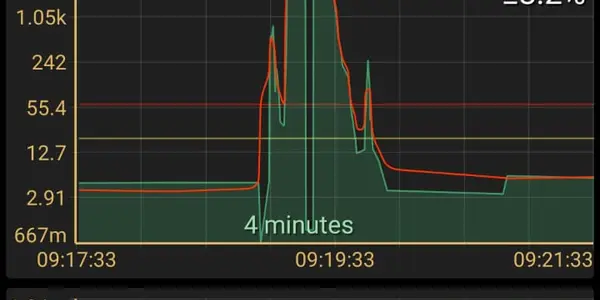
More on Radiacode 110
This is the second post reporting a few tests of the Radiacode 110 spectrometer, an extra-cool pocket dosimeter/radiation counter/spectrograph sold by RadiaCode.
This is the second post reporting a few tests of the Radiacode 110 spectrometer, an extra-cool pocket dosimeter/radiation counter/spectrograph sold by RadiaCode.


As 2010 nears its end, the Tevatron experiments feel the monopoly of top quark physics being taken from their hands, due to the good news on the running of the Large Hadron Collider. The ATLAS and CMS experiments there have started to mine their datasets, now amounting to over 20 inverse picobarns and growing significantly by the day. These datasets contain as many top quark pairs as half an inverse femtobarn worth of Tevatron collisions, due to the 20-fold higher cross section of top pairs at the LHC.

Quite in advance with respect to the stated goals of its 2010 collider program, the Large Hadron Collider has produced yesterday night the instantaneous luminosity of 10^32 cm^-2 s^-1 in the core of the ATLAS and CMS detectors. This is great news for all of us: at such a collision rate, on average one top quark pair is produced every minute, and one 120 GeV Higgs boson (if the thing exists) every 10 minutes makes its apparition there! (Calculations are in this recent post).

Two days ago I wrote here about the projected reach of Higgs boson searches of the Tevatron experiments, discussing what can be seen by CDF and D0 if they combine their analyses results, after improving them as is today thought possible to do. The reach was shown as a function of the integrated luminosity, which allows one to infer what can be done if the Tevatron stops running in 2011 or, as is being proposed, it continues for a few more years.

Last Tuesday I presented new precise Tevatron results on top quark physics at the "LHC Days" conference in Split. The top-quark measurements that CDF and DZERO have produced with their multi-inverse-femtobarn datasets of proton-antiproton collisions are very precise, and they surpass pre-Run-II expectations: suffices to say that the top-quark mass is now estimated with a 0.61% uncertainty, over twice smaller than promised. So it was nice to display these results to an audience mainly composed of LHC colleagues. I received several questions and the interest in my talk was clear.
I am spending a few pleasant days in Split for the conference "LHC Days". I will be representing the D0 and CDF collaborations here in a talk on top physics at the Tevatron; in the meantime, I am pleased to witness that talks are of high quality. This morning the most interesting to listen to (at least to me) was the one by Guido Altarelli, a distinguished theorist from the University of Roma III. Altarelli has given crucial contributions to the advancement of our understanding of Quantum Chromo-Dynamics in the seventies, and it is always a pleasure to listen to him (a previous report of a talk he gave in Perugia two years ago is here).
I will be attending next week to a conference in Split (Croatia). The conference is titled "LHC Days", and has the purpose of bringing together experimental physicists working at the main CERN experiments with theorists and experimentalists from all over the world, to discuss the current status and the future perspectives of research in particle physics, focusing of course on the Large Hadron Collider at CERN.
Georges Charpak, a French physicist and 1992 Nobel Prize winner, died yesterday.Of Polish origin, Charpak gave crucial contributions to experimental physics, in particular for his invention of the multiwire proportional chamber in 1968.Back then, the signal of passage of charged particles was recorded by bubble chamber images and images triggered by spark chambers - where the charge deposition would create a discharge in a very high electric field.

The Large Hadron Collider is increasing gradually the number of proton bunches that circulate in the machine. Yesterday's fill saw 104 colliding proton bunches, producing the record instantaneous luminosity of 3.5 x 10^31 collisions per square centimeter per second. This is no surprise, of course: luminosity is essentially the product of the number of particles crossing each other per second divided by the cross section of the beams, so if you increase the particles and manage to keep the beam transverse size constant, luminosity must go up.

I devote only a short piece today to the topic of the week -or the month- in particle physics: as many of you already know, yesterday the CMS collaboration has made public the results of their analysis of two-particle correlations, which evidences an effect never seen before in hadronic collisions, and which has been saluted very emphatically by the press around the world.The Analysis In Ten Lines

A very important new theoretical study has appeared last Tuesday in the hep-ph preprint arxiv. Titled "Precise Predictions on W+4 Jet Production at the Large Hadron Collider", it is signed by a strong team of theorists: C. Berger, Z. Bern, L. Dixon, F. Febres Cordero, D. Forde, T. Gleisberg, H. Ita, D. Kosower, and D. Maitre.I believe it may be quite useful if I review here the paper results, and explain to you why they are very important for the physics of the LHC. But first, I feel that there are a few details concerning the process of W+jets production at the LHC which might be obscure to most of you. Let me straighten them out -it is worthwhile to do it!Preliminaries

No, it is not a typo. I do mean "quirks": these are hidden-valley brothers of quarks predicted to exist in some fancy new physics scenarios. These particles have been sought by the DZERO experiment in a large dataset of proton-antiproton collisions, making use of a neat technique which I thought could be interesting to briefly explain today.

Back to breathing the air of Fermilab after a full year away, I got to gauge a bit better the aftermath of the little incident created by a posting of mine in July. As often happens with internet bubbles, they look quite dramatic as they inflate, but they leave no big scars. Two months have passed, and this looks like a good time to post here some ruminations about the general issue.Physics Experiments And Confidentiality