More on Radiacode 110
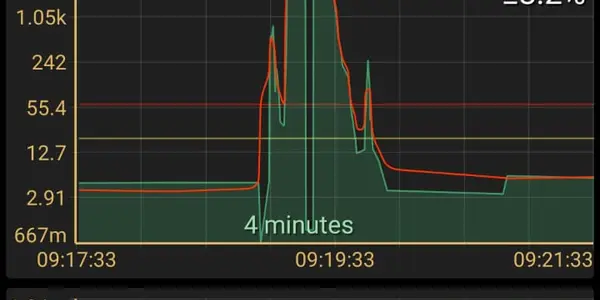
This is the second post reporting a few tests of the Radiacode 110 spectrometer, an extra-cool pocket dosimeter/radiation counter/spectrograph sold by RadiaCode.
This is the second post reporting a few tests of the Radiacode 110 spectrometer, an extra-cool pocket dosimeter/radiation counter/spectrograph sold by RadiaCode.

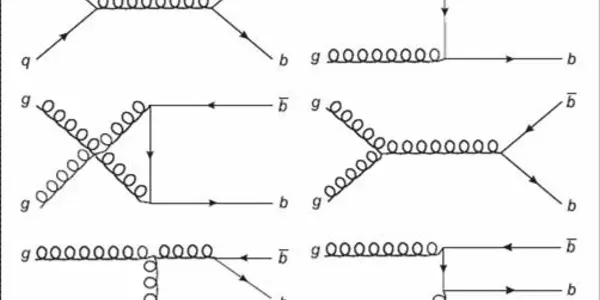
Embarassingly overdue, the slides of my talk on "Heavy Flavour and Quarkonia Production in 7 TeV pp Collisions", meant for the 2011 Les Houches meeting on "Recent Advances in QCD" to be held next week near Chamonix, France, are slowly coming together. Since these days I seem to be straggling my feet on the blog as well, I decided to kill two birds with one stone. So here you are going to get a short overview of recent measurements of b-quark production by CMS. While providing the results for experts and beginners alike, I will try to make this discussion as simple as possible (but not simpler), something that lately I tend to forget. I do not like my blog posts to be too technical, but maybe I am getting old and my popularization powers are weakening. Let's see.

Now that the two articles I have worked on in the past two months are finalized, I think I can disclose where and when they will be published. In the March 2011 issue of Physics World you will find two back-to-back feature articles on the LHC in 2011. Author, yours truly.
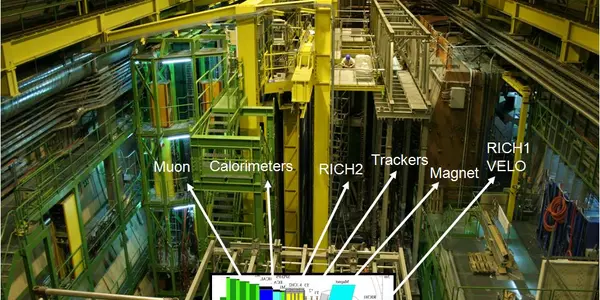
A recent paper in the arxiv describes the observation, in 7 TeV proton-proton collisions produced by the LHC collider in the core of the LHCb detector, of a new decay mode of the particle called "B-sub-s", a meson which is a bound state of a anti-bottom-quark and an s quark.
A week ago a meeting was held in Chamonix to discuss in detail the schedule for the near future of the Large Hadron Collider, and to take a decision on the schedule, in particular for 2012.
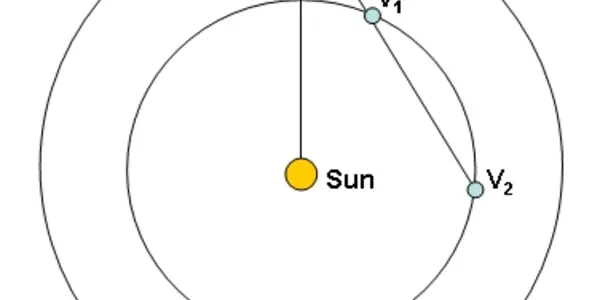
This morning, as I walked out of home headed to work, the sky was clear and still dark. As I looked up, I immediately noticed the bright light of Venus above the houses of Venice. Have you ever watched Venus on a clear morning sky ? It is a marvelous sight! No wonder the planet was named after the most beautiful of all goddesses.My trip to the University, in Padova, begins with a 7-minute walk to the Venice train station, followed by a 40 minute ride and then a further 15-minute walk in Padova to reach the Physics Department. While on the train I usually busy myself with document editing on my laptop, but on my walks I use to try and put to work the other main CPU I have got - my brain.

While listening to highly interesting talks on cutting-edge statistical issues at PHYSTAT 2011, I have casually been reading this morning a paper recently posted on the arxiv, which was pointed out to me by a Cypriot friend, Alex (thanks, Alex!). The authors (J. Baglio,
A. Djouadi,
S. Ferrag,
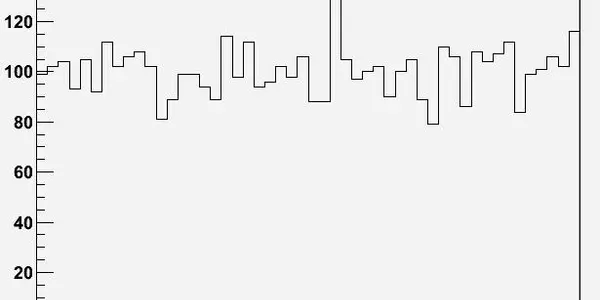
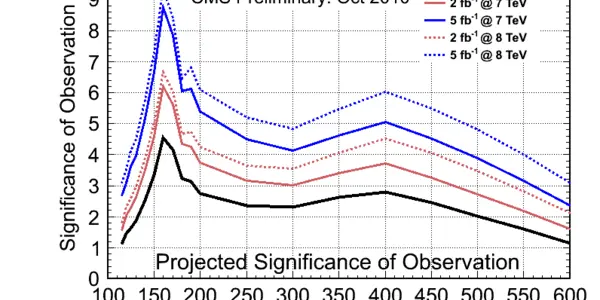
When physicists working in a collaboration want to publish the observation of a new effect in the data, they need to first convince their peer that what they are observing is real, and not the product of a weird fluctuation.Statistical fluctuations are everywhere, and they sometimes do produce weird results. We are only human, and when facing unlikely fluctuations we are invariably tempted to interpret them as the manifestation of something new and unknown.
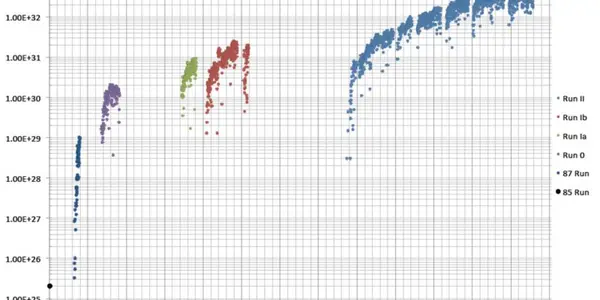
Thanks to the Tevatron Facebook account manager, R.M. (Ron, tell me if I can disclose your identity here), I can offer to you today an exceptional plot of historical significance.Before I paste below the plot in question, let me discuss what it is about. The Tevatron collider has operated since October 1985 -about a couple of geological eras back, in particle physics terms. The W and Z bosons were newborn babies back then, the top quark was thought to have a mass in the 30-50 GeV ballpark, and, to paraphrase the Rolling Stones, "Carlo Rubbia raged and the bodies stunk".
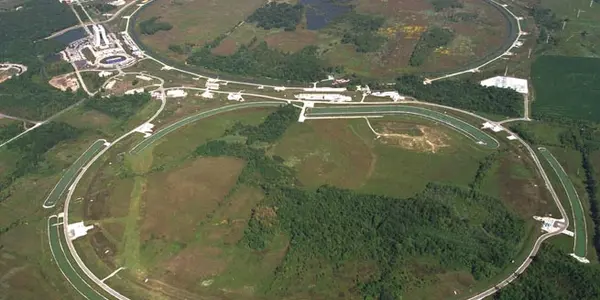
New important information on high-energy particle physics has recently been released by the CDF experiment, one of the two detectors scrutinizing the 2-TeV proton-antiproton collisions copiously produced by the Fermilab Tevatron collider located near Batavia, Illinois (see aerial view of the site below). The CDF experiment has ruled out the existence of so-called "Z' bosons" (particles extraneous to the Standard Model which are predicted by a number of new physics models) for Z' masses below one Tera-electronvolt.
Betting a grand on the existence or not of new physics is cool, but one does not need to be that daring (or to be that daring every other day) to enjoy the game of making predictions for what the fundamental research in experimental particle physics will discover or measure in a future close enough that we can reasonably expect to experience ourselves. So here I am, at the end of this eventful 2010, to look forward rather than backward, with no additional grand to invest but some insight to use, some reputation to waste, and a bit of humour to stuff between the lines.

A reader of this blog asked in the comments thread of a recent piece the following interesting question:"Assuming mH = 201 GeV/c2, how many Higgses shoud have been produced atthe Tevatron by now with an integated luminosity of 10 inversefemtobarns? And how many H -> ZZ -> µµµµ would one expect to see?"
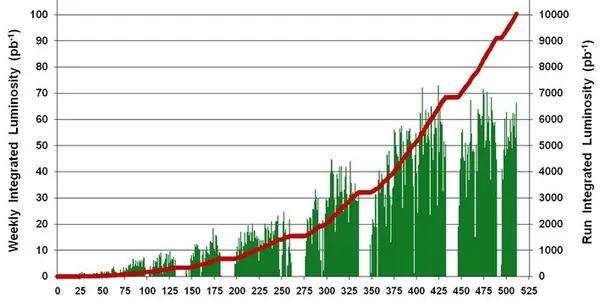
As sure as death and taxes, and as timely as a Swiss watch, the Tevatron collider never ceases to awe us. Well into its twentysixth year of life, the aged and celebrated proton-antiproton collider sitting just a few meters underground in the west Chicago suburbs hit the mark of 10 inverse femtobarns of collisions delivered to the core of the CDF and DZERO detectors.10 inverse femtobarns! Ten inverse femtobarns of proton-antiproton collisions is a HELL of a lot of them. Plus, you should multiply that number by two, since the same number of collisions happened inside two different collision areas -those manned by the two competing collaborations.