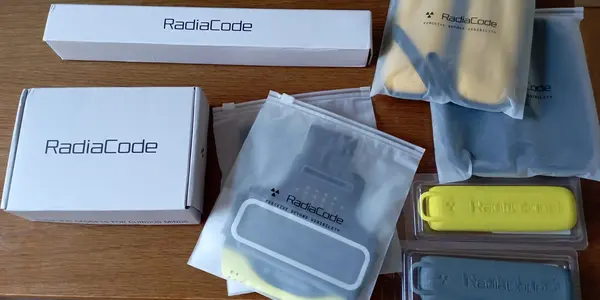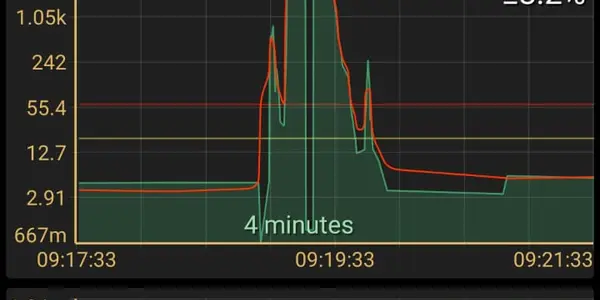
More on Radiacode 110
This is the second post reporting a few tests of the Radiacode 110 spectrometer, an extra-cool pocket dosimeter/radiation counter/spectrograph sold by RadiaCode.
This is the second post reporting a few tests of the Radiacode 110 spectrometer, an extra-cool pocket dosimeter/radiation counter/spectrograph sold by RadiaCode.

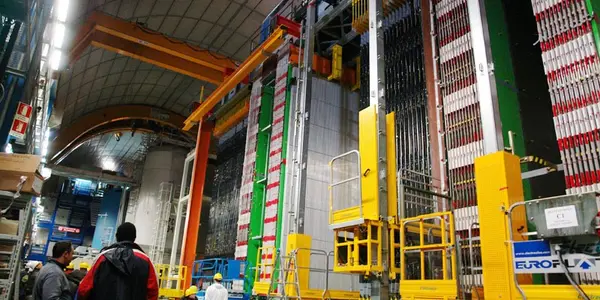
[Introduction: I published the text below last Monday, when the news of this controversial new measurement had spread in the corridors of physics departments, as well as in the threads of popular HEP blogs. I felt I was not doing anything wrong, since all I was reporting were facts, with a cautious opinion on my part. I was however forced to take it down only a few hours afterwards, due to a kind of pressure I could not ignore, my own job being at stake. I understand that the experiment who did this measurement was not too happy to see the news in print before they wanted to, but then again the fault is theirs. And in retrospect, what damage did I cause with the post below ?
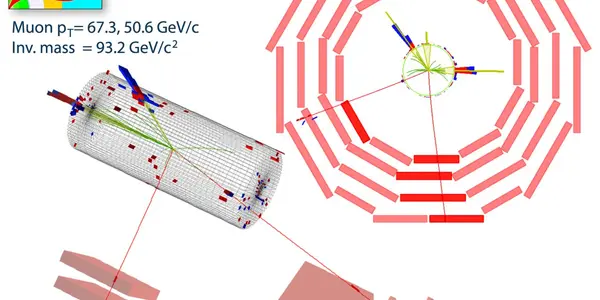
In two weeks I will be talking at TEDx Flanders, in the magnificent theatre of the Flemish Opera of Antwerp, Belgium. I can't wait, of course, and I have prepared a presentation which is hopefully going to be digestible, but I would hope enjoyable, for the thousand total outsiders who will listen to it in-between a couple dozen other extremely interesting performances and talks. The program is indeed quite diverse and exciting, and the event will last the full day of Saturday, Sept. 24th.

I enjoyed a lot reading a "discussion" prepared by Maury Goodman on the value of "confidence level", discovery thresholds, and what physicists believe or not. If you are a HEP physicist and you want to widen your horizons on the value of statistical claims in experimental results, you are bound to read it. But you might find it thought-provoking and enlightening even if you are a layman, provided you can use three neurons in a row.A few random excerpts should convince you to read the whole piece:Manjib: No reasonable high energy physics will believe a two sigma effect.
The diffusion of advanced graphical tools that we have witnessed in the course of the last two decades has caused a corresponding evolution in the way physicists display their data. True, there still exist pockets of resistence here and there; but these are usually due to old farts who are unwilling to learn the new tricks. To them the old cynical sentence by Max Planck unfortunately applies, and it can be paraphrased as follows: "A new data display tool does not triumph by convincing its opponents and making them use it, but rather because its opponents eventually die, and a new generation grows up that is familiar with it."

A hadron collider is a really nice toy to play with. Sometimes when I look at all those scientists busying themselves with the design, the construction, and the operation of the Large Hadron Collider and its experiments, as well as the analysis of the produced data, all I see are kids who play with their toys - bigger toys, as big as possible in fact, because their craving is always growing and cannot be satiated. I of course see myself that way, too. To me my job is a game -well, I see my life that way too! But I am divagating into philosophical observations which deserve another place to be discussed. Instead, here I want to show you why I think these detectors are marvelous toys. Give a look at the graph below, courtesy ATLAS.
Note: I have discussed today's topic in one of my best articles here some time ago, and I also gave even more technical insight in another piece. I decided to revisit the topic once more under the stimulus of a online HEP magazine, which is going to feature a text of mine soon. They do not care if I use the same text here too, so you get to read it here first.

Despite the hopes of most and the preconceptions of many, news from the Lepton-Photon conference in Mumbay, India, report that the Standard Model is as alive and strong as it has ever been. Indeed, the recent searches for Supersymmetry by ATLAS and CMS, now analyzing datasets that by all standards must be considered "a heck of a lot of data", have returned negative results and have placed lower limits on sparticle masses at values much larger than those previously investigated (by experiments at the Tevatron and LEP II).

If you work in experimental high-energy physics you soon acquire a particular sensitivity to the economical display of relevant information. Producing figures that convey the most meaning with the minimum effort is sort of an art, and it is a necessary consequence that HEP experimentalists -the smart ones- end up converging on the definition of graphs which are better than all others in this respect.

I have written enough today about the topic of Higgs boson searches at the LHC by discussing the new ATLAS limits (see previous post), but I feel that, before going to bed, I need to point out the new results on the same topic by CMS, the competitor experiment. As you know, I work in CMS and I have to be twice as cautious when I write about the results of my own experiment, because some of my colleagues have uncovered nerves when it comes to blogs. However, the little I'll say here tonight should cause no discomfort to anybody.
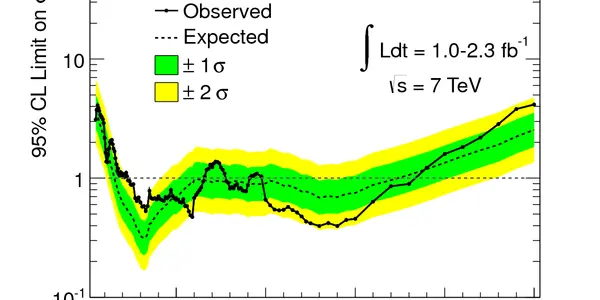
Much awaited, the results of searches for the Higgs boson at the Large Hadron Collider have been released by the ATLAS collaboration, and are being shown at the Lepton-Photon conference in Mumbay, India. I will provide here just the main results, with little commentary - I wish to let the cake cool down a bit before discussing the subject in detail, examining the various inputs.

In my latest instantiation of the "Guess the plot" series I offered a clipped part of a graph showing branching fractions of the Higgs boson. One of the readers made a comment which I was proud to read, since it showed that interested readers of this blog with no specialized education in particle physics can get to know quite a lot about the matter. I answered there more extensively than I do on average, and then I thought that the answer could be of some use to others to whom the thread had fallen out of the horizon. So I am recycling it here.

Like it or not, the Tevatron is going to shut down for good next month. This machine has provided us with tremendous new investigation power in the high-energy frontier of particle physics, and has led the research of hadronic collisions for over two decades. But all good things come to an end.