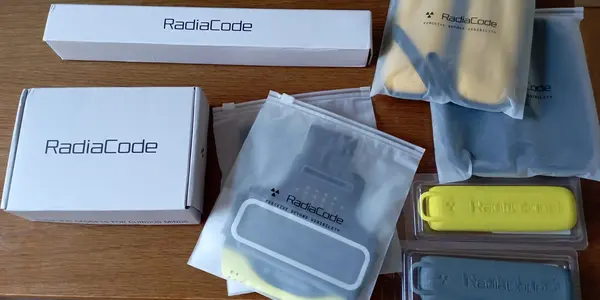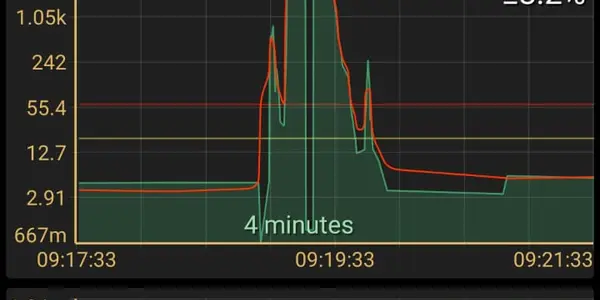
More on Radiacode 110
This is the second post reporting a few tests of the Radiacode 110 spectrometer, an extra-cool pocket dosimeter/radiation counter/spectrograph sold by RadiaCode.
This is the second post reporting a few tests of the Radiacode 110 spectrometer, an extra-cool pocket dosimeter/radiation counter/spectrograph sold by RadiaCode.


Particle physics experiments usually invest a considerable part of the time used to produce a measurement in the task of determining the corresponding uncertainty on the estimate, or -when a new effect is observed (say a quantity is measured away from zero, when zero would be the "null hypothesis", predicted by the current model)- estimating the statistical significance of the observation.
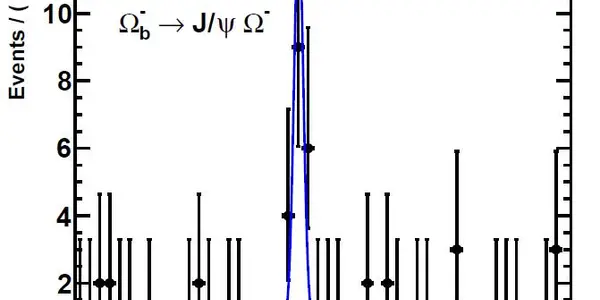
Another confirmation of correct evaluation of controversial HEP measurements awaited me just after the Higgs evidence was presented at CERN. I am sort of embarassed by this compulsory self-promotion, but this is my blog so I will excuse myself ;-)So the story is the following... Some of you might still remember the controversy over the Omega b discovery, at the Tevatron a couple of years ago.

Eilam Gross is a professor of Physics at the Weizmann Institute of Science of Rehovot, Israel, and a distinguished member of the ATLAS collaboration. That makes him a competitor, since I work for the other experiment around the ring, CMS. But Eilam is also a colleague, especially since we are members of the Statistics Committees of our respective experiments and we cooperate in a joint group to try and converge on common practices for statistical procedures in data analysis at the LHC. Ah, and- I forgot to mention he is the convener of the ATLAS Higgs group| So I am very pleased to feature his own take on the LHC results on Higgs searches...
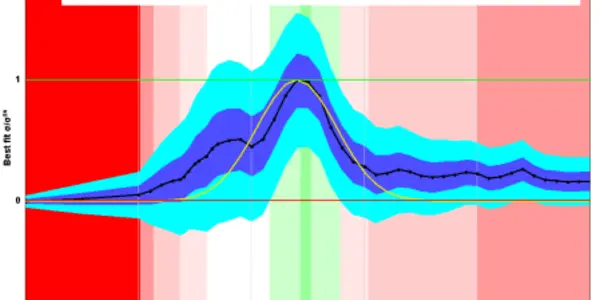
Updates:- Philip Gibbs does a great job, as always, at combining -albeit approximately- the results of different experiments in the Higgs search. He now has even a full combination of LEP II + Tevatron + CMS + ATLAS, where the signal strength, in SM units, fits absolutely bang on for a Higgs mass of about 125 GeV. Please see his article at the link above; but I cannot resist from stealing his most intriguing picture (sorry Phil!):
I received the text below from Jim Markovitch, and decided it was fun enough to make a guest post entry with it. Markovitch worked for the world's largest supplier of corporate credit information, where he designed and implemented algorithms to estimate the probability of the equivalence, for credit purposes, of two name/address records. More recently he has adapted these algorithms to help identify unusually efficient approximations of fundamental constants. Let us see what this is about - TD---
Every once in a while Lubos pleases with one of his straight-leg tackles, as he deals with stuff he shouldn't be a-messing with (I am still giggling at an incident of a few years ago, when he publically apologized after a week of nonsense). Today it's one of those blessed moments.
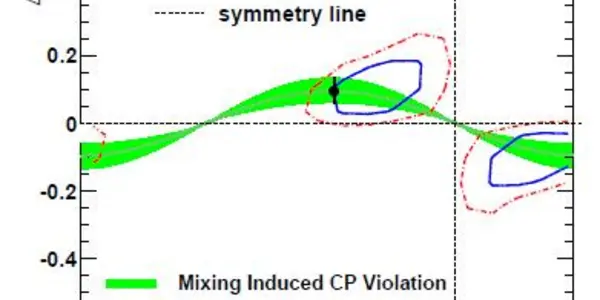
It is so annoyingly sweet to be right, when being right means that one's job is not going to become more exciting in the near future... Today CDF published their analysis of CP violation in the Bs sector, where a very exciting three-sigma deviation from the Standard Model predictions had been a bit prematurely and uncautiously claimed by a group of phenomenologists in 2008.
As everybody knows, next Tuesday we will be treated with a CERN webcast of the analysis results on the Higgs boson searches by ATLAS and CMS. I imagine many of you will want to tune in, but fear you will not grasp much given the typically technical jargon that physicists use to communicate the details of their analyses. So I thought I would provide here a very short glossary of terms you are likely to hear, and which you might have a hard time understanding correctly. Let me see if I can do a decent job.
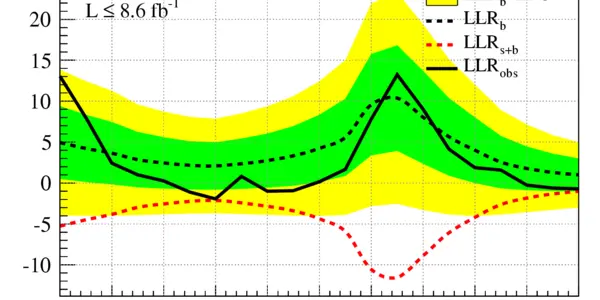
It is by now public that Rolf Heuer, the Director General of CERN, in announcing for December 13th two back-to-back talks of the CMS and ATLAS experiments on their Higgs search results with 2011 data, warned that the results might not be conclusive yet. Besides, nobody really could expect them to be, since the sensitivity expected by both ATLAS and CMS in the still not excluded region of the Higgs mass, with 5/fb of data per experiment and 7 TeV running conditions, ranges from 2 to 4 standard deviations in the rosiest circumstances.
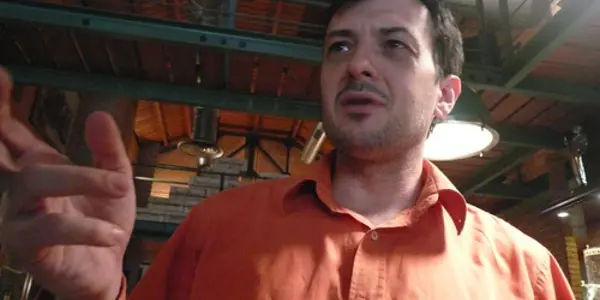
The text below was graciously written for this blog by Alejandro Rivero (below), a friend who has contributed to this blog other times in the past. His theoretical ideas are off the mainstream, but in a way which makes them interesting to me. I hope some of you will appreciate reading about the whole thing in summary here - Alejandro has a few papers out which you may want to read if you are specifically interested in the matter.
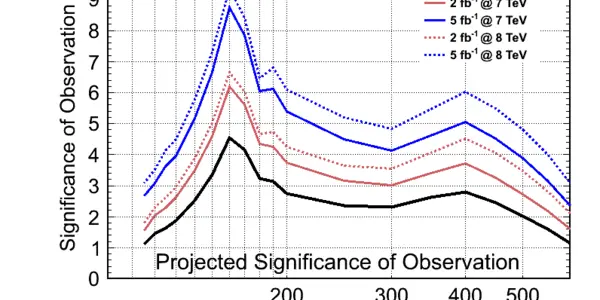
Update: I am keeping out of this, but you may well be interested in reading what Gibbs, Woit, and Motl have to say about recent leaks on the ATLAS and CMS results. So I hope I won't be crucified for three general links now!Update 2: And it is now public that a seminar at CERN will be given by ATLAS and CMS on December 13th. So the wait is almost over, officially...I have not written in a while - a full week. This is uncharacteristic enough that I owe you some sort of explanation.
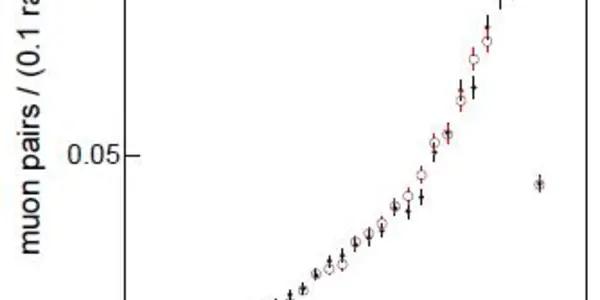
Do you remember the multi-muon anomaly in CDF ? The matter was discussed with quite some detail in a series of posts in this blog (back then at wordpress). In a nutshell, CDF could not explain their sample of events containing two muons, when these particles had a very large impact parameter (the impact parameter is the minimum distance of a trajectory from the interaction point: a large value indicates that the particle was produced elsewhere).