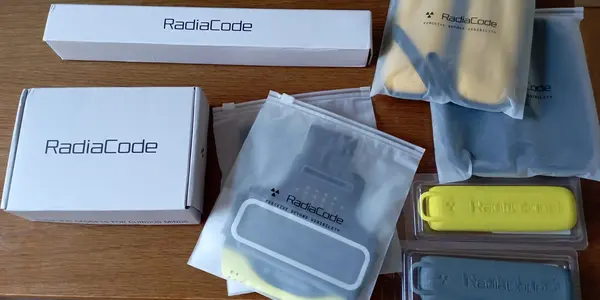
More on Radiacode 110
This is the second post reporting a few tests of the Radiacode 110 spectrometer, an extra-cool pocket dosimeter/radiation counter/spectrograph sold by RadiaCode.
This is the second post reporting a few tests of the Radiacode 110 spectrometer, an extra-cool pocket dosimeter/radiation counter/spectrograph sold by RadiaCode.

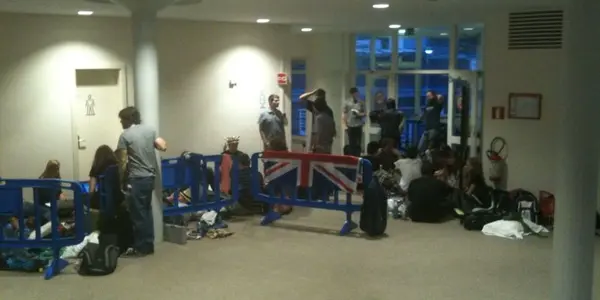
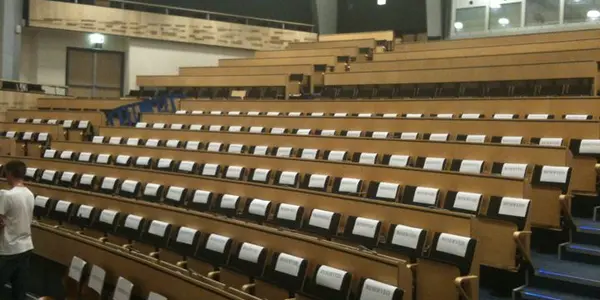
5.30 AM. Getting in at CERN through the B entrance I see no living soul. "Ha" -I tell myself- "I have been worrying too much".5.36 AM. But the people is all here since last night ! There is a huge queue of 180 people already, extending from the doors of the Main Auditorium all the way up the aisle and back down on the other side. Most of the higgs enthusiasts have camped since last night here, and there is even a couple of guys with wide shoulders (but a polite smile) that direct newcomers to the end of the line.Here are a couple of pictures of the queue as of now: the head of the queue close to the doors of the auditorium,
By now it's been written on so many newspapers and magazines -including Nature (the magazine, not the bitch)- that if a colleague of mine tries to reproach me for writing about the impending seminar at CERN, where ATLAS and CMS are vented to be showing observation-level signals of a new particle which smells like the Higgs and quacks like the Higgs, I will publically send him or her to hell.Besides, I have been cited as a "tease" in a nice summary which appeared in the Atlantic Wire site today. The line describing me (next to a picture that is N years old but which is dear to me for some reason) is the following:
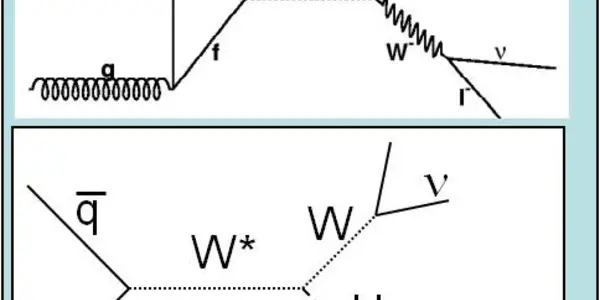
Robbing the LHC experiments of media attention for 41 hours, the CDF and DZERO experiments are presenting today the results of their searches of the Higgs boson in the full datasets of proton-antiproton collisions acquired in the course of the last 10 years. You can follow the live streaming of the Tevatron seminar at this link.UPDATE: the live streaming is here.Below I will give some introductory notions on Higgs physics at the Tevatron; at the bottom of this post I am discussing the actual results.Introduction
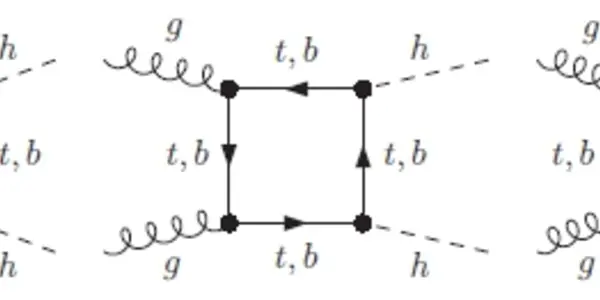
A very interesting paper appeared one week ago in the Arxiv. It is titled "Higgs Self-Coupling Measurements at the LHC", and it is authored by M.Dolan, C.Englert, and M.Spannovsky. The idea is that once and if a Higgs boson is found at the LHC, the next natural step of the research would be its characterization as a pure standard model object or a more complex, or just different, beast. Of course, once a signal were established, the LHC experiments would certainly want to measure all its properties as precisely as possible: mass, angular distributions, cross section in all the production mechanisms, and decay modes.

I am endlessly amazed by observing, time and again, that even experienced colleagues fall in the simplest statistical traps. Mind you, I do not claim to be any better - sorry, let me rephrase: to have been any better in the early days of my career as an experimentalist. But then, I started to appreciate that to really understand physics results I needed to at least get familiar with a small set of notions in basic Statistics.
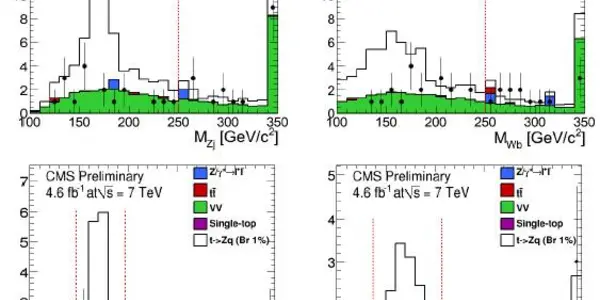
As we near the first week of July, with the start of the International Conference of High-Energy Physics in Melbourne (July 2nd-8th) and the July 4th press release at CERN on the new results of Higgs boson searches by ATLAS and CMS, the attention to new particle searches is understandably increasing. And the question is what the new 8-TeV data produced by the LHC this year will give.Will the final word on the existence (or absence) of the Higgs boson be said ? Will there be new particle discoveries ? Will the LHC surpass the Tevatron precision on the measurement of the top quark mass ? Is the Standard Model going to show cracks from the result of other, off-the-spotlight measurements ?
The tirade below (a bit over the top, admittedly, but I'm in the middle of a stressful week) is inspired by a post written today by Chad Orzel in his blog, Uncertain Principles. It is a breath of fresh air to hear that scientists outside high-energy physics (Orzel works in condensed matter) actually see things for what they are:
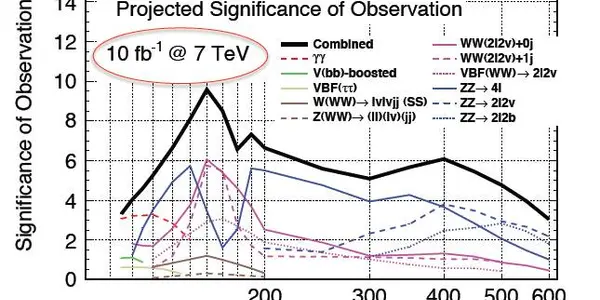
While Higgs rumors are appearing in blogs of the usual suspects, I cannot comment on those -and I decided it is better if I do not even link them here (I have grown wary of oversensitive reactions in my colleagues).The only thing I think I can discuss with you here now is the predictions on the Higgs boson significance level produced by CMS in October 2010 - a couple of geological eras ago, that is. Those predictions can be trusted because 2011 data showed to be perfectly in line with them, both for the 95% CL limits and for the significance -of course the former are valid in the full mass range and provide more verification power than the single significance number, which is only valid if the Higgs boson exists and has a particular mass.
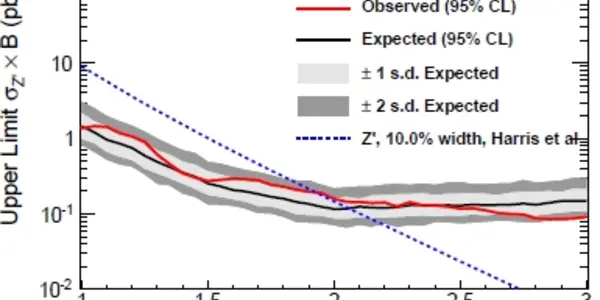
With the approach of Summer conferences -most notably, ICHEP, which alone has set a make-or-die deadline for the LHC experiments- physicists in ATLAS and CMS are frantically producing their results with data collected in 2012.
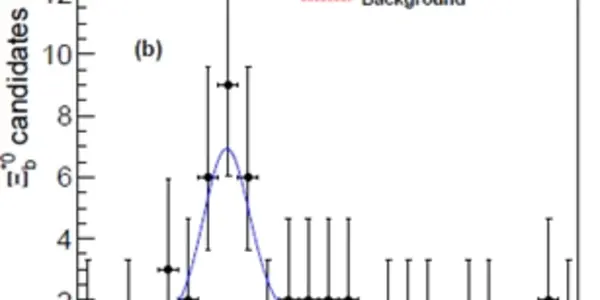
Two days ago I discussed at ICFP 2012 the most recent results of the CMS experiment at the CERN Large Hadron Collider. In the allotted time of my talk I could only cover few analyses, and I obviously chose some of the most interesting ones, so that was already a summary. Here I am bringing the information collapse one step further, by giving a itemized summary of some of the points I made, just in case you are interested. If you want to, you can also download the original slides of my talk from here (but be careful, it's a 8Mb file).
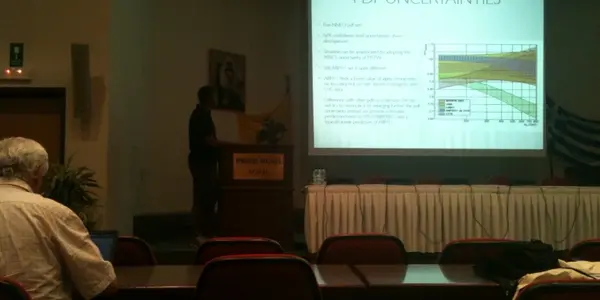
The International Conference on New Frontiers in Physics (ICFP) 2012 started today with a rich program of experimental and theory talks. I should be swimming in the Cretan sea in front of the nice conference venue (which is 40 meters away from the water), but my sense of duty forces me to give you some impressions of the presentations I heard.
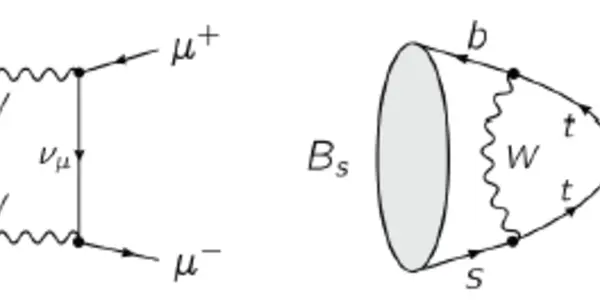
The CERN average of searches for rare B decays to muon pairs has been shown yesterday in a talk given by Mitesh Patel at the "Physics at the LHC" conference, which is being held in Vancouver (BC) this week. And the results are not very encouraging for supporters of Supersymmetry: the data is compatible with a Standard Model signal, but there is almost no space left for additional contributions due to the exchange of virtual SUSY particles in the loops producing the decays.