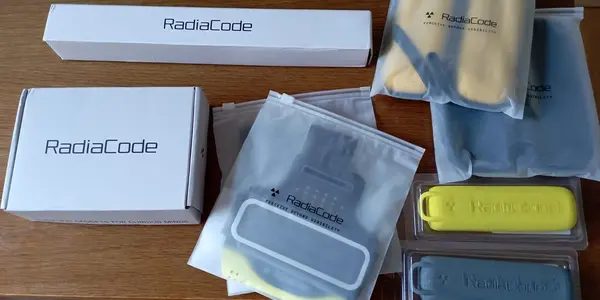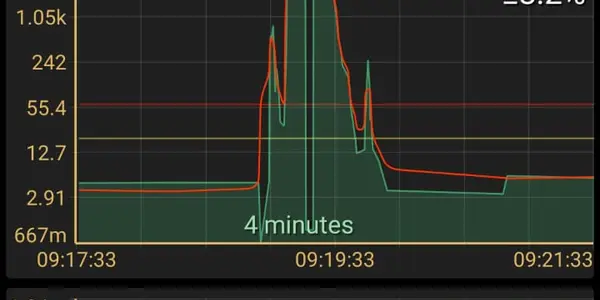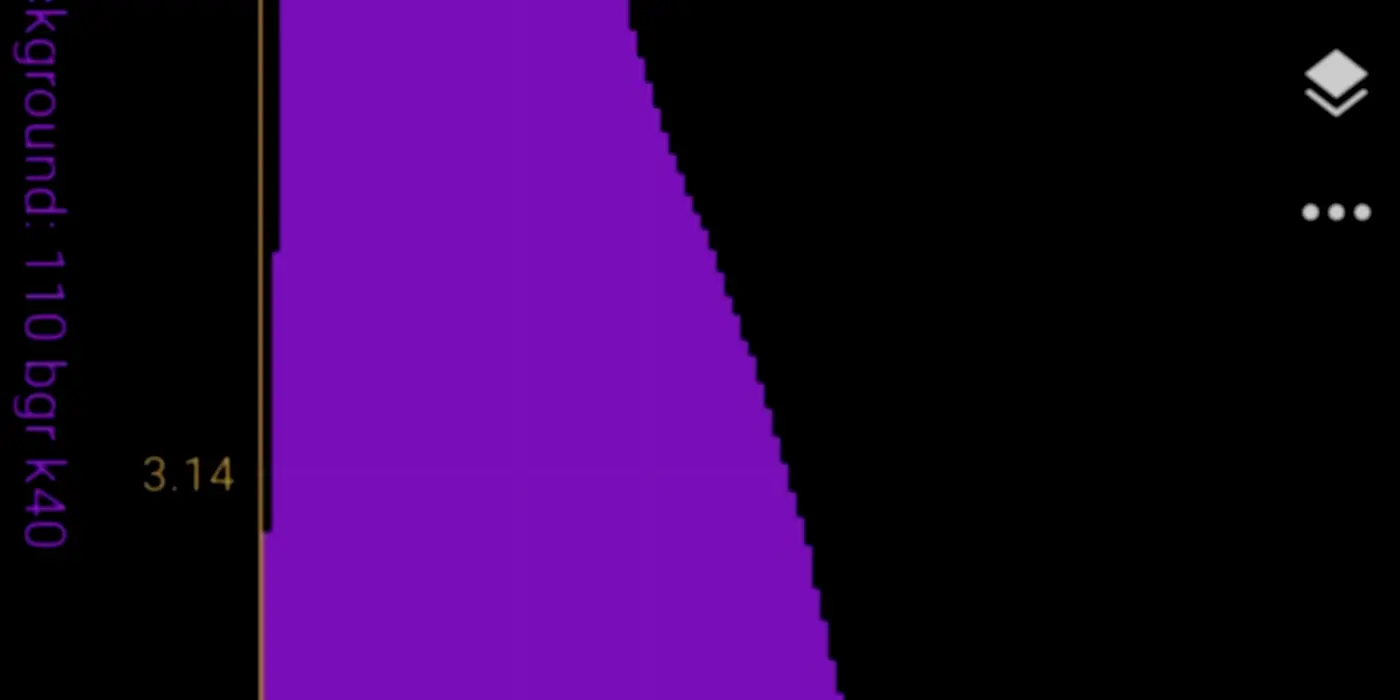
More on Radiacode 110
This is the second post reporting a few tests of the Radiacode 110 spectrometer, an extra-cool pocket dosimeter/radiation counter/spectrograph sold by RadiaCode.
This is the second post reporting a few tests of the Radiacode 110 spectrometer, an extra-cool pocket dosimeter/radiation counter/spectrograph sold by RadiaCode.

As I reported in a post a few days ago, the Italian sentencing of seven scientists to 6-years imprisonment for their misassessment of the risks of the population of L'Aquila, soon thereafter struck by a powerful earthquake which killed 309 and injured 2000, raised interest and disconcertment worldwide and spurred a debate which is not likely to end soon.Who is guilty ?
Italy is a beautiful, crazy country. Take today's verdict, which condemns seven scientists (Franco Barberi, Enzo Boschi, Mauro Dolce, Bernardo De Bernardinis, Giulio Selvaggi, Claudio Eva, and Gianmichele Calvi) to six years of prison, plus a huge fine, for allegedly reassuring the population about the unlikelihood of an earthquake on the eve of the devastating shock of April 6th, 2009, which caused 309 deaths and destroyed most of the mid-size town of L'Aquila, in central Italy.

I had a dream. So what, we all do. Well, this was particular, because I remember all of it well, and because it involved a very interesting situation. I was at Fermilab, in an office on a top-level floor of a tall building, when a powerful earthquake hit.
See, this is what I really like of a blog: when readers contribute significantly!

Yesterday I spent a very interesting day at Comunicare Fisica 2012, a conference held in TORINO which brought together researchers, high-school teachers, journalists and other professionals working in the field of the popularization of science. The session in the afternoon dealt with the use of the web 2.0, and of course among the topics discussed in the talks was the use of blogs.

Two papers describing results of searches for high-mass resonances decaying into jet pairs have appeared on the arxiv this week. They are authored by the CMS and ATLAS collaborations, and they both report lower limits on the mass of hypothetical particles predicted by several new physics signatures. Both collaborations base their results on the analysis of their full 2011 datasets.

Five years ago I was fascinated by an analogy used by my friend Michelangelo Mangano to explain the problem of naturalness, a crucial issue in fundamental physics, and maybe the biggest single indicium we have that new physics beyond the standard model of particle physics should exist, and be not too far away from our current experimental reach.

In particle physics searches (and elsewhere) the word "significance" is associated with the quantitative measure of how discrepant is one observation with a so-called "null hypothesis". That is, one searches for a new effect in some dataset, and defines what one expects to see in the absence of anything discrepant from theoretical predictions: that is the null hypothesis. A new particle in the data will usually manifest itself as an excess of events, and this will cause the data to deviate from expectations.
UPDATE: what a difference a small typo makes! In the report below I claimed that the CDF top mass measurement was yet to be stripped of the record of being the most precise in the world, given that the total uncertainty on the mass was 1.01 GeV, while the newest CMS result has a total error of 1.07 GeV... I however realized this morning that the total CDF uncertainty of the quoted measurement is 1.10, not 1.01 ! So the CMS result mentioned at the bottom of this article is indeed the most precise single measurement in the world of the top quark mass !--
In a few weeks I will speak in Torino, Italy at Comunicare Fisica 2012, a conference devoted to the communication of Physics in the media, in schools, through web sites, etcetera. And I need your help !Let me explain. I have submitted an abstract which reads as follows:
If you chance to take part in a conversation with people arguing that they do not want their tax money to go into building huge science gadgets whose utility for humanity is doubtful and null to them in particular, you have better be equipped with a sound way to shut their mouth.Of course, one way is to explain with patience the importance of basic science, the investment in the future, etcetera. You might like to insert well-learned quotes, such as "Fatti non foste a viver come bruti, ma per seguir virtute e canoscenza" ("You were not made to live like beasts, but to follow virtue and knowledge" - Ulysses in Dante Alighieri's "Inferno"). Well, good luck with that - I bet your argument will not go very far with the kind of opposition I have in mind.

It sometimes happens that my comments in the threads of my own blog get long and detailed (do not take this as me boasting about anything - it is just a fact). When that happens, I reason that they deserve to be promoted to a post by themselves, because threads are read by way fewer readers, and some of them might thus lose some interesting bit.Because of the above I am (re)posting the text below, which explains some "a priori" reasons why quarks come with fractional electric charges in multiples of one third, why the sum of charges of fermions in one family nullify, and why our universe chose to have quarks of three colours. Beware, some non-trivial concepts of quantum field theory are needed, but I will try to make this as painless as possible (but not more).