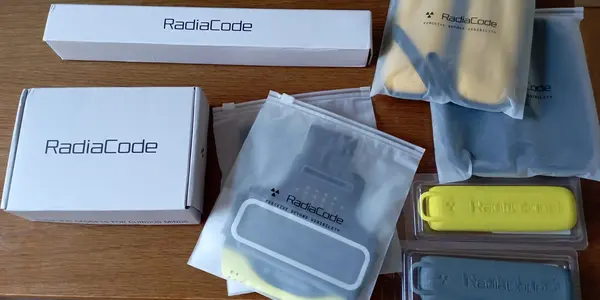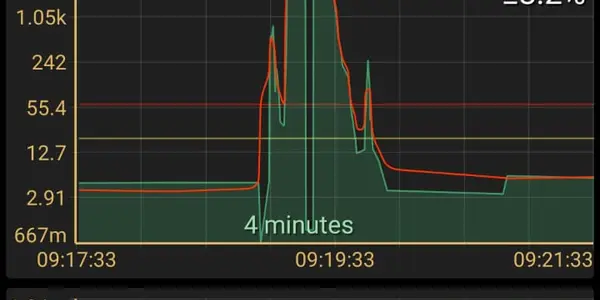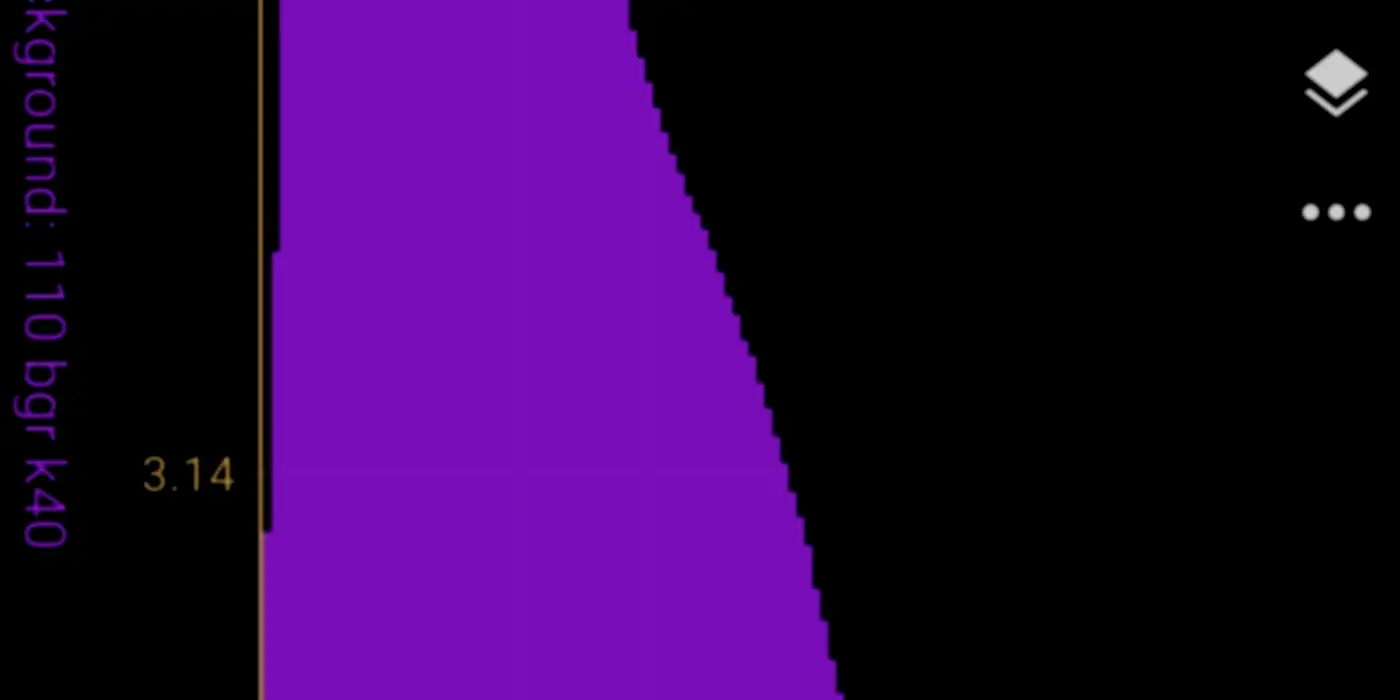
More on Radiacode 110
This is the second post reporting a few tests of the Radiacode 110 spectrometer, an extra-cool pocket dosimeter/radiation counter/spectrograph sold by RadiaCode.
This is the second post reporting a few tests of the Radiacode 110 spectrometer, an extra-cool pocket dosimeter/radiation counter/spectrograph sold by RadiaCode.

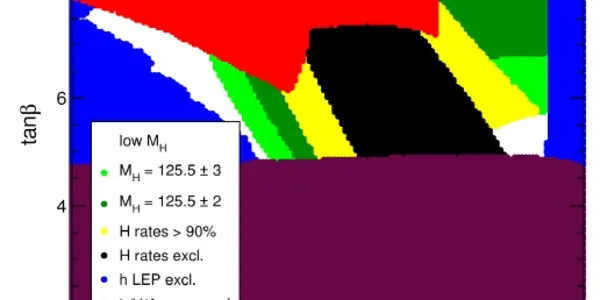
Last week a new important paper appeared in the Arxiv: "MSSM Higgs Boson Searches at the LHC:Benchmark Scenarios after the Discovery of a Higgs-like Particle", by M.Carena, S.Heinemeyer, O. Stal, C.Wagner, and G.Weiglein. The paper fills a void that was created after the discovery of the Higgs particle last July by the ATLAS and CMS experiments: a thorough assessment of what constraints on the allowed chunks of SUSY parameter space in the light of the existence of a neutral scalar at 125 GeV.
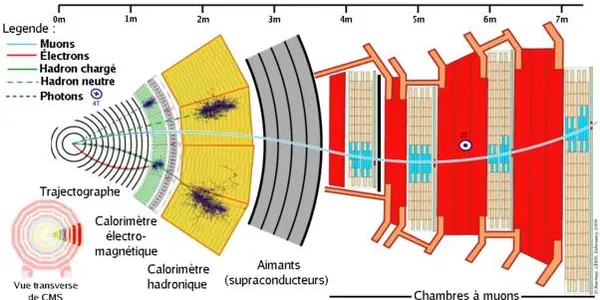
CMS is one of the two huge detectors built to study the high-energy collisions of protons produced by the Large Hadron Collider at CERN. As all previous collider detectors, CMS is a redundant multi-purpose collection of dozens sub-detector components, which use different physics mechanisms to detect everything that comes out of the collision point, from protons to muons to photons, neutrinos (using the energy imbalance in the calorimeters), neutral hadrons.
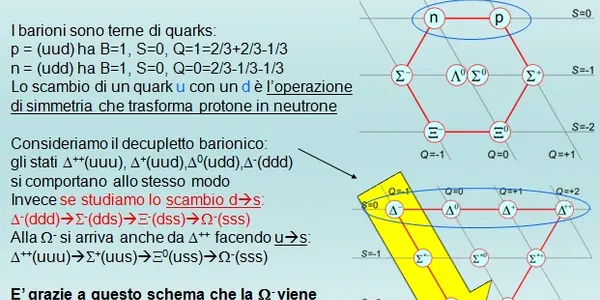
Today I spent the better part of the afternoon in the company of 150 high-school students at the Liceo Fermi in Padova, giving a seminar on particle physics in the context of a project called "Masterclasses" which has been active since 2005 and is a big success.
The project aims at students in the last years of their high school and attempts to involve them in the experiments undergoing at the CERN laboratories. Sets of lectures on particle physics and cosmology at the schools are followed by a "hands-on" session at the Physics Department, where students are taught and then tested in recognizing heavy particle decays from event displays.

Next Sunday Italians will vote to change the composition of the two houses of parliament: the "lower" Camera dei Deputati and "upper" Senato della Repubblica. And as often happens with Italian politics, things are complicated. So, despite this site is mostly visited for other reasons than trivialities about politics in foreign countries, I thought I would provide here my own short-sighted, biased panorama of the situation.
Every two years physicists and astrophysicists who work in the area of neutrino physics get together in the wonderful setting of Palazzo Franchetti, a historical palace on the Canal Grande in Venice, Italy, to discuss the latest results of experiments and theoretical ideas, and to plan for the future.

Quite some time ago I discussed here the tentative Y(4140) resonance claimed by the CDF collaboration in their Run II data. This was a peak which was found in B-decay data containing a J/Psi signal, a phi meson, and an additional kaon track, and it resulted from the study of the mass difference of the J/Psi + phi signal and the J/Psi alone.Confused ? You have all rights to be. I will explain everything in good order, but be sure that the matter was puzzling not only for laymen but also for insiders: because the find was mysterious, not predicted by existing models, and potentially controversial.B Decays and the CDF Claim

The Omega_b particle is a quite peculiar baryon, made up by three heavy quarks: a b-quark, and two s-quarks. Because of this composition, where only down-type quarks appear, the phenomenology of the decay of this particle is really spectacular: both the b-quark and the strange quarks take quite some time to decay, and as they take shifts to do it the Omega_b first transmutes into a Omega (a particle made up by three s-quarks!), then into a Lambda, and finally into a proton. Each of these decays generates a reconstructable decay point, so one can reconstruct the whole chain perfectly. A sketch will clarify matters - see below.

Nowadays whenever I set out to write about CMS I turn on a self-censorship co-processor in the back of my mind, one which is instructed to check that all the sentences I write are completely free from any possible misinterpretation or slant that may cause some colleagues to complain. Oh, strike that, we're a big family and we all love each other.The topic of today is in fact potentially explosive - how experiments perform their blind searches and the potential bias that results from the detailed procedures they employ. However, you will be disappointed by reading this article if you search for scandal and flame: I am going to explain why CMS does excellent science.

Today the arxiv features the paper describing the final word by the CDF experiment on its searches for the standard model Higgs boson. This paper supersedes previous ones describing searches performed in partial datasets and including only a subset of the decay channels that have been used, so if you are interested in knowing how CDF did in the end, that is the article to read. Or the present one, if you have less time to spend on the matter, or if you are interested in an ex-post evaluation of sensitivity predictions!
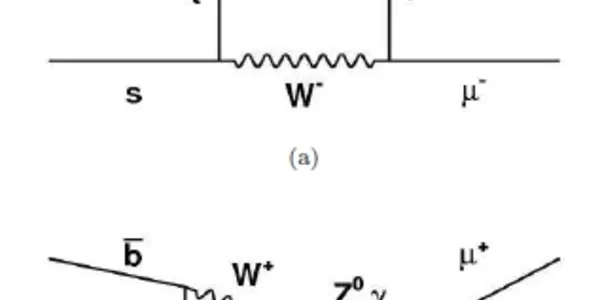
The DZERO collaboration has released last week the result of their search for the rare decay of B_s mesons into muon pairs, based on the full statistics of proton-antiproton collisions acquired during Run II - a total of 10.4 inverse femtobarns of integrated luminosity.
Sabine Hossenfelder is a well-known theoretical physicist as well as a successful blogger. In her blog today I read a letter she sent to Time Magazine. The letter was triggered by the following sentence in a piece by Jeffrey Kluger discussing the runners-up for "person of the year":“Physics is a male-dominated field, and the assumption is that a woman
has to overcome hurdles and face down biases that men don’t. But that
just isn’t so. Women in physics are familiar with this misconception and
acknowledge it mostly with jokes.”
Ben Kilminster is a friend and a distinguished colleague working for the CMS and CDF experiments. Besides being a long-time higgs hunter, having sought that particle for over a decade in the two mentioned experiments, Ben is a veteran of science outreach since for many years he has published summaries of CDF results for the public on the online magazine "Fermilab Today". When I saw him posting on a social network an earlier version of the text below, which I liked a lot, I asked him to make it a guest post entry for my blog, and he graciously agreed.