More on Radiacode 110
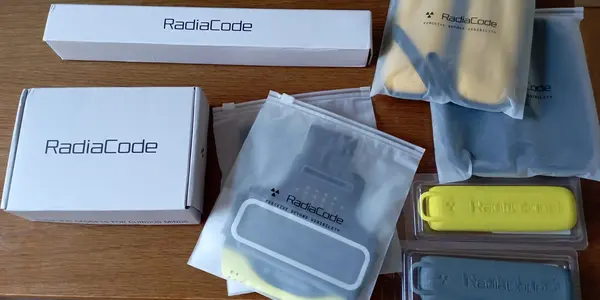
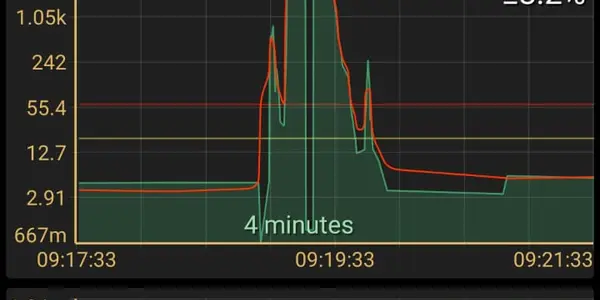
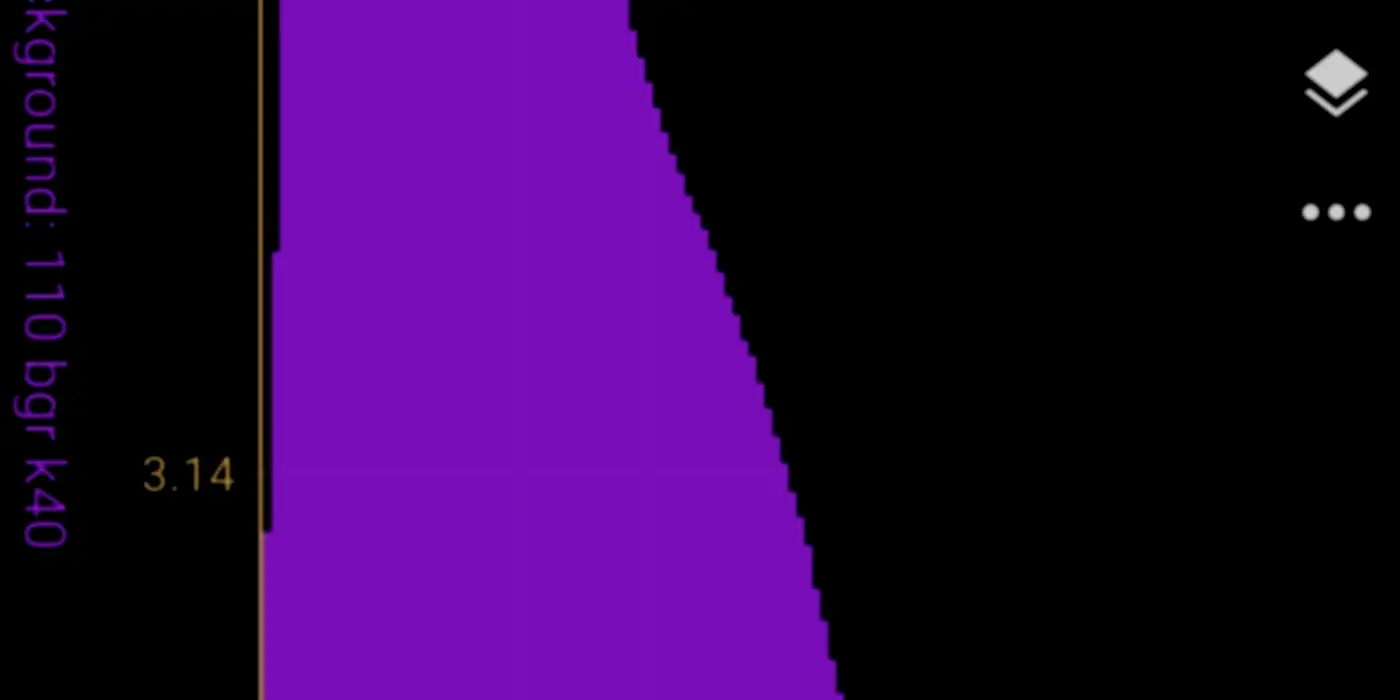
This is the second post reporting a few tests of the Radiacode 110 spectrometer, an extra-cool pocket dosimeter/radiation counter/spectrograph sold by RadiaCode.
This is the second post reporting a few tests of the Radiacode 110 spectrometer, an extra-cool pocket dosimeter/radiation counter/spectrograph sold by RadiaCode.


When we want to combine several estimates of a physical quantity into a more precise one that accounts for all in the correct way, we routinely rely to the weighted average: we take each of the N independent, Gaussian-distributed measurements x_i +- σ_i (i=1,...,N) and compute with them the quantityto which we associate the error computed asThe recipe above is simply the result of applying the method of least squares, or -equivalently- of a likelihood maximization.
The querelle on the device patented by Andrea Rossi, the E-CAT, which allegedly produces heat from nuclear fusion processes inside a small cylindrical reactor fueled with Hydrogen and Nickel powder, continues to draw the attention of the gullible as well as that of the knowledgeable. It is just entertaining to both!
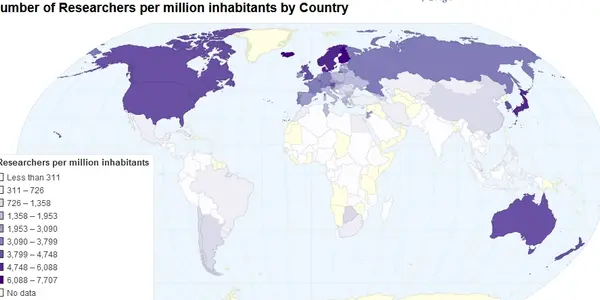
Thanks to a Facebook friend, I got to give a look today at a very interesting pair of graphs. The first one shows the number of researchers per million inhabitants divided by country, in a world map. The second shows the fraction of female researchers. The data comes from UNESCO, and is based on surveys dated 2011.
This morning I had a funny dream, and as I woke up at the end of it and watched the clock with the only eye I had managed to open, I realized it was not yet really time to wake up. On the other hand, I really liked the dream I had had: it was quite vivid and detailed, plus it lent an occasion for a blog post! Hence I crawled out of the bed and reached for the nearest laptop in order to download the contents of my mind before it made room for something else and the dream got lost forever.
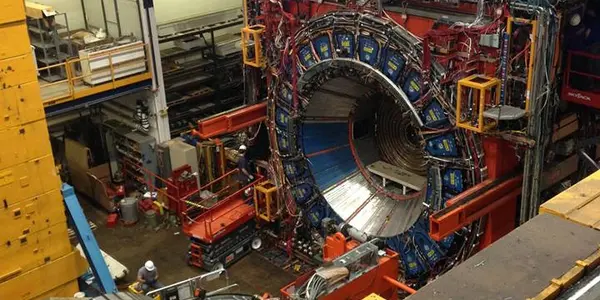
Like HAL 9000 in the wonderful movie "2001 - the space odyssey", the CDF detector is being disassembled piece by piece, losing its functionality bit by bit, and turning from one of the most complex electronics systems ever built into a pile of junk in the course of a long, slow process. The central part of the detector has been transported out of the collision hall on rails, into the assembly hall, which is now serving the opposite purpose. If you ever visited Fermilab, the assembly hall is inside the big orange building you drove by as you got to the Wilson Hall from the east entrance.
Jacques Distler is a Professor of Physics at the University of Texas at Austin, and a distinguished theorist, as well as a physics blogger. Along with experimentalist Gordon Watts (who covered $250) he took my $1000 bet that the LHC would not discover new physics in its first 10/fb of proton-proton collision data. I discussed my take on the bet in a previous post; here Jacques explains his point of view, why he took the bet, and what he thinks of the present situation with new physics searches at the high-energy frontier. The article below has appeared today at Distler's blog, and I reproduce it here with his permission.
In September 2006 I was in Ponta Delgada, the main town of the island of San Miguel in the Azores, for a physics conference where I was presenting results of the CDF experiment. I remember listening to a very nice talk by Guido Martinelli, who was discussing the status of flavour physics, and getting rather depressed at the view of a very consistent picture of agreement between B physics observables and Standard Model predictions. This came at a moment when the CDF experiment had been probing the high-energy frontier with very detailed measurements, none of which appeared to show even the smallest glimpse of a departure from model predictions.
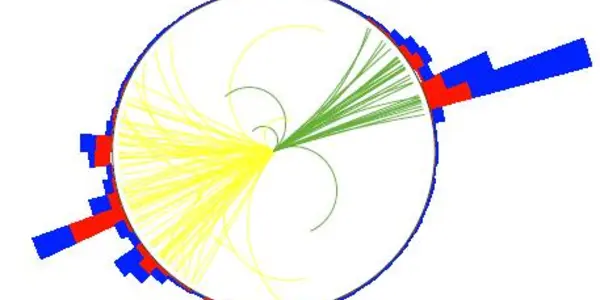
A thick paper by the ATLAS collaboration has been published by the Cornell Arxiv today. It is going to become a reference to all ATLAS analyses searching for new phenomena at high energy, or studies of boosted top quarks or vector bosons; and a good example of the new techniques that make sense of the energy distribution inside high-momentum jets.
The problem of classifying elements of a data set as belonging to one class or another, depending on their characteristics, is a very, very well-studied one, and one which is particularly important in particle physics. Imagine, for instance, that you collect events with four high-transverse-momentum leptons (electrons or muons) with the ATLAS or CMS detector, and you wish to sort out which of these fit better to the hypothesis of being originated by Higgs boson decay into two Z bosons (with each Z boson in turn producing a lepton pair) rather than to the alternative hypothesis of being due to the incoherent production of a pair of Z bosons -a process that has nothing to do with Higgs bosons. This means you need to classify the data events using their observed features.

Statistics data analysis is one of those things that experimental physicists learn along the way. It is not a topic usually included in the curriculum studiorum of physics students at Universities: only few basic ingredients are taught during laboratory courses, and not much is added to that during a typical Ph.D. program. One usually learns the most common tools to fit histograms, combine measurements, estimate uncertainties on the field, as these things are always needed to produce publishable physics results. But several key statistical concepts often remain fuzzy and obscure in the mind of a large fraction of experimental physicists throughout their career. I know this because this happened to me, too - for quite a few years after my graduation.
[The title of this article comes from a T-shirt with ten advices on what to do when everything else fails]It has always surprised me to realize how confident we physicists are of the good faith of our colleagues. We may argue endlessly over one graph or result, getting to the point of publically casting doubts on the dexterity or intelligence of our peers (yes, I've seen that), but we never seem to doubt -privately or otherwise- their scientific integrity.
"Oh Wind, if Winter comes, can Spring be far behind ?"Good old Shelley inspired me to start today's article with the above verse, taken from his magnificent "Ode to the West Wind". With the weather we are experiencing these days in Geneva and northern Italy, I found it a relieving thought...So, winter conferences are over, and summer ones are still far away. This is therefore a nice moment to try an assessment on the quality of the results that the two competing CERN experiments have produced on the study of the Higgs boson. Why ? Because we are not going to have to change our conclusions in a short time scale caused by a result about to be published. How to compare the results