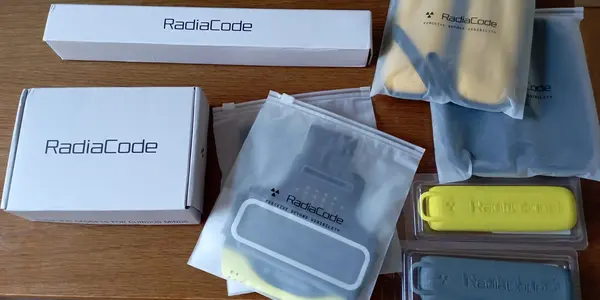
More on Radiacode 110
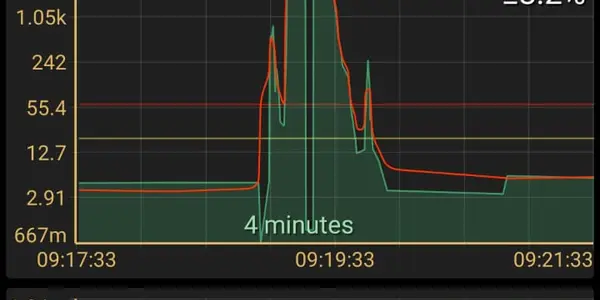
This is the second post reporting a few tests of the Radiacode 110 spectrometer, an extra-cool pocket dosimeter/radiation counter/spectrograph sold by RadiaCode.
This is the second post reporting a few tests of the Radiacode 110 spectrometer, an extra-cool pocket dosimeter/radiation counter/spectrograph sold by RadiaCode.


In a paper appeared a few days ago on the Cornell Arxiv Campbell, Ellis and Williams discuss how the LHC experiments have a chance to obtain information on the Higgs boson width by studying four-lepton events at masses much above the 126 GeV region where they cluster when produced by Higgs boson decays. Here I am going to show the graph that is at the source of this idea, and the general conclusions that the theorists reach on the precision that ATLAS and CMS can obtain on that parameter.First of all let me explain to outsiders what is the Higgs boson width. In order to do so I need to make a short digression.
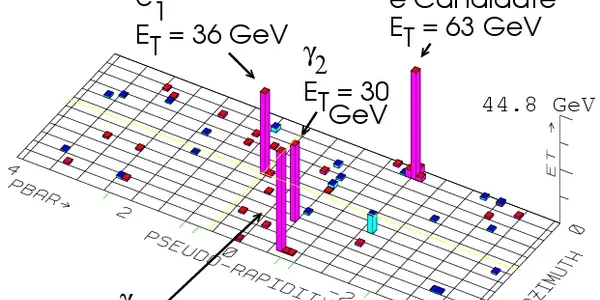
It happens in 1995, toward the end of Run 1B of the Fermilab Tevatron, in the middle of a otherwise anonymous store. The CDF detector is taking good data, and the shift crew in the control room take care of the usual business - a look at the colourful monitors that plaster the walls, a check at trigger rates, the logging of a few standard warnings issued by the data acquisition system, and the occasional browsing of e-mails.

These days I am trying to reconstruct some stories from my old experiment, CDF. The CDF experiment was conceived in 1979 and constructed in the early eighties at the Fermi laboratories in Batavia, near Chicago. CDF took the first proton-antiproton collisions in 1985, and it collected data in1987-88, 1992-96, and 2001-2011, thus becoming the longest-lasting particle physics experiment in the history of science.
The results of the LUX experiment are out - and they are negative: no dark matter signal has been spotted by the extra sensitive detector. This is a normal day for you and me, but a gloomy day for those that counted on the neutralino to be the first supersymmetric particle to show up and redeem decades of claims.

Do you remember the dijet bump at 140 GeV that CDF published in March 2011 ? This was a surprising excess in the mass distribution of pairs of jets found in events containing a leptonic W boson decay.
Yesterday evening I chanced to attend, invited by a friend, the opening of the 2013-2014 academic year of the university of Venice "Ca' Foscari", which was held at the Malibran theater. It was the first time I attended one such event, since technically (and practically) I am not an academic, but a researcher at the INFN, the Italian National Institute of Nuclear Physics. I do occasionally teach university courses (I just took a break from doing so after 5 years of teaching a course of subnuclear physics for 5th year undergraduates); but I do that for the university of Padova, not Venice - my office is at the department of physics of the university of Padova. Besides, Venice does not have a course of laurea in Physics.

Please note: spoiler information in this article!
The recent movie "Gravity", featuring the two hollywood stars George Clooney and Sandra Bullock, is a very interesting experiment in film-making.I can hardly recall other movies with just two characters, so this must clearly be a rare occurrence and one which shows that the movie treads in largely unexplored territory. Can people be entertained by one-man shows ? Well, yes, if the story is an extraordinary one. Tom Hanks does excellently in "Cast Away", for instance. "Gravity" is similar in the use of the loneliness of the protagonist and the large odds against her survival. But it is more radical in the total absence of other human figures, except Clooney of course.
The president Fernando Ferroni sent today an open, touching message to the personnel of the National Institute of Nuclear Physics, the Italian research organization he directs. The INFN contributed to the discovery of the Higgs boson by participating to the CMS and ATLAS experiments at CERN, providing funding and personnel -administrative staff, technicians, and researchers who are active members of the two big collaborations and who gave critical contributions to the discovery.
Today I was in the mood of cleaning up some areas of my labyrintic hard drive, after having performed a periodic backup of its contents. I thus came across some pieces of text that had been sitting in a remote folder, waiting to be used for a project now obsolete. I was about to just dump these files in the trash bin, when it occurred to me that this was stuff that had taken me some good time to put together, and maybe there was a better use for it.

HIGGS AND ENGLERT!Note: this article is being updated in real time as events unfold... Updates are at the bottom. Note in particular the 12.05 update...!---
A few days ago I posted the results of a poll ran on 50 or so participants to a workshop on the Higgs boson in Madrid. The poll consisted of six questions on the expectations one had on the possibility of new discoveries by present-day accelerators, as well as on the nature of the underlying theory of fundamental interactions, and on the nature of dark matter.

UPDATE: Just found out that Peter Woit anticipated me on this - see his blog entry.---Just five years ago, on the eve of the start of the Large Hadron Collider, most particle physicists - experimentalists and theorists alike - would have been willing to bet their left testicle or ovary on the fact that new physics would very soon be discovered, most likely Supersymmetric particles (if a suitable payoff had been offered in exchange).