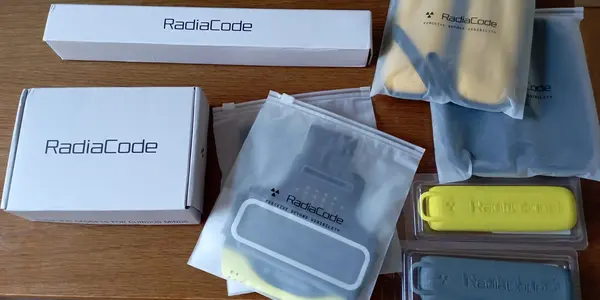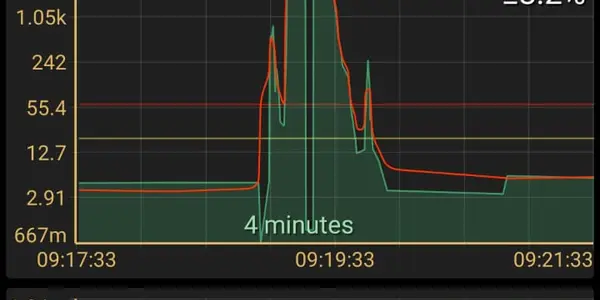
More on Radiacode 110
This is the second post reporting a few tests of the Radiacode 110 spectrometer, an extra-cool pocket dosimeter/radiation counter/spectrograph sold by RadiaCode.
This is the second post reporting a few tests of the Radiacode 110 spectrometer, an extra-cool pocket dosimeter/radiation counter/spectrograph sold by RadiaCode.


I have reported about the studies of resonances in the decays of the B+ meson by CDF, CMS, and LHCb a few times in the recent past. The situation, in a nutshell, was the following until yesterday: CDF found a new particle, the Y(4140), as a resonant (J/ψ φ) intermediate state produced when B+ mesons decay into a J/ψ, a φ, and a positive kaon; CDF also saw some evidence for a further excitation of the same two-body system; CMS confirmed the CDF claims, finding observation-level significance for both states; and LHCb did not confirm either of the two. Furthermore Belle, a B-factory experiment studying electron-positron collisions, also found no evidence for the Y(4140) state.

The ATLAS Collaboration published last week the results of a search for dark matter particles produced in association with a W or Z boson by the 8-TeV proton-proton collisions collected during the 2012 run of the Large Hadron Collider. The search uses techniques similar to ones I have described in recent articles here discussing results of the CMS experiments on different new physics signatures, and I thought it would be interesting to review it here.

Three weeks ago I gave a plenary talk at the 2nd International Conference on New Frontiers in Physics, which was held in Kolymbari, in the greek island of Crete. The talk focused on some of the most interesting new results by the CMS Collaboration, but being just 30' long it only contained a summary of these. The purpose of the talk was primarily that of advertising the many talks on specific physics topics -Top, Higgs, Exotica, QCD- which were given by some of my colleagues in the parallel sessions; however I was able to show and discuss some nice new measurements myself.

Last week I met Marek Karliner at the ICNFP 2013 conference in Crete, where we both enjoyed a nice friendly atmosphere, great food, and a wonderful peaceful location. Professor Marek Karliner is the chair of the Institute of Theoretical Physics of Tel Aviv in Israel. Since he agrees that outreach in physics is an important service that researchers should provide to the community, I was able to convince him to write for this blog the short article which you find below, on the interesting topic of baryons containing two heavy quarks - TD.
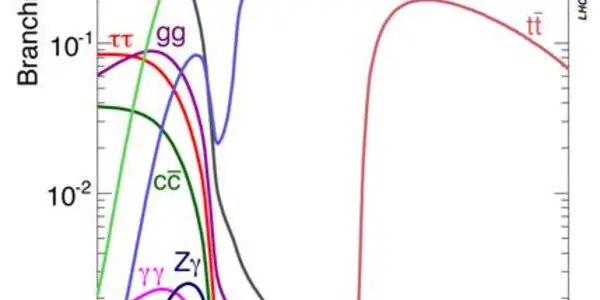
One year has passed since the joint discovery, by the CMS and ATLAS experiments at the Large Hadron Collider at CERN, of a particle which perfectly fits our expectations for a Standard Model Higgs boson. Highly wanted and sought for at particle colliders since the seventies, the Higgs boson is now an established reality, and the interest of experimental physicists has moved to a detailed study of the observable properties of this particle.
One year has passed since the joint discovery, by the CMS and ATLAS experiments at the Large Hadron Collider at CERN, of a particle which perfectly fits our expectations for a Standard Model Higgs boson. Highly wanted and sought for at particle colliders since the seventies, the Higgs boson is now an established reality, and the interest of experimental physicists has moved to a detailed study of the observable properties of this particle.

Yesterday I had the great pleasure to listen to George Zweig, who gave seminar about the discovery of the idea of quarks (or Aces, as he originally named them) at the International Conference of New Frontiers in Physics which is going on this week in the nice setting of Kolymbari, on the north-west coast of the Mediterranean island of Crete.

Thanks to a friend and follower of this blog, which I will not name for once to protect him from your flaming, I can share today with you one of the best instances of involuntary humor in particle physics graphs I have ever seen in my whole life. The graph appears to be genuine, so this is a good candidate for the IgNobel prize IMHO.

Back from the beautiful Greek island of Naxos, I find myself in Venice for just a day before leaving to another Greek island - Crete. But this time for business rather than vacations: I will be giving a CMS Overview talk at the International Conference of New Frontiers in Physics, which started yesterday in Kolympari, on the north-western coast of the island.As usual, I am lagging behind with the task of putting together my presentation slides. This time I had been working at a reasonable pace while on vacation, and I thought I was almost done, when I was notified that due to the absence of the CMS colleague who was in charge of speaking about CMS Heavy Ion Results, I was to cover in more detail that part than I would have.

Yesterday CMS published the results of a new search for a heavy partner of the bottom quark, by looking for the decay b' -> bZ: that is, the heavy b' is sought in a so-called Flavour-Changing neutral current process. The "neutral current" is an old but still used terminology to indicate the emission of a neutral vector boson, the Z.

Despite the shutdown of the Fermilab Tevatron collider, two years ago, and the subsequent disassembling of the glorious CDF detector, the CDF Collaboration continues to produce excellent physics results using the large bounty of data they have accumulated in the course of the past 10 years.Today you can find in the Cornell arxiv a new paper by CDF, which describes a new very interesting measurement of a property of the top quark - the particle discovered at Fermilab in 1995, the heaviest known elementary particle we know. The property measured is the lifetime of top quarks.

Note: this is the fourth, and last, part of a four-part article (see part I, part II, part III) on the five-sigma criterion for discovery claims in particle physics. If you haven't read the first three installments, the text below may or may not make much sense to you...