More on Radiacode 110
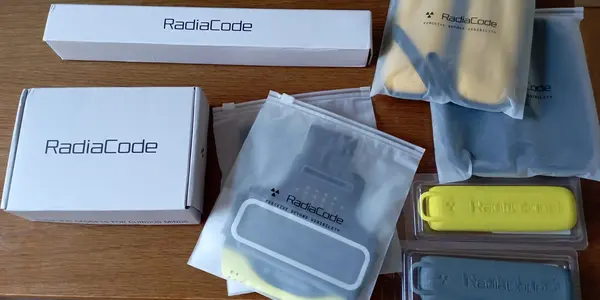
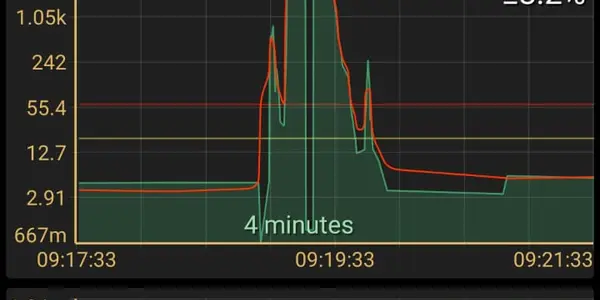
This is the second post reporting a few tests of the Radiacode 110 spectrometer, an extra-cool pocket dosimeter/radiation counter/spectrograph sold by RadiaCode.
This is the second post reporting a few tests of the Radiacode 110 spectrometer, an extra-cool pocket dosimeter/radiation counter/spectrograph sold by RadiaCode.

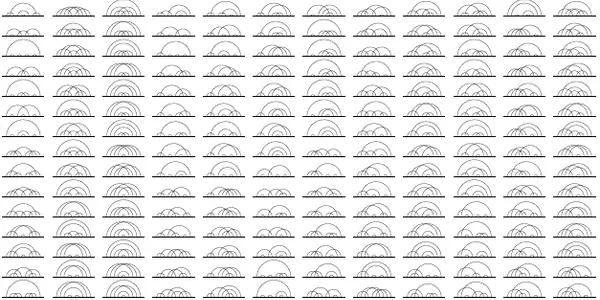
Apologizing for the silence of last week, due not so much to Christmas holidays but to my working around the clock to write a grant proposal, I wish to show you today a graph which describes very well the complexities of modern day frontier theoretical calculations. That graph is the collection of some of the Feynman diagrams that have to be calculated in order to evaluate a property of the electron called its "anomalous magnetic moment".

Ben Allanach, guest blogger, is a Professor of Theoretical Physics at the University of Cambridge. He is grumpy about the way that public funds are being unnecessarily directed to scientific publishing houses. So I am offering this space to him to hear what he has to say about that...
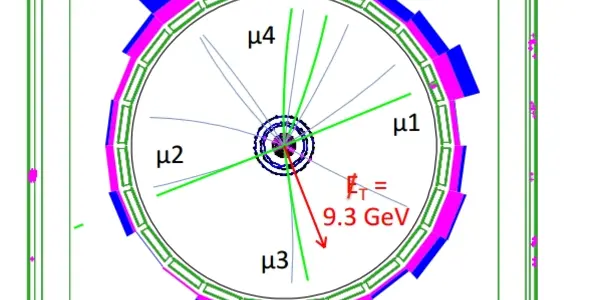
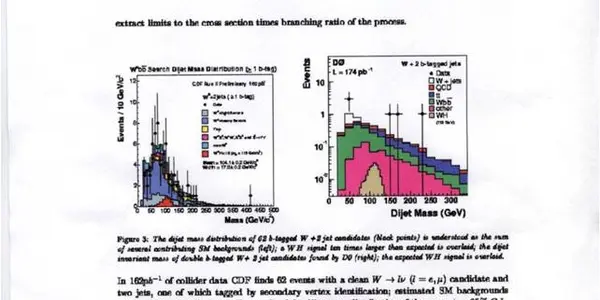
Alas, for once I must say I am not completely happy of one new result by the CDF collaboration - the experiment to which I devoted 18 years of my research time, and where I learned almost everything I know about experimental particle physics.
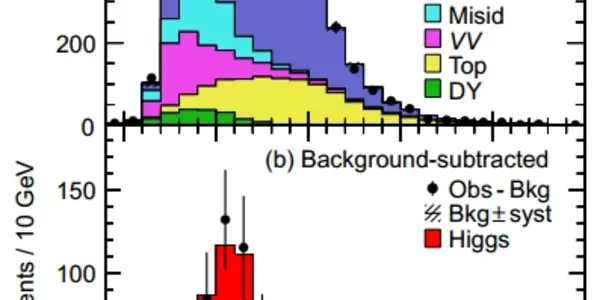
The latest paper by the ATLAS Collaboration is a very detailed report of the search for Higgs boson decays to W boson pairs in Run 1 data. The H->WW* process contributes significantly to the total bounty of Higgs boson candidates that the two CERN experiments have been able to collect in the 2011 7-TeV and 2012 8-TeV proton-proton collisions, but the presence of neutrinos in the final state prevents the clean reconstruction of an invariant mass peak, hence the WW* final state has remained a bit "in the shadows" with respect to the cherished ZZ* and gamma-gamma final states.

One of the funniest misnomers in particle physics is the naming of coupling strength parameters of the fundamental interactions as "constants". We speak of a fine structure constant (alpha) to address one of the most important parameters of electromagnetism; and we call "strong coupling constant" the coupling strength parameter alpha_s of QCD. But these are not constants at all! In fact, they are parameters that show a quite distinct dependence on the energy of subatomic processes.

I remember a funny shirt I once saw at a physics conference - it gave 10 tips on what to do when "everything else fails". Here is the list:10. Subtract Infinity9. Add heavy fermions8. Set all fermion masses to zero7. Invent another symmetry6. Throw it on the lattice5. Blame it on the Planck scale4. Recall the success of the SM3. Invoke the Anthropic Principle2. Wave hands a lot, speak with a strong accent1. Manipulate the data
Yesterday I worked from scratch at a problem which certainly others have already solved in the past. I have mixed feelings with such situations: on one side I hate to reinvent the wheel, especially if there is an easy way to access a good solution; on the other I love to invent new ones...Anyway this time I have decided I will ask you for some help, as collectively we may have a better idea of the optimal solution to the specific problem I am trying to address. But before I explain the problem, let me give you some background on the general context.Searches for new physics at the LHC
Bringing the concept of peer review to another dimension, I am offering you to read a review article I just wrote. You are invited to contribute to its review by suggesting improvements, corrections, changes or amendments to the text. I sort of need some scrutiny of this paper since it is not a report of CMS results -and thus I have not been forced by submit it for internal review to my collaboration.
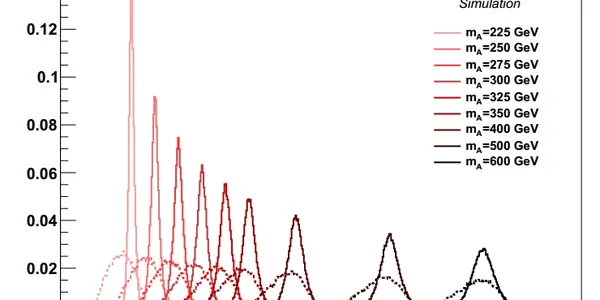
I am quite happy to report today that the CMS experiment at the CERN Large Hadron Collider has just published a new search which fills a gap in studies of extended Higgs boson sectors. It is a search for the decay of the A boson into Zh pairs, where the Z in turn decays to an electron-positron or a muon-antimuon pair, and the h is assumed to be the 125 GeV Higgs and is sought for in its decay to b-quark pairs. If you are short of time, this is the bottomline: no A boson is found in Run 1 CMS data, and limits are set in the parameter space of the relevant theories. But if you have a bit more time to spend here, let's start with the beginning - What's the A boson, you might wonder for a start.
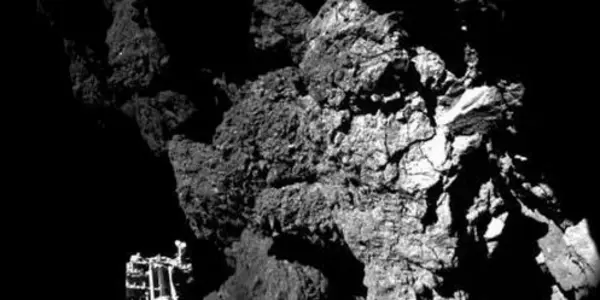
This one is definitely too juicy to ignore - I need to join the crowd of bystanders-in-awe. As you may have heard, ESA's ROSETTA spacecraft successfully landed yesterday on the solid nucleus of comet 67/P, Churyumov-Gerasimenko - a 2.5 mile long conglomerate of rock and ice. I refrain from giving detail of that enormous achievement for humankind, because I rather want to comment on this rather funny twist of the whole story. But still let's first enjoy at least one nice picture of the surface of that distant solar system body...
Forget the Higgs Boson, the Landing on Comets, Missions to Mars, the Genome Project, Nanostructures and all that. This start of this new millennium looks like the dark ages to me if I have to gauge it from discussions I overhear in public places.
Results of a new search for single top production and large missing energy have been published by the ATLAS collaboration in a recent preprint. I think it is worthwhile to have a look at the idea behind this new search, as the signature of invisible particles produced in LHC collisions and escaping the detectors is important in many of the current and future investigations of beyond-the-standard-model physics.