More on Radiacode 110
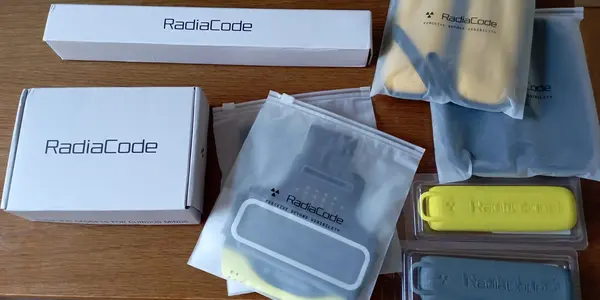
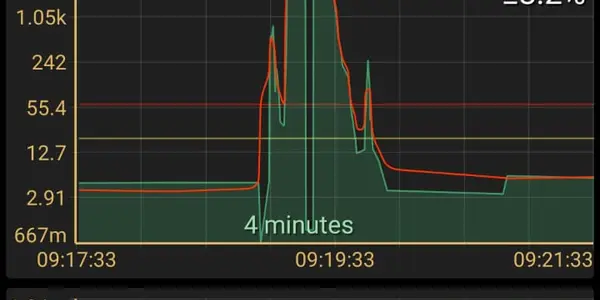
This is the second post reporting a few tests of the Radiacode 110 spectrometer, an extra-cool pocket dosimeter/radiation counter/spectrograph sold by RadiaCode.
This is the second post reporting a few tests of the Radiacode 110 spectrometer, an extra-cool pocket dosimeter/radiation counter/spectrograph sold by RadiaCode.


This week I am in Warsaw, where I attend the XI workshop on particle correlations and femtoscopy. I am actually here to give a seminar on statistical methods in particle physics next Thursday, but of course I am also going to try and deepen my understanding of the field of investigations of heavy ion collisions.Jan Pluta, one of the old-schoolers of the field, gave an introductory talk this morning. It was titled "A brief history of femtoscopy and particle correlations - a personal view". I am reporting below some impressions from his presentation.What is femtoscopy ? Jan started by warning that he would indeed only give a personal view of the history of the field, and that the view of others may be very different.
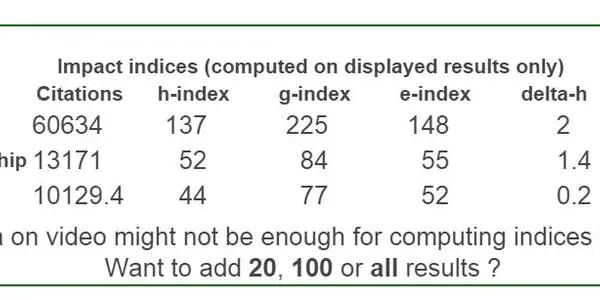
Recurrently, uninformed journalists re-discover the h-index and decide to create their own list of the "top scientists" in their country. The most zealous also draw some summary statistics from the list, and then venture to speculate wildly about it. Alas, it's a pattern I've seen a few times now.The latest is an article which somebody posted on my Facebook column. It is uninteresting to see what conclusions are drawn from the graphs and lists published there, as the data are quite incomplete - in the h-index-ordered list of Italian researchers I do not appear, for one, but similarly do not dozens of top scientists who have even higher h-indices.
As I am spending my time these days selecting candidates for early-stage researcher positions in the EU network I am coordinating, I am reminded of my own experience as a participant to job interviews from the other side of the table. The text below tells the story of my interviews for a post-doctoral position in 1998. Enjoy! ----
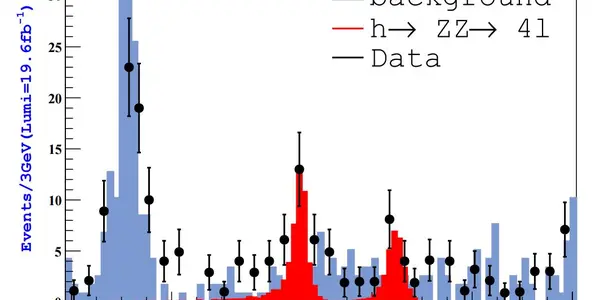
A longtime follower of this blog, Tony Smith, pointed out to me today this arxiv paper published three days ago. In it, CMS data from Run 1 of the LHC are used to speculate that there might be a second Higgs boson hiding in the data at a mass of about 145 GeV. Check out the two graphs that they produce.The first one, shown below, is their own interpretation of the four-lepton invariant mass from CMS data and background in the H-->ZZ--> four lepton final state:

Yesterday my 16 year old son surprised me by explaining that he had been taught at school what alpha, beta, and gamma decays are. He had learned a lot, but I was able to add a little more background information to the picture as he asked me what was the neutrino, which his professor had correctly explained was one of the particles emitted in beta decay.With hindsight, my surprise probably comes from keeping my brain inactive and sticking to a rather conservative idea of how sciences should be taught at school; that idea is that understanding physics requires you to have some solid basis in maths, and that the explanation of phenomena should proceed along with quantitative calculations.
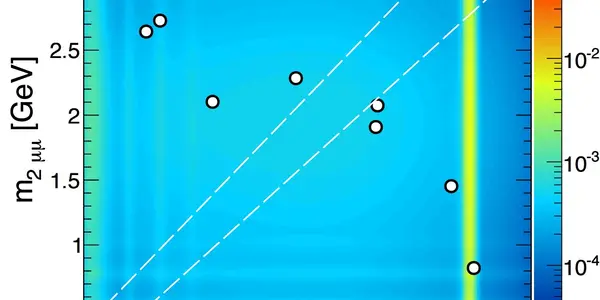
The graph below, I hope you'll agree, is significantly cooler and better-looking than the typical data display plots you get from high-energy physics analyses. Colours are bright, graphical symbols are clean, and one grasps the essence of the information quickly once one knows what it is about. So, let me tell you what it is about for starters.
Yesterday I chaired the selection committee to choose the student who will be hired in the AMVA4NewPhysics network by the Padova section of INFN, and during the interviews I asked all candidates a couple of "easy" physics questions, meant to test the students' reasoning process rather than their prior knowledge.The first question was only apparently easy - even too much, from the outset. The fact is, the devil is always hiding in the details, as I immediately realized as I tested it by asking an experienced colleague to answer it. He got part of the question wrong, but in doing so he clarified to me that there was a non trivial aspect below the surface.
The winners of the 2015 Nobel Prize in Physics are:
Takaaki Kajita Kajita (Super Kamiokande)
Arthur McDonald (Sudbury Neutrino Observatory - SNO)
“for the discovery of neutrino oscillations, which shows that neutrinos have mass"
It is with great sadness that I heard (reading it here first) about the passing away of Guido Altarelli, a very distinguished Italian theoretical physicist. Altarelli is best known for the formulas that bear his name, the Altarelli-Parisi equations (also known as DGLAP since it was realized that due recognition for the equations had to be given also to Dokshitzer, Gribov, and Lipatov). But Altarelli was a star physicist who gave important contributions to Standard Model physics in a number of ways.
Last Friday I was invited by the University of Padova to talk about particle physics to the general public, in occasion of the "Researchers Night", a yearly event organized by the European Commission which takes place throughout Europe - in 280 cities this year. Of course I gladly accepted the invitation, although it caused some trouble to my travel schedule (I was in Austria for lectures until Friday morning, and you don't want to see me driving when I am in a hurry, especially on a 500km route).

The challenge of providing Ph.D. students in Physics with an overview of statistical methods and concepts useful for data analysis in just three hours of lectures is definitely a serious one, so I decided to take it as I got invited to the "Indian Summer School" in the pleasant lakeside town of Traunkirchen, Austria.
Category theory is a branch of mathematics which attempts a formalization in terms of simple elements and associations between them. A rather abstract construction, indeed, and certainly one above my head (I am an experimentalist, for god's sake!).