Adaptive Complexity

Michael White

Michael White

Welcome to Adaptive Complexity, where I write about genomics, systems biology, evolution, and the connection between science and literature, government, and society. I'm a biochemist and a postdoctoral fellow in the Department of Genetics and the Ce…
RSS Feed
How Would We Evolve If We Always Opened Beer Bottles With Our Teeth?

How Would We Evolve If We Always Opened Beer Bottles With Our Teeth?

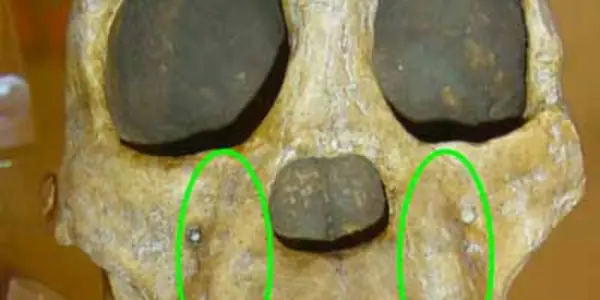
Show Me The Science Month Day 11Imagine a world where the major source of human nutrition was beer. That may sound fantastic to some of you, but now imagine that, in this beer-world, there are no bottle openers and no twist-off caps. To get at the beer, you have to open the bottles with your teeth. Day in, day out, you're opening bottles with your teeth. If the world continued like this for a few thousand generations, how would the human jaw evolve into a better beer bottle opener?2 million years ago, our ancestors lived in such a world. OK, so it didn't involve beer-bottles, but our ancestors did have to use their teeth to get at what was essentially armored but highly nutritious food - nuts and seeds.

The Amphibious Ancestors of Whales

The Amphibious Ancestors of Whales

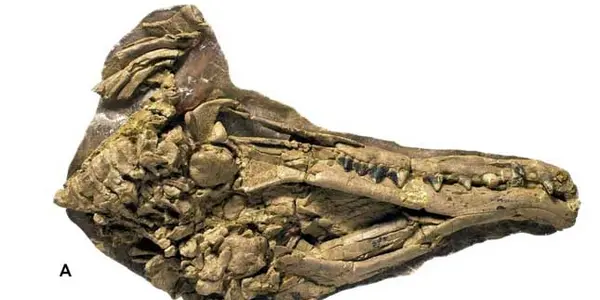
Show Me The Science Month Day 9In what is now central Pakistan, an eight-and-a-half foot long, pregnant aquatic mammal went belly-up, and sank to the bottom of the shallow coastal waters. 47 million years later, a huckster by the name of Duane Gish denied that such mammals ever existed:There simply are no transitional forms in the fossil record between the marine mammals and their supposed land mammal ancestors . . . It is quite entertaining, starting with cows, pigs, or buffaloes, to attempt to visualize what the intermediates may have looked like. Starting with a cow, one could even imagine one line of descent which prematurely became extinct, due to what might be called an “udder failure” (Gish DT. Evolution: The Challenge of the Fossil Record. El Cajon (CA): Creation-Life Publishers, 1985 p.78-9, quoted at Talk Origins).Gish may have found it entertaining to imagine what a half-whale, half-buffalo looked like, but today's scientists don't have to imagine the appearance of land-based ancestors of whales. The fossil series leading up to whales tells a very detailed and remarkable story of how furry, four-legged land mammals eventually gave rise to behemoth marine descendants. A spectacular fossil find, reported yesterday in PLoS One, reveals some amazing details from the evolutionary history of whales.Figure 5A from Gingerich, et al.


What a New Fossil Tells Us About New Zealand's Watery Past

What a New Fossil Tells Us About New Zealand's Watery Past

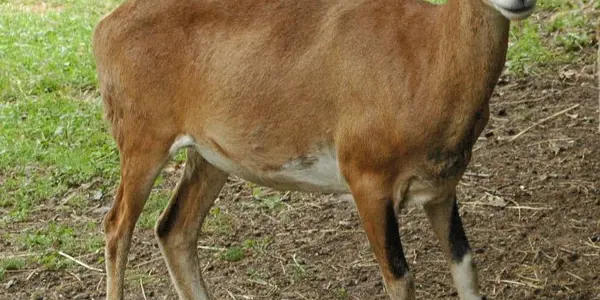
Show Me The Science Month Day 8A tuatara may look like an iguana, but it's a reptile in a category all its own. Tuataras are most closely related to lizards and snakes, but in some ways they are oddballs among reptiles, with unique characteristics among reptiles, like their affinity for cool weather, their nocturnal lifestyle, a third eye on top of the skull, and vertebrae that more closely resemble those of fish and amphibians than reptiles. Male tuataras also have another odd feature - they lack a certain member, which means their reproductive behavior differs from other lizards.Image courtesy of the Wikipedia Commons

Cloning Experiment Refutes Creationist

Cloning Experiment Refutes Creationist

Evolution may be viewed as a controversial subject by much of the US population, but evolutionary biologists frequently complain that this controversy is manufactured by opponents of evolution who have a very flawed understanding of what the science of evolution is. This poor grasp of the science was demonstrated once again in a talk given by Intelligent Design advocate Jonathan Wells, who claims that "DNA does not control embryo development."Wells, who has a PhD in biology, (I don't know what the director of graduate studies at UC Berkeley was smoking), has repeatedly demonstrated his cluelessness about basic elements of biology, and he is a clear illustration of why a PhD does not necessarily indicate anything about its holder's knowledge. Over at Pharyngula, PZ Myers has a thorough takedown of Wells' absurd talk. The talk is based on the bizarre claim that "DNA does not control embryo development." If that's true, Wells argues, then the whole tottering neo-Darwinian edifice collapses, or something like that.

Poor Gene Copying and the Evolution of New Species

Poor Gene Copying and the Evolution of New Species

Show Me The Science Month Day 7The birth of new species always involves a barrier to cross-breeding between two different groups of the same species. This barrier may start out as a geographical barrier (two raccoon populations on different sides of a mountain never encounter each other and thus fail to interbreed), but however it starts, reporductive barriers always turn into a genetic barrier. To form new species, two populations of organisms have to drift apart genetically.The genetic split can happen in a variety of ways, as scientists are discovering in the their quest to find 'speciation genes.' It can happen because a selfish gene fails to be shut down in the offspring of cross-breeding flies, and it can happen because one mouse gene doesn't work right when it encounters genetic variants from another subspecies.A report in Science describes one more speciation gene, this time in two sub-species of thale cress plants. In this case, the barrier to reproduction is the result of faulty gene copying.

Yet Another Gene to Create Species

Yet Another Gene to Create Species

Show Me The Science Month Day 6Yesterday we discussed the discovery of a gene that keeps mouse subspecies from producing fertile hybrid offspring. In other words, a gene that is putting a reproductive barrier between incipient mouse species.Scientists have discovered speciation genes in other organisms as well. A report by Nitin Phadnis and H. Allen Orr at the University of Rochester describes a speciation gene that puts a reproductive barrier between fruit fly subspecies.

Hunting for Genes that Keep Species Separate

Hunting for Genes that Keep Species Separate

Show Me The Science Month Day 5Speciation Genetics is, in a sense, an oxymoron. Genetics is the study of heritable characteristics, but the researchers who study speciation genetics are looking for genes that cause inheritance to fail. They are looking for the genetic incompatibilities that keep species apart.Speciation is about how a population of similar, interbreeding organisms becomes two or more populations so different from each other that they no longer form a common gene pool. Species' differences can be extremely subtle. In fact, an evolutionary process of speciation means that there must be a point at which the physical differences between two species is hard to discern, as well as a point when two populations aren't quite different species, but well on their way to becoming separate. At some point, when one gene pool splits into two, genetic incompatibilities arise that make cross-breeding between two populations a doomed enterprise.What kinds of genetic incompatibilities first arise in the process of speciation? What types of genes are involved? A paper in the January 16th issue of Science reports on the discovery of a 'speciation gene' keeping two mouse sub-species from producing viable offspring.

Deciphering the Tracks of Evolution in Our Genomes

Deciphering the Tracks of Evolution in Our Genomes

Show Me The Science Month Day 4How did we become human? You can ask the same question in a slightly different way: how did we become different from chimps?  Although the common ancestor that we shared with chimps 5-7 million years ago was not itself a chimp, it probably resembled modern-day chimps much more than it resembled us. Both humans and chimps have been changing under evolutionary pressure since our lineages split, but humans have obviously picked up traits that make us stand out from other modern apes, most notably our intelligence.

Size Matters for Plants Too

Size Matters for Plants Too

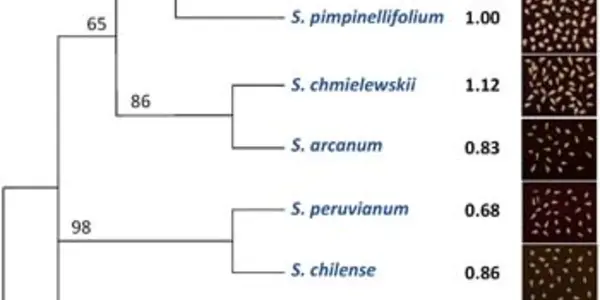
Show Me The Science Day 3Reproduction involves some tricky trade-offs for all species, and anyone who has watched a David Attenborough film knows that you can find a wide range of reproductive strategies in nature. Some animals spend their energy producing hundreds or thousands of offspring and leave them to fend for themselves. Others, like whales and humans, produce only a few offspring but expend an enormous amount of resources trying to give those offspring the best chance in life possible.Plants face a similar trade-off. They can choose to produce many energetically cheap small seeds, or fewer, more expensive large seeds. A recent paper in PLoS Genetics takes a look at one of the genes involved in seed size evolution. They study naturally-occurring genetic variation in found in this gene, and the relationship of that genetic variation to seed size in the domesticated tomato and its wild relatives.Variation in Seed Size, Figure 1 from Orsi and Tanksley

Putting Evolution in Reverse

Putting Evolution in Reverse

Show Me The Science Month, Day 2How do two populations change genetically when they are subjected to different evolutionary pressures? To answer this question, many intrepid evolutionary biologists have trudged out into the field to painstakingly study wild populations, but in many cases, we can learn more by studying evolution in the lab. In a paper published the February issue of Nature Genetics, a group of Portuguese and US researchers report a study of 28 years of evolution in a set of lab fruit fly populations. Their results are an example of how studying evolution in the lab, even for a short time, can provide insight in to how natural selection shapes the genetic contours of a population.

Primitive Dinosaur Feathers

Primitive Dinosaur Feathers

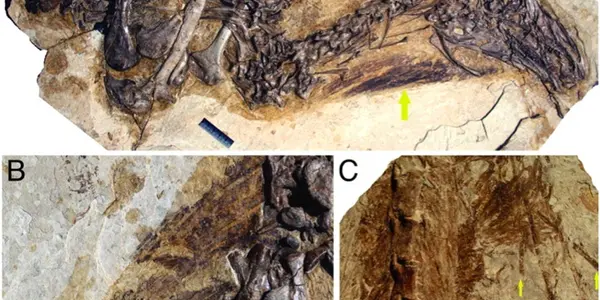
Show me the science: 30 days of evolution blogging, day 1Birds are the modern day descendants of dinosaurs, or as paleontologist Kevin Padian likes to say, birds are dinosaurs. But how did birds evolve from grounded, naked reptiles into plumed aviators? Evolutionary biologists have been piecing together the details for nearly 40 years, and this month, a major prediction about feather evolution has been vindicated.Xing Xu and colleagues at the Chinese Academy of Sciences report the discovery of 120 million-year-old primitive fossil feathers, whose structure matches a prediction about the evolution of feathers made 10 years ago. With this fossil discovery, all major stages of feather evolution predicted by evolutionary biologists have been found in the fossil record.Xu, et al., Figure 1, copyright PNAS

Did God Short-Change Us on Genes?

Did God Short-Change Us on Genes?

Via Pharyngula, some non-scientist MD thinks that ~21,000 protein-coding genes aren't nearly enough to make a human (which of course then means that evolution is wrong):4) The Human Genome Project showed that only 1-2% of Human DNA codes for proteins, or about 25,000 genes. These are not enough to account for the complexity of the organism. What is the other 98% of the genome's function? We don't know.(BTW, the count of human genes has gone down since the genome sequence was first released; the latest number I hear from my gene-finding colleagues is about 21,000.)PZ points out the absurdity of this claim that we're short on genes: