If you see multiple graves in medieval graves, it is reasonable to assume children and adults were related, but a new study finds that was not the case. They were separated by sex, males in one section of the graveyard and females in another, and more likely buried en masse just due to time rather than genetics.
Intriguingly, one of the people the researchers studied made a famous pilgrimage, trekking thousands of miles. And she was buried with her souvenir of the trip.
The graves analyzed contained 142 individuals from three sites in Sweden and of those,116 were in 50 group burials, while 25 from single burials served as a comparison group. Their commonalities allowed scholars to converge on insights of the social world of the time, which pushes anthropological speculation a little farther out.
Modern DNA methods allowed researchers to determine the biological sex of children who were too young to be identified osteologically, which is how they determined kids were buried by the same cemetery rules as adults - which meant males and females were buried on different sides of the churchyard.
A key find is known as Lady 56, from a cemetery at Västerhus. DNA linked her to her parents, her brother, and two daughters but she didn't spend her entire life in Jämtland. A scallop shell in her position affirms that she instead made a famous pilgramage to Santiago de Compostela in Spain, which once rivaled Jerusalem and Rome because of the tomb of Saint James the Apostle. Hundreds of thousands still travel this Camino de Santiago each year, but they don't walk from Sweden for a year.
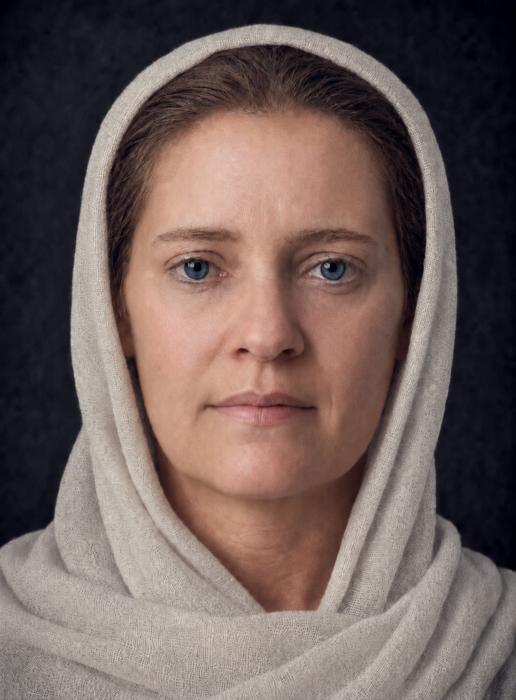
Forensic facial reconstruction based on morphology and genetics of one of the key Västerhus individuals analysed in the study. The reconstruction and the photograph are by Oscar Nilsson/Stockholm University.
It's definitely a journey for the young and she died before the age of 30 but not before bringing back a scallop shell, which was symbolic of the intersecting paths pilgrims took from all over the Christian world to reach that same destination in Santiago. And science helps fill in questions about the the social worlds in which people lived, worked, worshipped, and were laid to rest.
Citation: Maja Krzewińska, Anna Kjellström, Reyhan Yaka, Ricardo Rodríguez-Varela, Zoé Pochon, Vendela Kempe Lagerholm, Charlotte Hedenstierna-Jonson, Torun Zachrisson, Natalija Kashuba, Verónica Sobrado, Thijessen Naidoo, Kıvılcım Başak Vural, Mattias Jakobsson, Gülşah Merve Kılınç, Jan Storå, and Anders Götherström,Equal in death: Ancient genomic analysis of children’s early Christian burials.Sci. Adv.12,beaeb8588(2026), DOI:10.1126/sciadv.aeb8588