You Feel Colder As You Age: The Science Reason Why
Older people report feeling colder, enough that it is clearly happening, but why has been a mystery. Until now.
Older people report feeling colder, enough that it is clearly happening, but why has been a mystery. Until now.


The best reasons to allow hunting in animal-heavy states are that they get hit by cars a lot and they starve. When it comes to cars, some areas are going to be a lot more dangerous than others and it is not a question of how many animals are there but simply where the road is. They have done things their way for 6,000 years and don't want to change, regardless of what automobiles might like.But the animals will go over. Case in point: The Wildlife Conservation Society (WCS) has announced the successful use of newly constructed overpasses that provide safe passage for thousands of migrating pronghorn over U.S. Highway 191 in Trapper’s Point, Wyoming, and surrounding areas.

Greenland has areas of very clean water, the like of which just does not exist in developed nations, but also highly polluted water, making it an excellent location for studying the environmental impacts of chemicalsMore than 10,000 tons of antibiotics are consumed in Europe each year and an estimated 30-60% of those pass through animals and humans completely unchanged. These different substances can then reach the ocean via hospitals, municipal sewage, fish farms and run-off from agriculture and landfills.A research group from the University of Gothenburg wanted to examine the potential effects of accumulating antibiotics in the seabed, so off to Greenland they went.
New research findings show that immune system development is affected by gravity changes when astronauts are exposed to stresses during launch and landing which disrupts their body’s natural defenses against infection. Changes to the immune system need to be investigated before astronauts undergo longer space missions. Researchers looked at how antibody production is affected when animal development occurs on board a space station and which part of space travel has the greatest impact on antibodies, which are the proteins that the immune system uses to protect us from diseases.
Why, in difficult driving conditions or when lost, do people turn down the volume of their radio? Some new research links motor skills and perception, specifically as it relates to a second finding; a new understanding of what the left and right brain hemispheres "hear." The findings, the first to match human behavior with left brain/right brain auditory processing tasks, may eventually point to strategies that could help stroke patients recover their language abilities and to improve speech recognition in children with dyslexia.
In a pinch and need to go back in time or flee to Alpha Centauri in a hurry? Find a mathematician, quick!If only Einstein's theory of special relativity were extended to work beyond the speed of light, things would be easy. But of course Einstein's theory holds that nothing could move faster than the speed of light. Special Relativity was published in 1905 and explained how motion and speed is always relative to the observer's frame of reference. The theory connects measurements of the same physical incident viewed from these different points in a way that depends on the relative velocity of the two observers.
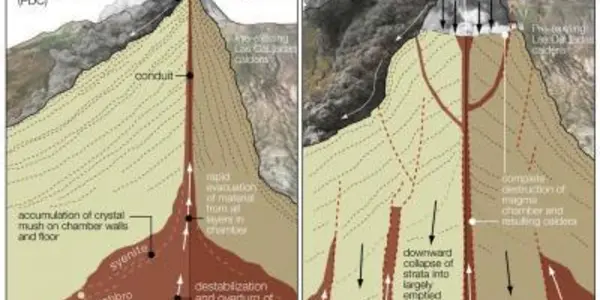
The Las Cañadas volcanic caldera on Tenerife in the Canary Islands has generated at eight major eruptions during the last 700,000 years, catastrophic events which resulted in eruption columns of over 10 miles high and expelled widespread pyroclastic material over 60 miles. For comparative purposes, even the smallest of those Tenerife eruptions expelled over 25 times more material than the 2010 eruption of Eyjafjallajökull, Iceland. The Las Cañadas volcano is an IAVCEI (International Association of Volcanology and Chemistry of the Earth's Interior) Decade Volcano – identified by the international community as being worthy of particular study in light of their history of large, destructive eruptions and proximity to populated area.

A concrete marker to condemn the assassination of Julius Caesar has confirmed that the legendary statesman and general was stabbed right at the bottom of the Curia of Pompey while he sat, presiding over a meeting of the Senate. Currently, the remains of this building are located in the archaeological area of Torre Argentina, right in the historic center of the Roman capital. Caesar's adopted son and successor, Augustus, ordered the structure created to protest the death of his father. The classical texts had stated Julius Caesar was stabbed in the Curia of Pompey on March 15th of the year 44 B.C. but it lacked material evidence.

A rocky planet twice Earth's size, called 55 Cancri e, that orbits a nearby star is likely a diamond planet, according to new research.55 Cancri e has a radius twice Earth's and a mass eight times greater, making it a "super-Earth." It is one of five planets orbiting the sun-like star, 55 Cancri, that is located 40 light years from Earth yet visible to the naked eye in the constellation of Cancer. The planet orbits at hyper speed; its year lasts just 18 hours, in contrast to Earth's 365 days. It is also blazing hot, with a temperature of about 3,900 degrees Fahrenheit, researchers said, a far cry from a habitable world.
Recently, some people subjected themselves to perhaps the most annoying study of 2012; they had to sample and pick the most irritating noises in the world, and they did it for science. Researchers used functional magnetic resonance imaging (fMRI) to examine how the brains of 13 volunteers responded to a range of sounds. Listening to the noises inside the scanner they rated them from the most unpleasant to the most pleasing. Scientists were then able to study the brain response to each type of sound and they believe they have found the interaction between the region of the brain that processes sound, the auditory cortex, and the amygdala, which is active in the processing of negative emotions when we hear unpleasant sounds.
Scientists have used a three GeV synchrotron radiation facility to visualize an interaction between gluten and T-cells in the human immune system, providing insight into how celiac disease is triggered. And it will lead to a vaccine, they believe.An increasingly diagnosed chronic inflammatory disorder, celiac disease affects the digestive process of the small intestine. When a person with celiac disease consumes gluten, a protein found in wheat, rye and barley, their immune system triggers T-cells to fight the offending proteins, which damages the small intestine and inhibits absorption of important nutrients into the body. There are no treatments, apart from making sure to eat no foods with gluten.
Can researchers improve the quality of matter akin to that found in plasma screens? A new study improves the understanding of plasma sources, where a certain portion of the particles are ionized. Under certain circumstances, plasma tends to form structures - filaments of electric discharge that are like mini-lightning. Researchers recently investigated barrier discharge, which features at least one electrical insulating material within the discharge gap that acts as an electrically insulating barrier and can be used as a plasma source. They investigated the transition from a highly ordered filament pattern, which is arranged hexagonally, to a disordered system due to the reduction of the externally applied voltage.

In January, 2005, ESA’s Huygens probe bounced, slid and wobbled its way to rest for 10 seconds after touching down on Saturn’s moon, Titan. As you can imagine, that tells scientists quite a bit about the nature of that moon’s surface.They reconstructed the chain of events by analyzing data from a variety of instruments that were active during the impact, in particular changes in the acceleration experienced by the probe. The instrument data were compared with results from computer simulations and a drop test using a model of Huygens designed to replicate the landing and the analysis revealed that, on first contact with Titan’s surface, Huygens dug a hole 12 cm deep before bouncing out onto a flat surface.