You Feel Colder As You Age: The Science Reason Why
Older people report feeling colder, enough that it is clearly happening, but why has been a mystery. Until now.
Older people report feeling colder, enough that it is clearly happening, but why has been a mystery. Until now.


For over a year, Google has been the target of U.S. and European antitrust investigations, but now the search company has fired back. In a report commissioned by Google and released today, two acclaimed antitrust experts dismiss Google's critics' claims as lacking any compelling legal or economic argument for a government antitrust case.
What Does the Chicago School Teach About Internet Search and the Antitrust Treatment of Google? the work of Judge Robert Bork and Professor Gregory Sidak. The report examines the legal theories of Google's critics and compares those conjectures to the real-world search experience.
Hydraulic fracturing technology, called fracking, has been around since the 1940s but has recently gained attention as the energy industry expanded cleaner natural gas production.
The inaugural Energy Census from business intelligence company Polecat says it is a big topic, with energy writers noting that CO2 emissions from energy have plummeted and coal emissions have gone even farther back in time, to the days of the first Reagan administration. Meanwhile, detractors claim it causes headaches and cancer (cancer has been the go-to disease for everything since Rachel Carson made up a scare about DDT 50 years ago) and even that it could cause the earth to deflate.

If you ask an adult for the midpoint between 1 and 9 they say 5. Mentally, they put 9 points on a ine and add 1 and then split that in half.But if you ask a child or someone from a culture not trained in maths, the answer could be different; perhaps 3. It isn't that they don't know how to count, it's because it's actually more natural for humans to think logarithmically instead of linearly, say researchers. Neural circuits seem to bear out that hypothesis; in psychological experiments, multiplying the intensity of some sensory stimuli causes a linear increase in perceived intensity.

The European Southern Observatory (ESO) is officially 50 years old today and this morning, for the first time ever, observations with ESO’s Very Large Telescope were made of an object chosen by the public. The winner of an anniversary competition pointed the VLT towards the spectacular Thor’s Helmet Nebula and the observations were broadcast live over the Internet. The signing of the ESO Convention on October 5th, 1962 and the foundation of ESO was the culmination of the dream of astronomers from five European countries; Belgium, France, Germany, the Netherlands and Sweden. They had decided to join forces with the primary goal of building a large telescope that would give them access to the southern sky.
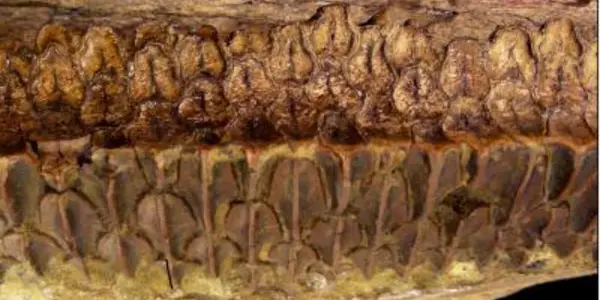
Duck-billed dinosaurs, also known as hadrosaurids, had an amazing capacity to chew tough and abrasive plants with grinding teeth more complex than those of cows, horses, and other modern grazers.
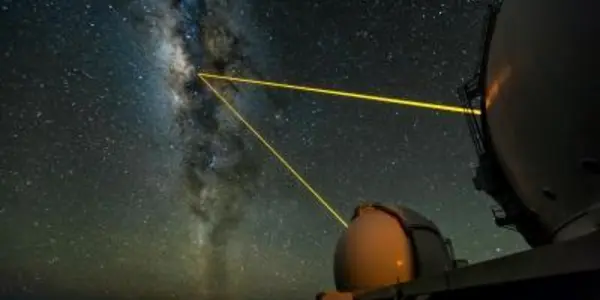
Black holes may not be so dangerous to stars after all. The discovery of a star named S0-102 may help reveal whether Albert Einstein was right in his fundamental prediction of how black holes warp space and time - it orbits the enormous black hole at the center of our Milky Way galaxy in a blazing 11.5 years. Black holes, which form out of the collapse of matter, have such high density that nothing can escape their gravitational pull, not even light. They cannot be seen directly, but their influence on nearby stars is visible and provides a signature. Einstein's theory of general relativity predicts that mass distorts space and time and therefore not only slows down the flow of time but also stretches or shrinks distances.
Serial killers and recidivist criminals of all kinds lack empathy. So do some people with poor social skills. A compassion-based meditation program called Cognitively-Based Compassion Training (CBCT) was recently used to try and improve the ability to read the facial expressions of others.
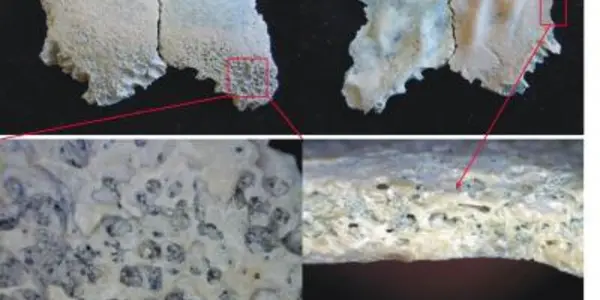
A skull fragment unearthed in Tanzania verifies that our ancient ancestors were eating meat at least 1,500,000 years ago and that can tell us something about the evolution of human physiology and brain development and why we wouldn't be where we are if there was a Prehistoric PETA.The two-inch skull fragment was found at the famed Olduvai Gorge in northern Tanzania, a site that for decades has yielded numerous clues into the evolution of modern humans and is sometimes called `the cradle of mankind.'
Leaves store carbon. In the spring, leaves soak up carbon dioxide from the atmosphere, converting the gas into organic carbon compounds, and then in the autumn, trees shed those leaves, which decompose in the soil as they are eaten by microbes. Over time, decaying leaves release carbon back into the atmosphere as carbon dioxide.
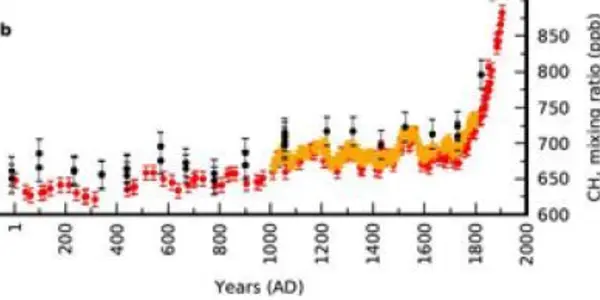
The Greenland ice sheet has a tale to tell about ancient greenhouse gas emissions too. Researchers have determined how much methane originates from natural sources and how much is due to human activity, from Roman times to the present.Methane is an underestimated greenhouse gas, 23X the impact of CO2 but not as long-lived, and like CO2 it has natural sources and also originates from human activities. The emissions from natural sources varies due to \climate variations; as an example, bacteria in wetlands release methane and less is emitted in dry cycles when wetlands shrink.
The Affordable Care Act controversy rages on. In this week's BMJ, journalist Jeanne Lenzer says the basic assumption that US people don't have enough health care is misleading and in reality, Americans have too much - and that unnecessary care costs an estimated $800 billion per year. The article arrives as an international conference named 'Preventing Overdiagnosis' was announced for September, 2013 in the United States, hosted by The Dartmouth Institute for Health Policy and Clinical Practice, in partnership with the BMJ, Consumer Reports and Bond University of Australia.
Researchers have found a way to 'toggle' the intestinal enzymes responsible for processing starchy foods on and off, which could lead to better control of those processes in people with Type 2 diabetes.This "toggling" was discovered in the lab of Simon Fraser University chemist Mario Pinto, who has designed inhibitors capable of regulating each of the four starch-digesting enzymes known as alpha-glucosidases. Three of those enzymes are responsible for generating glucose from starch, each in different ways. A fourth enzyme breaks down sucrose, also giving glucose. Occasionally one or more of the enzymes is missing, which also affects how glucose is created, Pinto explains.