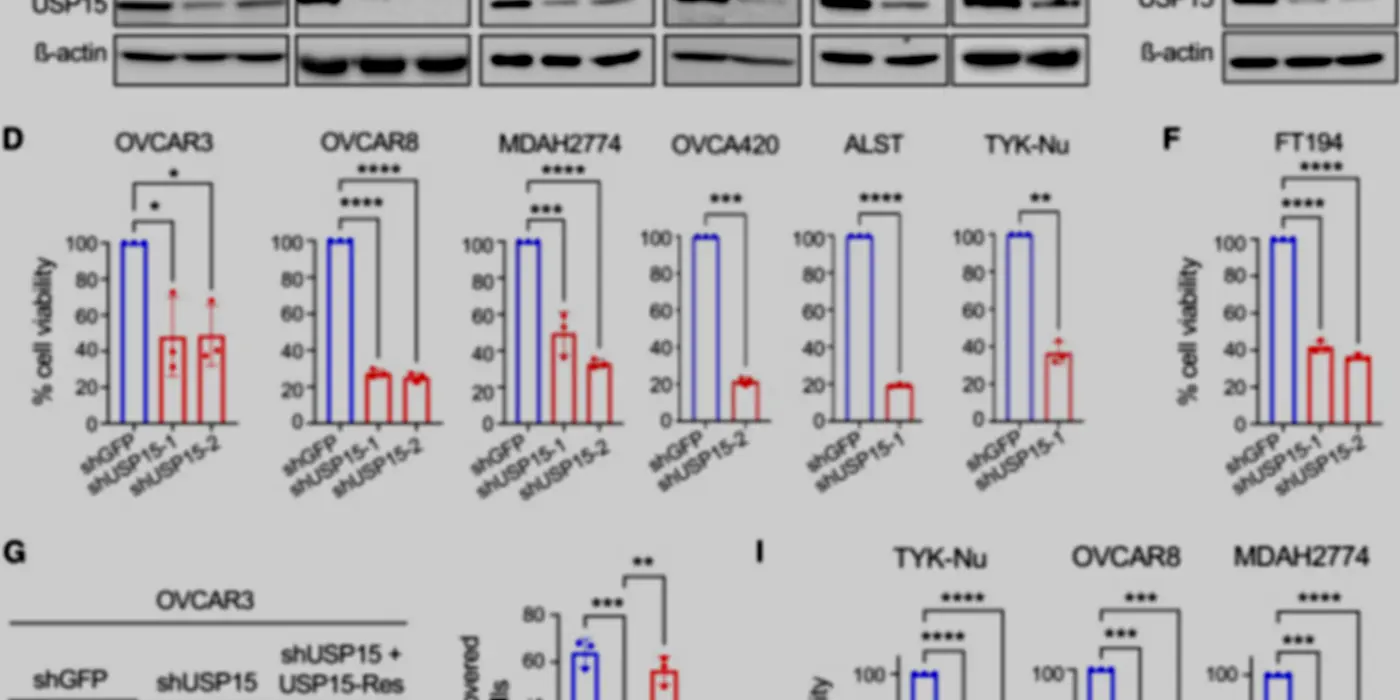
Enzyme USP15 Limits Ovarian Cancer Cells And Boosts Chemotherapy
Ovarian cancer is devastating, five-year survival rate under 30%, when detected after it has spread. New basic research may improve that.
Ovarian cancer is devastating, five-year survival rate under 30%, when detected after it has spread. New basic research may improve that.


Social isolation and stress are two environmental mechanisms likely to contribute to breast cancer susceptibility, researchers from the University of Chicago said this week.Their study, published in PNAS, found that isolation led to higher production of a stress hormone, corticosterone, among rats that were kept alone and subjected to the disturbances of colony life as well as stressful situations, such as the smell of a predator or being briefly constrained. Additionally, the isolated rats took longer to recover from a stressful situation than rats that lived together in small groups.
A study appearing in Nature Geoscience this week claims that Earth's temperature may be 30-50% more sensitive to atmospheric carbon dioxide than previous estimates suggest, and the effects of this increased sensitivity could make climate change an even bigger threat than it already is.The results of the study show that the models currently used to forecast climate change often neglect components of the Earth's climate system that vary over long timescales and have an important effect on temperature sensitivity--such as land-ice and vegetation.
The next time you have a little too much to drink and need to sober up, researchers say you should avoid caffeine because it doesn't counter the effects of alcohol intoxication and may lead to some less than brilliant choices, like driving. The reason? People who consume caffeine and alcohol are likely to feel awake and competent and may have a harder time recognizing that they're drunk as a result.

Our ability to learn new information and retain lifelong memories appears to lie in the minute junctions where nerve cells communicate, according to a new study conducted by NYU Langone Medicine Center researchers and published online this week in the journal Nature. The scientists, led by Wen-Biao Gan, PhD, associate professor of physiology and neuroscience at NYU School of Medicine, discovered that a delicate balancing act occurs in the brain where neuronal connections are continually being formed, eliminated, and maintained. This feat allows the brain to integrate new information without jeopardizing already established memories.
An international team of scientists has developed a new method of measuring CO2 absorption by the oceans and mapped CO2 uptake for the entire North Atlantic for the first time.Appearing tomorrow in the journal Science, the study could greatly improve our understanding of the natural ocean 'sinks' and enable more accurate predictions about how the global climate is changing.The new technique could also lead to the development of an 'early-warning system' to detect any weakening of the ocean sinks – seen by some scientists as the first sign of more pronounced climate change.
Thanks to compliance with the Montreal Protocol, the ozone layer is beginning to recover and that means Antarctica is about to experience more warming and an increase in snowmelt, a new study in Geophysical Research Letters predicts. Based on space-borne microwave observations between 1979 and 2009, the study suggests that Antarctic snowmelt levels should revert to higher norms as one of the climate drivers, the SAM (Southern Hemisphere Annular Mode), subsides as the damage to the ozone layer is repaired.
Scientists from MIT say they are developing a new kind of power plant that can generate electricity without emitting any carbon dioxide into the atmosphere and can be built at prices comparable to conventional natural-gas plants, and even to coal-burning plants. The catch, unfortunately, is that they need the government to inflate the price of coal through a cap and trade scheme or some other carbon tax to make the new power plant a viable alternative.
Researchers from the Johns Hopkins Bloomberg School of Public Health say it's time to ban smoking in private residences. Never mind those archaic ideas like choice and private property, this must be done, they argue, to protect the children. And if you don't want to protect children, well, what's wrong with you?Their push for tighter restrictions on smoking is based on a new paper published in Cancer Epidemiology, Biomarkers&Prevention, which suggests that hair nicotine concentrations are higher in children exposed to secondhand smoke at home, and the younger the children, the higher the concentration under the same level of secondhand smoke exposure at home.
While feeding birds may seem like an ordinary and innocuous activity, scientists are reporting this week that it can have a profound effect on the evolutionary future of a certain species of bird, and those changes can be seen in the very near term. A report published online in the December 3rd issue of Current Biology shows that what was once a single population of birds known as blackcaps has been split into two reproductively isolated groups in fewer than 30 generations, despite the fact that they continue to breed side by side in the very same forests.
Although the H1N1 vaccine is generally believed to be safe and effective, researchers from the University of Missouri have uncovered evidence that taking over-the-counter pain relievers, like aspirin and Tylenol, can reduce the effectiveness of the vaccine because they inhibit the normal function of enzymes that help regulate the immune system. The role of these enzymes, called COX enzymes, is not yet understood completely, andmedications that inhibit them may have adverse side effects. Recent research has discovered that drugs that inhibit COX enzymes, such as COX-2, have an impact on the effectiveness of vaccines. This new research indicates that inhibiting COX-1, which is present in tissues
Cancer researchers at the University of Oklahoma have found a way to turn ineffective new cancer drugs into deceptive cancer-killers. By using a patented chemical compound called SHetA2, the researchers tricked cancer cells into responding to new treatments and committing suicide. Their new study appears in the journal Gynecologic Oncology."This discovery means that we can use our non-toxic cancer prevention pill to improve treatment for people who already have cancer," said Doris Mangiaracina Benbrook, Ph.D., principal investigator on the project. "All studies to date have not found any side effects of taking our drug, giving hope that we can prevent cancer in healthy people, and improve treatment for cancer patients, without increasing toxicity."
Political scientists from the University of Missouri say that the general public knows very little about foreign policy, and what they do know is based primarily on "rhetoric" from whatever president occupies the White House. They also suggest that plainly stated, easy-to-understand foreign policy explanations from presidential administrations are likely to receive public support, while complicated, convoluted policy explanations are likely to face greater public skepticism. The findings are published in Political Research Quarterly.