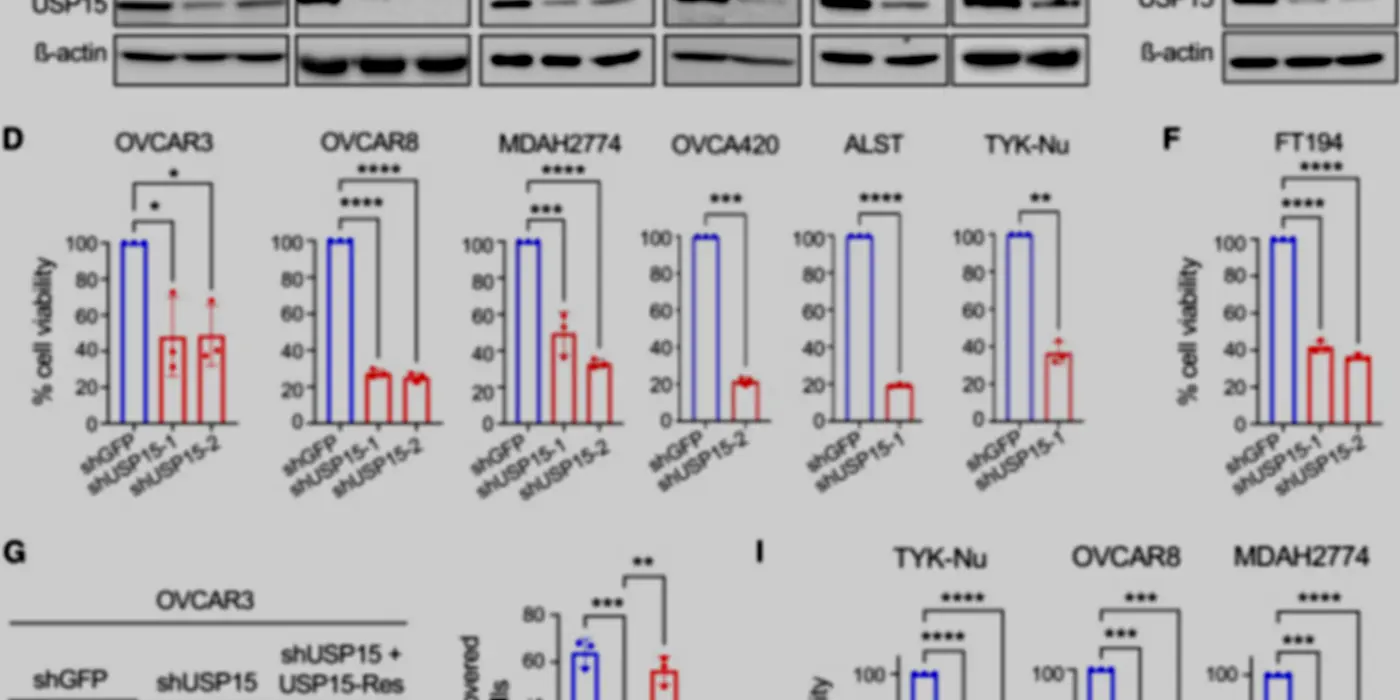
Enzyme USP15 Limits Ovarian Cancer Cells And Boosts Chemotherapy
Ovarian cancer is devastating, five-year survival rate under 30%, when detected after it has spread. New basic research may improve that.
Ovarian cancer is devastating, five-year survival rate under 30%, when detected after it has spread. New basic research may improve that.


According to one historian, the anti-government rallies that made their way across the country last summer, known as tea parties, may explain more about Americans than their views on high taxes and gun control. Ohio State University historian Randolph Roth claims that the distrust of government on display at the tea parties earlier this year has appeared sporadically throughout America's history and may be linked to homicide rates. In short, when Americans begin routinely complaining about how they hate their government and don't trust their leaders, they commit more murders.
Contrary to the widely held assumption that people use facebook and other social networking sites to make idealized impressions of themselves, a new psychology study suggests that facebook and myspace profiles are actually utilized for genuine social interaction and portray accurate personality images as a result. To conduct the study, the researchers collected 236 profiles of college-aged people from the United States (facebook) and Germany (StudiVZ, SchuelerVZ). The researchers used questionnaires to assess the profile owners' actual personality characteristics as well as theirideal-personality traits (how they wished to be). The personality traits included: extraversion, agreeableness, conscientiousness, neuroticism and openness.
The right kind of stress response in the operating room could lead to quicker recovery for patients after knee surgery, according to a new study published in the Journal of Bone and Joint Surgery. The results could be used to develop methods for predicting how well patients will fare after they leave the hospital.
Religious people say their belief in a personal god functions as a moral compass, helping them form opinions about controversial issues and distinguish right from wrong. A new study published in the Proceedings of the National Academy of Sciences, however, suggests that it's just the opposite; people attribute whatever they happen to believe to god.
According to a new study soon to appear in NeuroImage, active cocaine abusers were, on average, able to suppress activity in brain regions linked to drug cravings when asked to inhibit their response to a "cocaine-cues" video. The findings suggest that clinical interventions designed to strengthen these inhibitory responses could help cocaine abusers stop using drugs and avoid relapse.Scientists used a brain-scanning technique called positron emission tomography (PET) and a radioactively "tagged" form of glucose — the brain's main fuel — to measure brain activity in 24 active cocaine abusers during three different conditions: 1) while subjects simply lay
Men could soon have the same control over their fertility that women have had since the 1960s, according to a new paper published in the December 2009 issue of The FASEB Journal. The authors of the paper say they have found how and where androgenic hormones work in the testis to control normal sperm production and male fertility.The discovery was the result of studies performed in two groups of mice. The first group of mice was normal, but the second was missing a gene from the peritubular myoid cells in the testis. This missing gene codes for the androgen hormone receptor, and when missing, sperm production was significantly decreased when compared to the normal group. The result was infertility.
If you think the stress you experience during the holidays is doing you harm, you're right. Scientists from the University of Connecticut and Yale University say that entertaining your in-laws or traveling long distances this time of year can make you sick, and they they know why. According to their study published in the Journal of Leukocyte Biology, the same part of our nervous system that is responsible for the fight-or-flight response (called the sympathetic nervous system) also controls regulatory T cells, which are used by the body to end an immune response once a foreign invader has been removed or destroyed.
Just because a vaccine is available doesn't mean people will choose to be inoculated, according to new research published amid widespread public confusion about the merit of H1N1 flu shots. The research, appearing in the December issue of Health Services Research, looked at acceptability of potential future HIV vaccinations among high-risk adults in Los Angeles and demonstrated that many factors come into play when a person decides whether or not to be vaccinated.
Before you eat that next slice of pecan pie or second serving of mashed potatoes at Christmas dinner this year, you may want to think twice; those extra helpings could be even worse for your waistline than previously thought. A new research report appearing online in The FASEB Journal suggests that a diet high in fat and sugar actually switches on genes that ultimately cause our bodies to store too much fat. This means these foods hit you with a double-whammy as the already difficult task of converting high-fat and high-sugar foods to energy is made even harder because these foods also turn our bodies into "supersized fat-storing" machines.
As the world's oceans warm, they are absorbing less carbon dioxide, a new study in the November 25 issue of Geophysical Research Letters has found. With the oceans currently absorbing over 40 percent of the CO2 emitted by human activity, this could quicken the pace of climate change.
University of Minnesota researchers have developed a new computer model called the Virtual StreamLab, designed to help restore real streams to a healthier state. The Virtual StreamLab demonstrates the physics of natural water flows at an unprecedented level of detail and realism and was unveiled for the first time this week at the 2009 American Physical Society Division of Fluid Dynamics meeting in Minneapolis.
An international team of researchers probing the nerve-insulating myelin sheath have uncovered how mutations affect the structure of myelin, a focal point of research in multiple sclerosis and other neurological disorders.The findings were central to the group's broader conclusion that a set of protein processes required in the early-stage conversion of glucose into fatty acids are critical to the proper formation and layering of myelin membrane. The researchers report their in the Proceedings of the National Academy of Sciences.